Sugar Creek Trading Company
Oregon Grape Root
Oregon Grape Root
Impossibile caricare la disponibilità di ritiro
Mahonia aquifolium
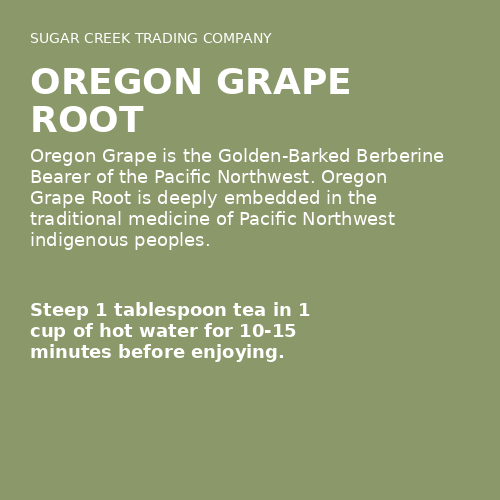
Oregon Grape Root — The Golden-Barked Berberine Bearer of the Pacific Northwest
Botanical Identification
Common Names: Oregon Grape Root, Oregon Grape, Holly-Leaved Barberry, Mountain Grape, Trailing Mahonia
Latin Name: Mahonia aquifolium (Pursh) Nutt. (syn. Berberis aquifolium)
Family: Berberidaceae (Barberry family)
Parts Used: Root and root bark (occasionally rhizome)
Origin: Native to western North America, from British Columbia south through Oregon, Washington, Idaho, and into northern California. Grows in coniferous forest understories, rocky slopes, and woodland edges from sea level to approximately 2,100 meters. The plant is an evergreen shrub reaching 1 to 3 meters, with holly-like compound leaves and clusters of bright yellow flowers followed by dusty blue-purple berries.
Appearance: The dried root and root bark display a vivid yellow interior — the unmistakable color of berberine alkaloids. The outer bark is rough and grayish-brown. When cut fresh, the root stains hands and surfaces a deep golden-yellow. The taste is intensely bitter, characteristic of berberine-containing plants.
Cultural and Historical Use
Oregon Grape Root is deeply embedded in the traditional medicine of Pacific Northwest indigenous peoples. The Salish, Nlaka'pamux (Thompson), Okanagan, Kwakwaka'wakw, and Blackfoot nations used root decoctions as blood purifiers, digestive bitters, and treatments for skin conditions including boils, eczema, and infected wounds. The Nlaka'pamux specifically chewed the root bark for stomach complaints and prepared yellow root dye for basketry.
European settlers rapidly adopted the plant after observing indigenous use. By the late 1800s, Oregon Grape Root had become a staple of Eclectic medical practice in the United States, prescribed by physicians like John King and Harvey Wickes Felter for "torpid liver," chronic skin eruptions, syphilitic conditions, and general debility. The Eclectics recognized it as a gentler alternative to Goldenseal (Hydrastis canadensis) — another berberine-containing species that was already being overharvested by that era.
Oregon designated Mahonia aquifolium as its state flower in 1899, reflecting the plant's cultural prominence. Today it remains one of the most important berberine sources in Western herbal medicine, valued for its relative abundance compared to threatened Goldenseal populations.
Key Bioactive Compounds
| Compound | Class | Primary Action |
|---|---|---|
| Berberine | Isoquinoline alkaloid | Antimicrobial, blood sugar regulation, lipid metabolism, bile stimulation |
| Berbamine | Bisbenzylisoquinoline alkaloid | Anti-inflammatory; modulates immune cell activity |
| Oxyacanthine | Bisbenzylisoquinoline alkaloid | Smooth muscle relaxant; mild hypotensive effect |
| Jatrorrhizine | Protoberberine alkaloid | Antimicrobial; synergistic with berberine against resistant organisms |
| Columbamine | Protoberberine alkaloid | Cholagogue (promotes bile flow); digestive bitter |
How It Works in the Body
Berberine and Metabolic Health: Berberine activates AMP-activated protein kinase (AMPK), a master cellular energy sensor. AMPK activation increases glucose uptake in muscle cells, improves insulin sensitivity, and shifts lipid metabolism toward oxidation rather than storage. Multiple clinical trials have demonstrated that berberine lowers fasting blood glucose, HbA1c, and LDL cholesterol at levels comparable to metformin. Oregon Grape Root delivers berberine in a whole-plant matrix alongside synergistic alkaloids.
Antimicrobial Activity: Berberine intercalates into bacterial DNA and inhibits the enzyme FtsZ, which is essential for bacterial cell division. It shows broad-spectrum activity against Staphylococcus aureus, Streptococcus species, Escherichia coli, Candida albicans, and Giardia lamblia. Importantly, berberine also inhibits bacterial efflux pumps — the mechanisms bacteria use to expel antibiotics — potentially restoring sensitivity to conventional drugs.
Liver and Digestive Support: The intensely bitter alkaloid profile stimulates gustatory bitter receptors on the tongue and in the gut, triggering a cascade of digestive secretions including gastric acid, pancreatic enzymes, and bile. Berberine specifically increases bile secretion and promotes healthy bile composition, supporting fat digestion and the elimination of metabolic waste products through the liver.
Skin Health: Oregon Grape Root's historical reputation as a skin herb has been validated by modern research on psoriasis. Berberine inhibits keratinocyte hyperproliferation — the excessive skin cell growth characteristic of psoriasis — and reduces inflammatory cytokines (IL-17, TNF-alpha) in skin tissue. A standardized Mahonia aquifolium extract (Relieva) was approved in Germany as a topical treatment for mild to moderate psoriasis.
Dose Guidelines
| Form | Suggested Dose | Notes |
|---|---|---|
| Dried root decoction | 1–2 teaspoons simmered in 8 oz water for 15–20 minutes, 2–3 times daily | Strong bitter flavor. Can combine with licorice or ginger to improve palatability. |
| Tincture (1:5, 45% ethanol) | 2–4 mL (40–80 drops), 3 times daily | Standard Western herbal dosing. Take before meals for digestive benefit. |
| Powdered root (capsules) | 500–1,000 mg, 2–3 times daily | Encapsulated to avoid the intense bitterness if preferred. |
| Topical (poultice or wash) | Strong decoction applied to affected skin areas | Traditional for eczema, psoriasis patches, and minor skin infections. |
Preparation and Uses
- Root Decoction: Because the root is dense and woody, it requires simmering (decoction) rather than steeping. Add 1 to 2 teaspoons of chopped or powdered root to cold water, bring to a low boil, and simmer covered for 15 to 20 minutes. Strain and drink warm. The resulting tea is deeply golden-yellow and profoundly bitter.
- Digestive Bitter Formula: Combine Oregon Grape Root with Dandelion root, Gentian, and a small amount of Orange peel for a classic Western digestive bitter tincture. Take 15 to 30 minutes before meals.
- Skin Wash: Prepare a concentrated decoction (double the root, half the water), let cool, and apply with a clean cloth to affected areas. Can be used as a compress held against psoriasis plaques or eczematous patches.
- Antimicrobial Synergy: Herbalists frequently combine Oregon Grape Root with herbs that complement berberine's antimicrobial action — Uva Ursi for urinary tract infections, Goldenseal for upper respiratory infections, or Echinacea for immune activation.
Optimal Context for Use
- Chronic skin conditions including psoriasis, eczema, and acne — both internal and topical
- Digestive sluggishness, poor appetite, and insufficient bile production
- Blood sugar and metabolic support as part of a comprehensive health regimen
- Mild to moderate bacterial or fungal infections — gut, urinary, or topical
- Liver support and gentle detoxification protocols
- As a sustainable alternative to overharvested Goldenseal in formulas calling for berberine
Sustainability and Ethical Harvesting
Mahonia aquifolium is far more abundant and ecologically resilient than its berberine-containing cousin Goldenseal (Hydrastis canadensis), which is listed as vulnerable by CITES. Oregon Grape readily regenerates from rhizome fragments and is not currently threatened. It is widely cultivated as an ornamental landscape plant throughout the Pacific Northwest and Europe.
Wild-harvesting should still follow ethical guidelines: take no more than 10 to 15 percent of a given stand, avoid harvesting in riparian buffers where the plant provides erosion control, and prioritize root harvest from areas where the plant is already being cleared for development or trail maintenance. Supporting cultivated sources or sustainably wild-crafted suppliers further reduces ecological pressure.
Safety and Cautions
- Pregnancy: Contraindicated during pregnancy. Berberine stimulates uterine contractions and has shown embryotoxic effects in animal studies. Avoid throughout all trimesters.
- Nursing: Not recommended while breastfeeding. Berberine can be transferred through breast milk and may cause jaundice in newborns.
- Drug Interactions: Berberine inhibits several cytochrome P450 enzymes (CYP3A4, CYP2D6) and may increase blood levels of drugs metabolized by these pathways, including cyclosporine, statins, and certain blood pressure medications. Consult a healthcare provider if taking prescription drugs.
- Blood Sugar Medications: Berberine can lower blood glucose. Combining with metformin, insulin, or sulfonylureas may cause hypoglycemia. Monitor blood sugar closely.
- GI Sensitivity: High doses may cause nausea, cramping, or diarrhea due to the potent bitter and cholagogue effects. Start with lower doses and increase gradually.
- Duration: Most herbalists recommend using berberine-rich herbs in cycles (2 to 4 weeks on, 1 to 2 weeks off) rather than continuously, to avoid disruption of beneficial gut flora.
This product has not been evaluated by the FDA. It is not intended to diagnose, treat, cure, or prevent any disease.
References
- Yin J, Xing H, Ye J. "Efficacy of berberine in patients with type 2 diabetes mellitus." Metabolism. 2008;57(5):712-717.
- Galle K, et al. "Mahonia aquifolium — a new type of topical treatment for psoriasis." Journal of Dermatological Treatment. 2003;14(suppl 2):21-23.
- Slobodnikova L, et al. "Antimicrobial activity of Mahonia aquifolium crude extract and its major isolated alkaloids." Phytotherapy Research. 2004;18(8):674-676.
- Turner NJ. "Food Plants of Interior First Peoples." Royal British Columbia Museum Handbook. 1997.
- Felter HW, Lloyd JU. King's American Dispensatory. 18th ed. Ohio Valley Company; 1898.
- Kong WJ, et al. "Berberine reduces insulin resistance through protein kinase C-dependent up-regulation of insulin receptor expression." Metabolism. 2009;58(1):109-119.
Final Note
Oregon Grape Root is the Pacific Northwest's own golden medicine — a berberine-rich botanical that stands as one of the most versatile and ecologically responsible herbs in the Western materia medica. Where Goldenseal populations have been devastated by overharvesting, Oregon Grape thrives in forest understories from British Columbia to California, offering the same core alkaloid chemistry in a sustainable package. Whether you are reaching for it as a digestive bitter before meals, a skin support herb for stubborn psoriasis, or a broad-spectrum antimicrobial ally, this yellow-rooted shrub delivers with the quiet, persistent strength of the old-growth forests it calls home.
Condividere