Sugar Creek Trading Company
Papaya Leaf
Papaya Leaf
Impossibile caricare la disponibilità di ritiro
CARICA PAPAYA
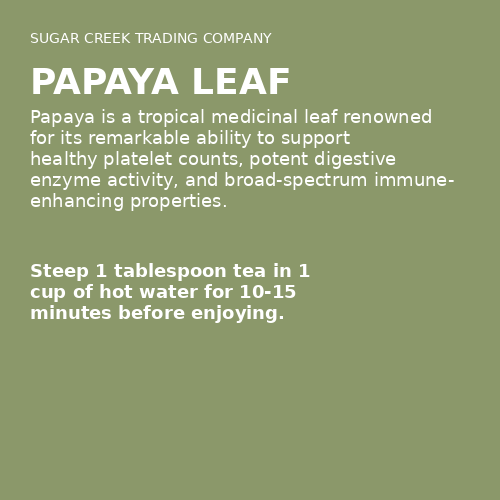
Tropical medicinal leaf renowned for its remarkable ability to support healthy platelet counts, potent digestive enzyme activity, and broad-spectrum immune-enhancing properties.
BOTANICAL IDENTIFICATION
Scientific Name: Carica papaya L.
Common Names: Papaya leaf, pawpaw leaf, melon tree leaf, papaw
Family: Caricaceae (Papaya family)
Carica papaya is a fast-growing, semi-woody, single-stemmed tropical tree reaching 5 to 10 meters in height. The trunk is hollow, unbranched, and marked with prominent leaf scars. The large, deeply palmately lobed leaves can span 50 to 70 centimeters in diameter, borne on long, hollow petioles clustered at the crown of the trunk. The tree is dioecious or polygamous, producing male, female, or hermaphrodite flowers depending on the variety. The well-known fleshy fruit develops from the female or hermaphrodite flowers, but it is the leaves that hold the greatest concentration of the plant's medicinal compounds.
Native to the lowland tropics of Central America and southern Mexico, Carica papaya has been distributed by human cultivation throughout the tropics and subtropics worldwide, thriving in frost-free regions with well-drained soils and abundant sunlight. It is now naturalized and cultivated across Southeast Asia, India, Africa, Australia, and the Pacific Islands, where both fruit and leaf preparations are integral to local healing traditions.
CULTURAL AND HISTORICAL USE
Papaya leaf has been used medicinally by indigenous peoples of the Americas for centuries before European contact. The Maya and other Mesoamerican cultures used leaf preparations for digestive complaints, intestinal parasites, and as a meat tenderizer, taking advantage of the same proteolytic enzymes that modern science has characterized. Spanish colonial accounts from the sixteenth century document indigenous use of papaya leaves wrapped around tough meats to soften them, a practice that simultaneously demonstrated the enzymatic power of the leaf.
In Southeast Asian traditional medicine, papaya leaf tea and juice have long been used as a treatment for dengue fever, particularly in Malaysia, the Philippines, and Indonesia. Mothers and village healers have passed down preparations of papaya leaf juice as a critical intervention when dengue patients' platelet counts drop dangerously low. This traditional use has been remarkably validated by modern clinical research, which has confirmed papaya leaf extract's ability to significantly accelerate platelet recovery in dengue patients.
In Ayurvedic medicine, papaya leaf is classified as bitter, pungent, and heating, used for liver support, digestive weakness, and as an antimalarial. In West African herbalism, the leaves are prepared as decoctions for malaria, jaundice, and intestinal worms. Australian Aboriginal communities in northern Queensland adopted papaya leaf tea after the plant's introduction, using it for general health tonic purposes. Across all these traditions, the common thread is the leaf's reputation as a powerful purifier and strengthener of the blood and digestive system.
KEY BIOACTIVE COMPOUNDS & BENEFITS
| Compound/Class | Location in Plant | Human Benefit | Role in Plant |
|---|---|---|---|
| Papain and chymopapain (cysteine proteases) | Leaf tissue and latex | Powerful protein digestion; anti-inflammatory; wound healing support | Defense against herbivorous insects |
| Acetogenins (including carpaine) | Leaf tissue | Platelet-boosting activity; potential antitumor effects under research | Potent insecticidal and antimicrobial defense |
| Carpaine (pseudoalkaloid) | Leaves, particularly young leaves | Supports cardiovascular function; mild antiarrhythmic properties; antimalarial | Chemical defense against herbivory |
| Flavonoids (quercetin, kaempferol, myricetin) | Leaf tissue | Antioxidant protection; immune modulation; anti-inflammatory synergy | UV protection and pollinator attraction |
| Phenolic acids (caffeic acid, chlorogenic acid) | Leaf tissue | Antioxidant; hepatoprotective; supports healthy blood sugar metabolism | Antimicrobial defense and structural support |
The platelet-boosting activity of papaya leaf is its most clinically significant and well-documented property. The mechanism appears to involve upregulation of genes responsible for platelet production (thrombopoiesis), specifically the ALOX-12 gene (arachidonate 12-lipoxygenase), which increases megakaryocyte production in the bone marrow. This effect is attributed to the synergistic action of the leaf's unique alkaloid and acetogenin profile rather than any single isolated compound.
HOW IT WORKS IN THE BODY
Papaya leaf exerts its therapeutic effects through several distinct and well-characterized physiological pathways.
Thrombopoietic Activity (Platelet Production):
The most intensively studied property of papaya leaf is its ability to increase circulating platelet counts. Clinical trials conducted on dengue fever patients in Malaysia, Pakistan, and India have demonstrated that papaya leaf extract can raise platelet counts significantly faster than standard supportive care alone. The mechanism involves stimulation of megakaryocyte maturation in bone marrow through upregulation of ALOX-12 and related thrombopoietic gene pathways. This makes papaya leaf a critical botanical for conditions involving thrombocytopenia (low platelet count).
Proteolytic Enzyme Activity:
The papain and chymopapain present in the leaves are powerful cysteine proteases that break down proteins into absorbable peptides and amino acids. When consumed with food, these enzymes significantly enhance protein digestion. They also exert systemic anti-inflammatory effects when absorbed, breaking down inflammatory protein complexes, fibrin deposits, and immune complexes that contribute to chronic inflammation and tissue damage.
Immune System Modulation:
Papaya leaf extract has been shown to increase the production of Th1-type cytokines (IL-2 and IFN-gamma) and enhance natural killer cell activity. This immune-stimulating profile helps explain its traditional efficacy against viral infections like dengue and its use as an antimalarial. The flavonoid content provides additional immune support through antioxidant protection of immune cells.
Hepatoprotective Effects:
Animal and in vitro studies have demonstrated that papaya leaf extract protects liver cells against oxidative damage from toxins including carbon tetrachloride and acetaminophen. This hepatoprotective action is attributed to the combined antioxidant effects of flavonoids, phenolic acids, and the alkaloid carpaine. Traditional use of papaya leaf for jaundice and liver complaints is supported by this research.
DOSE GUIDELINES
| Preparation Type | Typical Dose | Purpose |
|---|---|---|
| Dried leaf tea (infusion) | 1 to 2 teaspoons of dried leaf per cup, steeped 10 to 15 minutes | General digestive support, daily tonic, immune maintenance |
| Fresh leaf juice | 25 to 30 mL of fresh juice, twice daily | Acute platelet support (dengue and related conditions) |
| Dried leaf capsules or powder | 1,100 to 2,200 mg daily in divided doses | Standardized supplementation for platelet and immune support |
| Concentrated extract | Per manufacturer's directions, typically 500 to 1,000 mg daily | Concentrated therapeutic applications |
For platelet support, clinical trials have used doses equivalent to the juice of approximately 50 grams of fresh leaves administered twice daily. The dried leaf tea is appropriate for daily wellness use and gentle digestive support. Papaya leaf tea has a distinctly bitter flavor that many find challenging. Mixing with honey, lemon, or blending into a stronger-flavored herbal tea can improve palatability. Consistent daily use over days to weeks produces the most reliable results for chronic conditions.
PREPARATION AND USES
To prepare a standard infusion, steep one to two teaspoons of dried papaya leaf in a cup of freshly boiled water for 10 to 15 minutes, covered. Strain and drink warm or at room temperature. The tea is intensely bitter, which is actually an indicator of its active compound concentration. Honey or stevia can offset the bitterness without diminishing efficacy. For those who find the tea too challenging to drink, the dried leaf can be encapsulated using empty gelatin or vegetable capsules.
For the traditional dengue protocol, fresh papaya leaves are washed thoroughly, the tough central rib is removed, and the leaf tissue is pounded or blended with a small amount of water and strained through cloth to produce a dark green, extremely bitter juice. This fresh juice preparation delivers the highest concentration of active compounds and is the form used in the majority of clinical trials demonstrating platelet-boosting efficacy.
Papaya leaf can also be prepared as a digestive bitter by steeping it in combination with gentian root, chamomile, and peppermint to create a pre-meal digestive tonic that stimulates bile flow and enzyme production. For topical use, a poultice of crushed fresh leaves or a strong decoction applied as a compress has been traditionally used for wound cleaning, insect bites, and skin infections, leveraging the antimicrobial and proteolytic properties of the leaf.
OPTIMAL CONTEXT FOR USE
This herb is especially well-suited for individuals experiencing:
Low platelet counts (thrombocytopenia) from dengue fever, chemotherapy, or other causes, where supporting natural platelet production is critical
Digestive insufficiency including poor protein digestion, bloating after meals, and general enzyme deficiency
Weakened immune function or frequent infections where enhanced natural killer cell activity and Th1 immune response may be beneficial
Liver stress from environmental toxin exposure, medication use, or dietary imbalances
Chronic inflammatory conditions where systemic proteolytic enzyme therapy may reduce inflammatory protein accumulation
Papaya leaf pairs well with andrographis for acute immune challenges, with milk thistle for liver support protocols, and with bromelain-rich pineapple for enhanced anti-inflammatory enzyme therapy.
SUSTAINABILITY AND ETHICAL HARVESTING
Carica papaya is one of the most abundantly cultivated tropical fruit trees in the world, grown commercially across Central and South America, Southeast Asia, India, and Africa. The leaves are a byproduct of fruit production, making papaya leaf one of the most inherently sustainable medicinal botanicals available. Trees continuously produce new leaves throughout their productive lifespan, and harvesting lower leaves does not significantly impact fruit yield.
The primary sustainability consideration is ensuring that papaya leaf products are free from pesticide contamination, as conventional papaya farming can involve significant agrochemical use. Sourcing from organic or low-spray growers, or from regions where papaya grows semi-wild with minimal chemical inputs, provides the cleanest product. Supporting smallholder tropical farmers through fair trade purchasing practices helps ensure equitable economic benefit from the global demand for papaya leaf products.
SAFETY AND CAUTIONS
Papaya leaf is generally well tolerated at recommended doses, but several important precautions apply.
Pregnancy: Papaya leaf is strictly contraindicated during pregnancy. The papain enzyme and carpaine alkaloid may stimulate uterine contractions and have been associated with increased risk of miscarriage. This is one of the most important safety restrictions for this herb.
Latex allergy: Individuals with known latex allergy may cross-react with papaya leaf due to shared proteins between natural rubber latex and papaya plant tissue. Exercise caution and discontinue immediately if allergic symptoms develop.
Blood sugar effects: Papaya leaf may lower blood sugar levels. Individuals taking diabetes medications should monitor blood glucose carefully and consult their healthcare provider before use.
Anticoagulant interaction: Because papaya leaf can increase platelet counts, it may theoretically interfere with anticoagulant or antiplatelet medications. Discuss with a healthcare provider if taking warfarin, heparin, or similar drugs.
Surgical precaution: Discontinue papaya leaf at least two weeks before scheduled surgery due to potential effects on platelet function and blood clotting.
REFERENCES
Subenthiran, S., et al. "Carica papaya leaves juice significantly accelerates the rate of increase in platelet count among patients with dengue fever and dengue haemorrhagic fever." Evidence-Based Complementary and Alternative Medicine, 2013, Article ID 616737.
Gadhwal, A. K., et al. "Effect of Carica papaya leaf extract capsule on platelet count in patients of dengue fever with thrombocytopenia." Journal of the Association of Physicians of India, 64(6), 2016, pp. 22-26.
Otsuki, N., et al. "Aqueous extract of Carica papaya leaves exhibits anti-tumor activity and immunomodulatory effects." Journal of Ethnopharmacology, 127(3), 2010, pp. 760-767.
Seigler, D. S., et al. "Cyanide and cyanogenic glycosides in papaya." Phytochemistry, 61(3), 2002, pp. 245-250.
FINAL NOTE
Papaya leaf stands as one of the most compelling examples of traditional herbal knowledge being confirmed and expanded by modern clinical research. The ability of this humble tropical leaf to significantly boost platelet production has moved it from folk remedy status to the subject of peer-reviewed clinical trials and official health ministry recommendations in dengue-endemic countries. Beyond its headline platelet-supporting role, papaya leaf offers a rich array of digestive enzymes, immune-modulating compounds, and liver-protective agents that make it a versatile and powerful addition to any herbal practice. Its intense bitterness is a small price to pay for such profound therapeutic potential.
Condividere