Sugar Creek Trading Company
Pennyroyal
Pennyroyal
Impossibile caricare la disponibilità di ritiro
MENTHA PULEGIUM
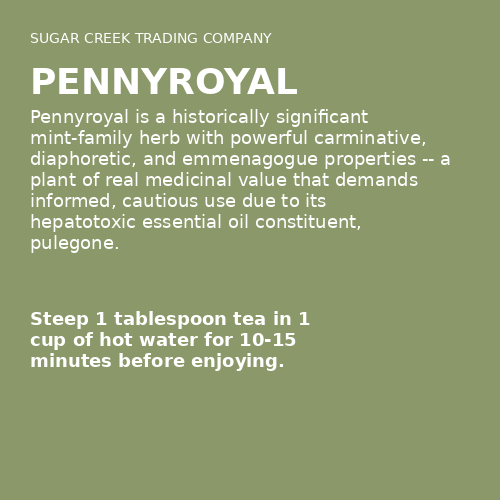
A historically significant mint-family herb with powerful carminative, diaphoretic, and emmenagogue properties -- a plant of real medicinal value that demands informed, cautious use due to its hepatotoxic essential oil constituent, pulegone.
BOTANICAL IDENTIFICATION
Scientific Name: Mentha pulegium L.
Common Names: Pennyroyal, European Pennyroyal, Pudding Grass, Squaw Mint, Mosquito Plant, Lurk-in-the-Ditch, Run-by-the-Ground, Piliolerian
Family: Lamiaceae (Mint family)
Mentha pulegium is a low-growing, creeping perennial herb reaching 15 to 40 centimeters tall, with square stems characteristic of the mint family and small, oval, opposite leaves that are gray-green and finely downy. The tiny lilac to pink flowers appear in dense whorls at the leaf axils during mid to late summer. The entire plant emits a strong, pungent, distinctly minty aroma when crushed -- sharper and more camphorous than peppermint or spearmint, reflecting its high essential oil content. Pennyroyal is notably smaller and more prostrate than its better-known mint relatives, often forming low mats along damp ground.
Native to Europe, western Asia, and North Africa, pennyroyal naturalized widely across temperate regions worldwide following European colonization. It thrives in damp meadows, stream banks, pond margins, and seasonally wet pastures. The American species, Hedeoma pulegioides, shares the common name "pennyroyal" and similar chemistry but is a different genus; this listing specifically provides European pennyroyal, Mentha pulegium.
CULTURAL AND HISTORICAL USE
Pennyroyal is one of the oldest documented medicinal herbs in European history, appearing in the writings of Pliny the Elder, Dioscorides, and virtually every major herbal text from antiquity through the Renaissance. The Greeks and Romans used it extensively as a digestive aid, flea repellent (the Latin name "pulegium" derives from "pulex," meaning flea), and flavoring for foods and wines. Pliny recommended pennyroyal tea for nausea, flatulence, and respiratory congestion, and it was a common ingredient in the spiced wine posca consumed by Roman soldiers.
In medieval Europe, pennyroyal was a kitchen and stillroom staple, used to flavor puddings (hence "pudding grass"), added to stuffings, and brewed as a tea for colds, fevers, and menstrual irregularities. The herb's strong emmenagogue properties -- its ability to promote menstrual flow -- made it one of the most widely known women's herbs throughout the Middle Ages and into the modern era. This same property is the source of its most dangerous historical use: pennyroyal essential oil was consumed as an abortifacient, a practice that has caused numerous documented fatalities due to pulegone-induced liver failure.
Eclectic physicians in 19th-century America valued pennyroyal tea (not the essential oil) as a diaphoretic for breaking fevers, a carminative for digestive gas, and a mild emmenagogue for delayed menses. They were careful to distinguish between the relatively safe herbal tea and the extremely dangerous essential oil, a distinction that remains critically important today. The herb fell out of mainstream use during the 20th century primarily due to safety concerns surrounding the oil, but the dried herb continues to hold a legitimate place in traditional Western herbalism when used knowledgeably.
KEY BIOACTIVE COMPOUNDS & BENEFITS
| Compound/Class | Location in Plant | Human Benefit | Role in Plant |
|---|---|---|---|
| Pulegone (monoterpene ketone) -- 60-90% of essential oil | Leaves and flowering tops (in essential oil glands) | Carminative, diaphoretic, insect repellent; TOXIC to liver in concentrated/essential oil form | Primary chemical defense against herbivorous insects |
| Menthone and isomenthone | Leaves | Digestive stimulant, mild antispasmodic | Aromatic insect deterrent |
| Piperitenone and piperitone | Aerial parts | Antimicrobial and antifungal activity | Broad-spectrum pathogen defense |
| Rosmarinic acid and flavonoids (diosmin, hesperidin) | Leaves | Anti-inflammatory, antioxidant, and antiallergic properties | UV protection and oxidative stress response |
| Tannins | Leaves and stems | Astringent, antimicrobial; support tissue toning | Herbivore deterrent and wound protection |
Pulegone is both the primary active compound and the primary safety concern in pennyroyal. In the small amounts present in an herbal tea infusion, pulegone contributes carminative, diaphoretic, and mild emmenagogue effects. However, the concentrated essential oil contains pulegone at levels that overwhelm the liver's detoxification capacity, producing the toxic metabolite menthofuran, which causes centrilobular hepatic necrosis. This critical distinction between herb-tea concentrations and essential-oil concentrations is the single most important fact about pennyroyal pharmacology.
HOW IT WORKS IN THE BODY
When used as a mild herbal tea at appropriate doses, pennyroyal exerts its effects through several well-understood mechanisms.
Digestive Carminative Action:
The volatile oils in pennyroyal, including pulegone and menthone at tea-level concentrations, relax smooth muscle in the gastrointestinal tract, reduce spasm, and promote the expulsion of trapped gas. This is the same basic mechanism by which peppermint and other mints aid digestion, though pennyroyal's stronger aromatic profile means smaller quantities are needed. The herb stimulates bile flow and gastric secretions, making it a traditional after-meal tea in European folk practice.
Diaphoretic and Febrifuge Properties:
Pennyroyal tea, taken hot, promotes perspiration and peripheral vasodilation, helping the body mount an effective fever response during acute illness. This was its primary use among Eclectic physicians: a hot cup at the onset of a cold or flu to "break" the fever and support the body's natural defense mechanism. The diaphoretic effect is gentle when the herb is taken as a tea and works best at the very onset of illness.
Emmenagogue Activity:
Pulegone and related monoterpenes stimulate uterine smooth muscle contraction and increase pelvic blood flow, which can promote the onset of delayed menstruation. This mechanism is mild at tea concentrations but becomes dangerously powerful at essential-oil concentrations. Historically, this property made pennyroyal one of the most well-known menstrual regulators in European and American folk herbalism.
Insect Repellent Properties:
Pulegone is a highly effective insect repellent, particularly against fleas, mosquitoes, and ticks. The dried herb placed in sachets, or a dilute infusion sprayed on surfaces, provides measurable insect-deterrent activity. This non-internal use remains one of the safest and most practical applications of the plant.
DOSE GUIDELINES
| Preparation Type | Typical Dose | Purpose |
|---|---|---|
| Mild herbal infusion | 1/2 to 1 teaspoon dried herb per cup, steeped (not boiled) 5-10 minutes; limit to 1-2 cups daily | Digestive carminative, mild diaphoretic for onset of colds |
| Tincture (1:5, 45% ethanol) | 0.5-2 mL, once to twice daily, short-term use only | Concentrated but controlled herbal preparation |
| External sachet | Dried herb placed in cloth bags near bedding, pet areas, or stored clothing | Natural flea and insect repellent |
CRITICAL: The essential oil of pennyroyal must NEVER be ingested. Even small amounts of the concentrated essential oil (as little as 10 mL) have caused fatal liver failure in documented cases. The doses listed above refer strictly to the dried herb in tea or tincture form, where the pulegone concentration is a tiny fraction of what is present in the distilled essential oil. Use pennyroyal only as a short-term remedy (no more than 7 consecutive days) and at conservative doses. This is not an herb for daily, long-term consumption.
PREPARATION AND USES
The safest and most traditional way to use pennyroyal is as a mild herbal infusion. Place half a teaspoon to one teaspoon of the dried herb in a cup, pour freshly boiled water over it, cover, and steep for 5 to 10 minutes. Do not simmer or boil the herb, as this concentrates the volatile oils beyond the levels present in a standard infusion. Strain thoroughly and drink. The tea has a strong, pungent mint flavor -- much more intense than peppermint -- and is best blended with gentler herbs such as chamomile, lemon balm, or elderflower to soften the taste and dilute the pulegone content further.
For external use, pennyroyal is one of the most effective natural flea repellents available. Stuff dried pennyroyal herb into small cloth sachets and place them in pet bedding, closets, drawers, or near doorways where insects enter. A cooled infusion of the herb can be used as a final rinse for pets (dogs only, never cats) after bathing to deter fleas, though it should not be used on animals that will lick their fur extensively. Pennyroyal can also be added to potpourri and herbal sachets for aromatic pest control in stored linens and woolens.
OPTIMAL CONTEXT FOR USE
Pennyroyal dried herb, used with appropriate caution and knowledge, is suited for:
Short-term digestive relief from gas, bloating, or intestinal cramping, particularly when stronger mints like peppermint are not available or a different aromatic profile is desired
The very onset of colds and flu, when a hot diaphoretic tea can support the body's fever response and promote perspiration -- used for 1 to 3 days only at the beginning of illness
Natural insect repellent applications, including flea deterrence in the home, closet sachets for moth prevention, and external rinses for flea control (see safety notes)
Herbalists and formulation students who wish to understand this historically significant plant and its place in the Western materia medica, using it as a minor ingredient in carefully constructed blends
When used internally, pennyroyal should be part of a carefully considered short-term protocol, not a daily staple. It combines appropriately with elderflower and yarrow for the classic cold-onset diaphoretic blend, or with chamomile and fennel for a carminative formula where the pennyroyal constitutes no more than 20% of the blend.
SUSTAINABILITY AND ETHICAL HARVESTING
Mentha pulegium is an abundant, easily cultivated perennial that faces no conservation concerns. It grows vigorously in damp soils across Europe, Asia, and the Americas, reproducing readily by runners and self-seeding. In some regions, it is considered a mildly invasive weed in wet pastures and streamside habitats. Commercial cultivation is straightforward, requiring only moist soil and partial to full sun, and the plant can be harvested multiple times per growing season.
Ethical considerations with pennyroyal center not on environmental sustainability but on responsible commerce. Suppliers have a duty to clearly communicate the safety distinctions between the dried herb and the essential oil, and to ensure that product labeling includes appropriate warnings. The plant's long history of misuse as an abortifacient in essential oil form means that responsible sourcing and clear consumer education are ethical imperatives for anyone offering this herb for sale.
SAFETY AND CAUTIONS
IMPORTANT: Pennyroyal requires more safety awareness than most herbs. Read this section carefully before use.
NEVER ingest pennyroyal essential oil. The concentrated essential oil contains 60-90% pulegone, which the liver metabolizes into menthofuran, a potent hepatotoxin that causes irreversible centrilobular necrosis. Documented fatalities have occurred from ingestion of as little as 10 mL (two teaspoons) of the essential oil. There is no safe internal dose of the essential oil. This product is the dried herb, NOT the essential oil, but this warning must be clearly understood.
Absolutely contraindicated in pregnancy. Pennyroyal is a strong uterine stimulant and has been documented to cause miscarriage, hemorrhage, and maternal death when used in attempts to terminate pregnancy. Even the herbal tea must not be consumed during pregnancy at any dose.
Contraindicated in liver disease. Individuals with any existing liver condition, hepatitis, fatty liver, or history of liver damage should not use pennyroyal internally, as even the lower pulegone levels in tea preparations add metabolic burden to compromised hepatic function.
Contraindicated in kidney disease. Pulegone metabolites are renally excreted and may cause additional stress to impaired kidneys. Avoid use if kidney function is compromised.
Do not use for children. Children's lower body weight and immature hepatic enzyme systems make them significantly more vulnerable to pulegone toxicity. Pennyroyal should not be given to children in any form.
Short-term use only. Do not consume pennyroyal tea for more than 7 consecutive days. Chronic use allows cumulative pulegone metabolite buildup that may stress the liver even at tea-level doses.
Do not combine with alcohol or hepatotoxic medications. Concurrent use of alcohol, acetaminophen, or other hepatotoxic drugs increases the risk of liver injury from pulegone metabolites.
Toxic to cats. Cats lack the hepatic glucuronidation pathway needed to metabolize pulegone and are extremely sensitive to pennyroyal toxicity. Never use pennyroyal on, near, or around cats in any form.
REFERENCES
Anderson, I.B., Mullen, W.H., Meeker, J.E., et al. (1996). "Pennyroyal toxicity: measurement of toxic metabolite levels in two cases and review of the literature." Annals of Internal Medicine, 124(8), 726-734.
Gordon, W.P., Huitric, A.C., Seth, C.L., McClanahan, R.H., & Nelson, S.D. (1987). "The metabolism of the abortifacient terpene, (R)-(+)-pulegone, to a proximate toxin, menthofuran." Drug Metabolism and Disposition, 15(5), 589-594.
European Medicines Agency. (2016). "Public statement on the use of herbal medicinal products containing pulegone and menthofuran." EMA/HMPC/138386/2005 Rev 1.
Felter, H.W. & Lloyd, J.U. (1898). "Hedeoma -- Pennyroyal." King's American Dispensatory, 18th Edition. Cincinnati: Ohio Valley Co.
FINAL NOTE
Pennyroyal is a plant that commands respect. Its long history in European and American herbalism reflects genuine medicinal value as a carminative, diaphoretic, and aromatic insect repellent. But its equally long history of tragic misuse as a concentrated essential oil demands that every person who handles this herb understands the critical distinction between the dried herb at tea strength and the distilled oil. Used wisely, conservatively, and short-term, the dried herb has a legitimate place in the informed herbalist's repertoire. Used carelessly, it is genuinely dangerous. Knowledge is the difference, and that knowledge begins with reading and heeding the safety information above.
Condividere