Sugar Creek Trading Company
Prickly Ash Bark
Prickly Ash Bark
Impossibile caricare la disponibilità di ritiro
Zanthoxylum americanum — Prickly Ash Bark (Northern)
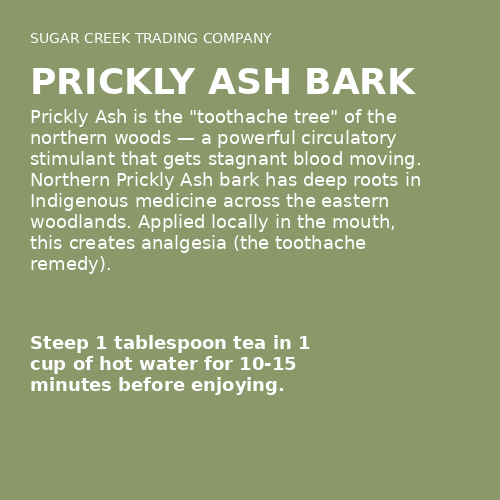
The "toothache tree" of the northern woods — a powerful circulatory stimulant that gets stagnant blood moving.
Botanical Identification
Species: Zanthoxylum americanum Mill.
Family: Rutaceae (Citrus family)
Common Names: Northern Prickly Ash, Toothache Tree, Yellow Wood, Suterberry, Angelica Tree (sometimes confused)
Parts Used: Dried bark (stem and branch bark)
Native Range: Eastern North America, from Quebec and Ontario south to Georgia and west to Oklahoma, predominantly in the northern half of this range
Botanical Description: A deciduous shrub or small tree reaching 10–25 feet in height with multiple stems. The bark is smooth to slightly furrowed, grayish-brown, and studded with distinctive paired thorns at each leaf node — the "prickly" of its common name. Leaves are alternate and pinnately compound with 5–11 ovate, finely toothed leaflets that are aromatic when crushed. Small yellowish-green flowers appear in axillary clusters before the leaves emerge in spring. Fruits are small, reddish-brown, two-valved follicles containing shiny black seeds. The bark has a characteristic warm, tingling, numbing sensation when chewed — a hallmark of the genus.
Species Note: This is the Northern species, Z. americanum, which should be distinguished from its southern relative, Zanthoxylum clava-herculis (Southern Prickly Ash or Hercules' Club). While both share similar therapeutic profiles, the Northern species is generally considered milder in its stimulant action and is the species most often referenced in Eclectic and traditional Appalachian herbal literature.
Cultural and Historical Use
Northern Prickly Ash bark has deep roots in Indigenous medicine across the eastern woodlands. The Ojibwe, Meskwaki (Fox), Menominee, and other Great Lakes nations used the bark and berries for toothache — chewing pieces of bark to numb oral pain, which gave rise to the enduring common name "toothache tree." The numbing, tingling quality of the bark made its analgesic use immediately self-evident to anyone who tasted it.
Beyond dental pain, Indigenous practitioners used prickly ash bark preparations for rheumatic complaints, sluggish digestion, and conditions associated with poor circulation. The Meskwaki used it as a blood purifier and for cramping pains. The Cherokee employed it for various pain conditions and as a remedy for lethargy and debility.
The Eclectic physicians embraced Northern Prickly Ash as one of their premier circulatory stimulants. John King, in the American Dispensatory, praised it for chronic rheumatism, paralytic conditions, and torpid states of the body where circulation was impaired. Finley Ellingwood described it as specific for "cold extremities, pale mucous membranes, and sluggish capillary circulation." The bark was official in the United States Pharmacopeia from 1820 to 1926 — over a century of recognized standing.
In Appalachian folk medicine, prickly ash bark tea was a spring tonic, taken to "wake up the blood" after the sedentary winter months. This tradition connects to the broader concept of alterative spring medicines found throughout rural American herbalism.
Key Bioactive Compounds
| Compound Class | Key Representatives | Noted Activity |
|---|---|---|
| Alkylamides (alkamides) | Herculin, neoherculin, sanshool-related compounds | Tingling/numbing sensation; sialagogue; circulatory stimulant |
| Isoquinoline alkaloids | Berberine, chelerythrine, magnoflorine, tembetarine | Antimicrobial, anti-inflammatory, bitter digestive stimulant |
| Coumarins | Xanthyletin, xanthoxyletin | Antispasmodic, mild vasodilatory |
| Lignans | Asarinin, sesamin | Antioxidant, potential synergistic effects |
| Volatile oils | Limonene, linalool, cineole | Aromatic, mildly warming, carminative |
| Tannins | Condensed tannins | Astringent, tissue-toning |
How It Works in the Body
The signature action of Northern Prickly Ash bark is circulatory stimulation, and this operates through multiple mechanisms. The alkylamides — particularly herculin and related sanshool-type compounds — activate transient receptor potential (TRP) channels in nerve endings, producing the characteristic tingling and numbing sensation. Applied locally in the mouth, this creates analgesia (the toothache remedy). Taken internally, these compounds stimulate peripheral nerve endings throughout the digestive tract and, by reflex, enhance peripheral blood flow.
The alkaloid fraction, which includes small amounts of berberine, contributes bitter tonic activity that stimulates digestive secretions — saliva, gastric acid, bile, and pancreatic enzymes. This explains the traditional use of prickly ash bark as a digestive tonic for sluggish, torpid digestion. The berberine content, while lower than that found in goldenseal or Oregon grape, adds a mild antimicrobial dimension.
The coumarins contribute antispasmodic effects that may help relax vascular smooth muscle, facilitating blood flow to peripheral tissues. Combined with the alkylamide-driven nerve stimulation, this creates the overall picture of an herb that "pushes blood outward" — warming cold extremities, relieving stagnant conditions, and invigorating tissues that have become sluggish due to poor perfusion.
The Northern species is generally considered gentler and more balanced in its stimulant action compared to the more intensely pungent Southern species, making it a better starting point for individuals sensitive to strong circulatory stimulants.
Dose Guidelines
| Preparation | Amount | Frequency | Notes |
|---|---|---|---|
| Dried bark decoction | 1–3 grams simmered in 8 oz water for 15–20 min | 3 times daily | Expect a pronounced tingling/warming sensation |
| Tincture (1:5, 60% ethanol) | 1–3 mL | 3 times daily | Often preferred for convenience; take in warm water |
| Bark chew (for toothache) | Small piece of dried bark | As needed | Chew gently against the affected area; discard after use |
| Powdered bark in capsules | 500–1000 mg | 2–3 times daily | Less immediate tingling effect than liquid preparations |
Preparation and Uses
- Bark Decoction: Add 1–3 grams of dried, cut bark to 8–10 ounces of cold water. Bring to a low simmer, cover, and cook for 15–20 minutes. Strain and drink warm. The decoction should produce a noticeable tingling, warming sensation on the tongue and throughout the body.
- Tincture: A 1:5 extraction in 60% ethanol is the standard. Take 1–3 mL diluted in a small amount of warm water, three times daily. The tincture preserves the alkylamide content well due to their alcohol solubility.
- Toothache Remedy: Chew a small piece of dried bark and hold it against the gum near the painful tooth. The alkylamides will produce a numbing, tingling sensation within minutes. This is a temporary measure — seek dental care for the underlying cause.
- Circulatory Blend: Combines well with ginger root and cayenne for enhanced peripheral circulation. For rheumatic complaints, blend with black cohosh and meadowsweet. For digestive torpor, pair with gentian root and orange peel.
- Liniment: A strong tincture can be applied topically to areas of poor circulation, joint stiffness, or muscle tension. The warming, tingling action penetrates well through the skin.
Optimal Context for Use
- Cold extremities, poor peripheral circulation, Raynaud's-type symptoms
- Sluggish digestion with feelings of heaviness, bloating, and torpor
- Chronic rheumatic and arthritic complaints aggravated by cold and damp
- Toothache and oral pain (local application)
- Spring tonic formulas to invigorate after winter stagnation
- As a synergist and "driver" herb in formulas — it enhances delivery of other herbs to peripheral tissues
- Best suited for cold, stagnant constitutions; use with caution in hot, inflamed presentations
Sustainability and Ethical Harvesting
Zanthoxylum americanum is a relatively common understory shrub across its range in the eastern United States and southeastern Canada. It is not currently listed as threatened or endangered in any state or province. However, bark harvesting from wild trees should be done responsibly: remove only branch bark from pruned limbs rather than stripping bark from the main trunk, which can girdle and kill the tree. Harvesting from managed woodlands and cultivated stands is preferred. The plant responds well to coppicing and can regenerate from the root system when cut back. Commercial cultivation is feasible and should be encouraged as demand grows.
Safety and Cautions
- Pregnancy: Prickly ash bark is traditionally contraindicated during pregnancy due to its strong circulatory stimulant action and potential to increase pelvic blood flow.
- Anticoagulant medications: The coumarin content and circulatory stimulant properties suggest caution when combining with blood-thinning medications (warfarin, heparin, aspirin, etc.). Consult a healthcare provider.
- Gastric sensitivity: The strong sialagogue and digestive stimulant action may aggravate conditions such as gastric ulcers, GERD, or active gastritis. Start with low doses.
- Hot, inflammatory conditions: Prickly ash is a warming herb. It is generally inappropriate for conditions with significant heat, redness, and active inflammation. It is best suited for cold, stagnant conditions.
- Large doses may cause nausea and excessive salivation due to the intense stimulation of secretory reflexes.
- Ensure correct identification — do not confuse with Aralia spinosa (Devil's Walking Stick), which is sometimes called "prickly ash" in some regions but is an entirely different plant.
References
- Felter, H.W. & Lloyd, J.U. (1898). King's American Dispensatory. 18th ed. Ohio Valley Co.
- Ellingwood, F. (1919). American Materia Medica, Therapeutics and Pharmacognosy. Ellingwood's Therapeutist.
- Moerman, D.E. (1998). Native American Ethnobotany. Timber Press.
- Bafi-Yeboa, N.F.A. et al. (2005). "Antimicrobial activity of bark extracts of Zanthoxylum americanum." Pharmaceutical Biology, 43(2), 163–169.
- Hoffmann, D. (2003). Medical Herbalism: The Science and Practice of Herbal Medicine. Healing Arts Press.
- Nozaki, R. et al. (2007). "Sanshool, a compound from Zanthoxylum, activates TRPV1 and TRPA1 ion channels." Biochemical and Biophysical Research Communications, 365(1), 22–27.
Final Note
This product is sold as a botanical specimen and herbal tea ingredient. It is not intended to diagnose, treat, cure, or prevent any disease. The information provided is for educational purposes and reflects traditional use and published research. Consult a qualified healthcare provider before using any herbal product, especially if you are pregnant, nursing, taking medication, or managing a health condition.
Condividere