Sugar Creek Trading Company
Punarnava Root
Punarnava Root
Impossibile caricare la disponibilità di ritiro
Boerhavia diffusa
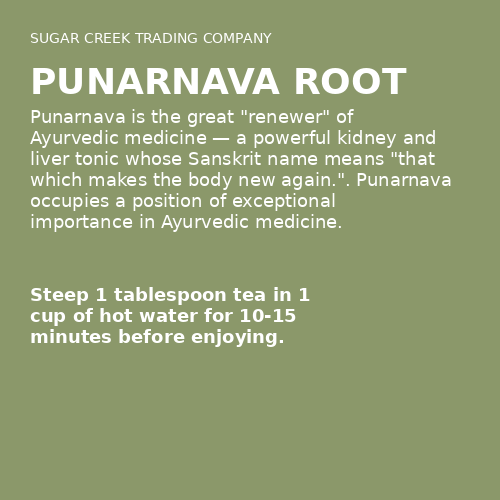
The great "renewer" of Ayurvedic medicine — a powerful kidney and liver tonic whose Sanskrit name means "that which makes the body new again."
Botanical Identification
Common Names: Punarnava, Spreading Hogweed, Red Spiderling, Horse Purslane, Raktapunarnava (red variety), Tarvine
Latin Name: Boerhavia diffusa L.
Family: Nyctaginaceae (Four o'clock family)
Part Used: Root (primary), whole herb also used in some traditions
Origin: Native to the Indian subcontinent and tropical regions of Asia, Africa, and the Americas. Found growing wild throughout India, particularly in warmer regions with sandy or loamy soils. The plant thrives in disturbed ground, roadsides, and waste areas up to elevations of about 2,000 meters. Also found throughout tropical Africa, the Caribbean, and South America.
Description: Boerhavia diffusa is a sprawling or creeping perennial herb with reddish-purple stems, thick fleshy roots, and small ovate leaves that are green above and whitish-pink beneath. The flowers are tiny, pink to purplish-red, and arranged in small clusters. The root — the primary medicinal part — is long, tapering, brownish externally, and yellowish-white internally, with a slightly bitter, astringent taste. Two varieties are recognized in Ayurvedic practice: the red-stemmed form (Raktapunarnava, considered more potent) and the white-stemmed form (Shwetapunarnava).
Cultural and Historical Use
Punarnava occupies a position of exceptional importance in Ayurvedic medicine. The name itself — from the Sanskrit punar (again) and nava (new) — reveals the plant's traditional reputation as a full-body rejuvenator (rasayana). The ancient text Charaka Samhita lists punarnava among the most important herbs for treating shotha (edema and swelling) and classifies it as one of the primary shothaghna (anti-edema) plants in the Ayurvedic materia medica. It is described as a tridoshic herb, capable of balancing all three doshas but especially effective at reducing excess kapha (fluid and congestion). The Sushruta Samhita recommends it for urinary disorders, ascites, and anemia. In Ayurvedic clinical practice, punarnava has been prescribed for millennia for kidney disease, hepatic cirrhosis, congestive heart failure (where fluid retention is the dominant symptom), and chronic inflammatory conditions. In traditional African medicine, closely related Boerhavia species are used for jaundice, kidney stones, and gonorrhea. In Brazilian folk medicine, the plant is known as erva-tost and used as a diuretic and anti-inflammatory.
Key Bioactive Compounds
| Compound | Class | Function |
|---|---|---|
| Punarnavine | Alkaloid | Diuretic; anti-inflammatory; smooth muscle relaxant |
| Boeravinone A-J | Rotenoid flavonoids | Hepatoprotective; antioxidant; anti-fibrinolytic; calcium channel blocking |
| Liriodendrin | Lignan glycoside | Potent diuretic; calcium channel antagonist; hypotensive |
| Beta-sitosterol | Phytosterol | Anti-inflammatory; immune modulation |
| Ursolic acid | Pentacyclic triterpene | Hepatoprotective; anti-tumor; anti-inflammatory |
| Hypoxanthine-9-L-arabinofuranoside | Purine nucleoside | Immunomodulatory activity |
| Potassium nitrate | Mineral salt | Contributes to diuretic and vasodilatory effects |
How It Works in the Body
Punarnava's pharmacological profile is remarkably broad, but its most clinically significant actions center on kidney protection, fluid regulation, and liver support. As a diuretic, punarnava operates through multiple mechanisms: the alkaloid punarnavine and the lignan liriodendrin promote increased urine output through direct effects on renal tubular function, while the plant's natural potassium content helps prevent the electrolyte depletion that commonly accompanies pharmaceutical diuretics. This makes punarnava a "potassium-sparing" diuretic in functional terms. For kidney protection, research demonstrates that punarnava extracts reduce blood urea nitrogen (BUN) and serum creatinine levels in experimentally induced kidney damage, suggesting direct nephroprotective activity. The boeravinone compounds provide powerful hepatoprotective effects by stabilizing hepatocyte membranes, scavenging free radicals, and reducing lipid peroxidation in liver tissue. These same rotenoid compounds have demonstrated calcium channel blocking activity, which contributes to the plant's blood-pressure-lowering and smooth-muscle-relaxing effects. Punarnava also modulates the immune system: studies show it enhances macrophage activity and increases antibody production while simultaneously reducing excessive inflammatory responses — a balance that is characteristic of true adaptogenic immunomodulators. In Ayurvedic terms, the herb's ability to clear excess fluid (kapha) while simultaneously nourishing and rejuvenating tissue (rasayana action) explains its traditional reputation as a "renewer" of the body.
Dose Guidelines
| Preparation | Amount | Frequency |
|---|---|---|
| Dried root powder | 3 - 5 g | Twice daily with warm water or honey |
| Decoction (kashaya) | 1 tablespoon root in 2 cups water, simmer to 1 cup | 1 - 2 cups daily |
| Tincture (1:5, 45% alcohol) | 3 - 5 mL (60-100 drops) | 2 - 3 times daily |
| Capsule (standardized extract) | 500 - 1,000 mg | Twice daily with meals |
| Punarnava Mandur (classical formulation) | 250 - 500 mg | Twice daily, as directed by Ayurvedic practitioner |
Traditional Ayurvedic method: The root powder is commonly mixed with warm water or honey, or combined with ginger and black pepper to enhance absorption and bioavailability (the trikatu principle).
Preparation and Uses
- Root Decoction (Kashaya): The most traditional preparation. Simmer 1 tablespoon of cut and sifted root in 2 cups of water, reducing to 1 cup over 15 to 20 minutes. Strain and drink warm. The taste is mildly bitter and slightly sweet. This is the preferred preparation for kidney and urinary support.
- Powder (Churna): The dried root ground to fine powder can be mixed with honey, warm water, or ghee. In Ayurvedic practice, combining punarnava churna with gokshura (Tribulus terrestris) and varuna bark (Crataeva nurvala) creates a powerful kidney support formula.
- Capsules: For convenience, the root powder or standardized extract can be encapsulated. This is the most practical option for daily supplementation.
- Punarnava Mandur: A classical Ayurvedic iron-containing formulation combining punarnava with mandur bhasma (processed iron oxide), triphala, and other herbs. Traditionally used for anemia, edema, and liver disorders. Should be used under practitioner guidance.
- External Poultice: Fresh root paste or decoction-soaked compresses are applied externally in traditional practice for joint swelling, edema, and skin inflammation.
- Combination with Gokshura: Punarnava and gokshura together form one of Ayurveda's most effective kidney-support pairs. Punarnava reduces fluid retention and protects nephrons, while gokshura supports urinary flow and provides anti-lithiatic (stone-preventing) action.
Optimal Context for Use
- Fluid retention and edema — particularly when related to impaired kidney or liver function.
- Chronic kidney disease support — as an adjunct to conventional care, to support renal filtration and reduce uremic toxins.
- Liver protection — for individuals with fatty liver, hepatitis, or exposure to hepatotoxic substances.
- Urinary tract health — recurrent UTIs, urinary frequency, or sluggish urinary output.
- Anemia (in the form of Punarnava Mandur) — the classical formulation enhances iron absorption and red blood cell formation.
- Joint inflammation — where swelling and fluid accumulation are prominent symptoms.
- General rejuvenation — in Ayurvedic rasayana protocols for overall vitality, particularly in aging individuals with signs of kapha imbalance (heaviness, fluid congestion, sluggish metabolism).
Sustainability and Ethical Harvesting
Boerhavia diffusa is an abundant, weedy species that grows readily in disturbed soils across the tropics. It is not currently endangered or at risk from overharvesting. The plant regenerates vigorously from root fragments, making sustainable harvest straightforward. However, as demand for Ayurvedic herbs grows globally, cultivation is increasingly preferred over wild collection to ensure quality control and prevent contamination from roadside or industrial areas where the plant often colonizes. Organic cultivation of punarnava is expanding in India, particularly in states like Rajasthan and Madhya Pradesh. The plant's ability to thrive in poor soils with minimal inputs makes it an excellent candidate for sustainable dryland farming.
Safety and Cautions
- Pregnancy and Breastfeeding: Punarnava has traditionally been avoided during pregnancy due to its diuretic and potential uterine-stimulating effects. Not recommended during pregnancy or lactation without professional guidance.
- Hypotension: Due to its blood-pressure-lowering effects, individuals already on antihypertensive medications should use punarnava with caution and monitor blood pressure regularly.
- Diuretic Medications: Punarnava may potentiate the effects of pharmaceutical diuretics (furosemide, hydrochlorothiazide), leading to excessive fluid loss. Use should be coordinated with a healthcare provider.
- Diabetes Medications: Some studies suggest punarnava may lower blood glucose levels. Individuals on insulin or oral hypoglycemics should monitor blood sugar closely.
- Kidney Disease: While punarnava is traditionally used to support kidney function, individuals with advanced kidney disease should use it only under qualified practitioner supervision, as altered kidney function affects drug and herb clearance.
- Electrolyte Balance: As with any diuretic herb, prolonged use at high doses could theoretically affect electrolyte balance. Ensure adequate mineral intake during extended use.
References
- Rawat, A.K.S., et al. "Hepatoprotective activity of Boerhavia diffusa L." Journal of Ethnopharmacology, 56(1), 1997.
- Pareta, S.K., et al. "Aqueous extract of Boerhavia diffusa root ameliorates ethylene glycol-induced hyperoxaluric oxidative stress and renal injury." Pharmaceutical Biology, 49(12), 2011.
- Mishra, S., et al. "Scientific basis for the therapeutic use of Boerhavia diffusa (Punarnava)." Current Science, 77(5), 1999.
- Ahmed-Belkacem, A., et al. "Inhibition of hepatitis C virus replication by boeravinones." Gastroenterology, 132(5), 2007.
- Mudgal, V. "Studies on medicinal properties of Convolvulus pluricaulis and Boerhavia diffusa." Planta Medica, 28(1), 1975.
- Bhowmik, D., et al. "Traditional Indian memory enhancers and their importance." Journal of Pharmacognosy and Phytochemistry, 1(5), 2013.
- Charaka Samhita, Sutra Sthana, Chapter 4 — classification of shothaghna (anti-edema) herbs.
Final Note
Punarnava root is not intended to diagnose, treat, cure, or prevent any disease. It is a traditional Ayurvedic botanical with a growing body of modern scientific support. Punarnava's strength lies in its gentle yet effective action on the kidneys and liver — the body's two primary detoxification organs. For individuals managing chronic kidney or liver conditions, punarnava should be used as a complement to, never a replacement for, qualified medical care. Consistent use over weeks to months is the traditional approach, reflecting the herb's gradual, restorative nature — true to its name, it renews the body slowly and steadily.
Condividere