Sugar Creek Trading Company
Red Clover Blossom Tops
Red Clover Blossom Tops
Impossibile caricare la disponibilità di ritiro
Trifolium pratense — Red Clover Blossom Tops
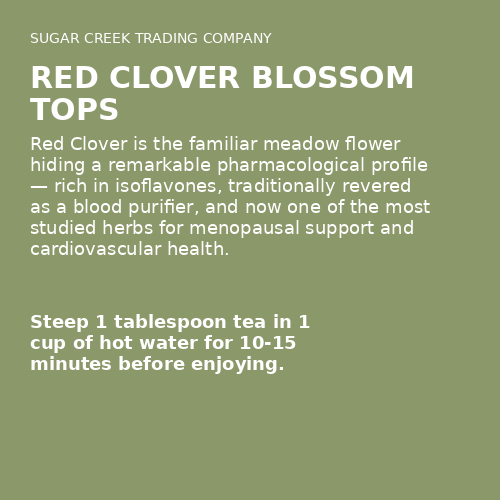
The familiar meadow flower hiding a remarkable pharmacological profile — rich in isoflavones, traditionally revered as a blood purifier, and now one of the most studied herbs for menopausal support and cardiovascular health.
Botanical Identification
Species: Trifolium pratense L.
Family: Fabaceae (Leguminosae)
Common Names: Red clover, meadow clover, cow clover, wild clover, purple clover, trefoil
Parts Used: Dried flower heads (blossom tops), harvested at peak bloom
Native Range: Native to Europe, western Asia, and northwest Africa; widely naturalized across North America, Australia, and temperate regions worldwide
Appearance: The dried blossom tops are round, globular flower heads composed of many small tubular florets, ranging from deep pink-purple to reddish-brown when dried. They have a mild, slightly sweet, hay-like aroma.
Cultural and Historical Use
Red clover has been a fixture of European folk medicine since at least the medieval period. Its trifoliate leaves carried symbolic weight — associated with the Trinity in Christian tradition and considered a protective charm in Celtic practice. But it was the flower tops that earned a place in the herbalist's apothecary, valued as a "blood cleanser" and alterative — a remedy believed to gently improve the body's ability to process and eliminate waste through the lymphatic system, liver, and kidneys.
In the Eclectic medical tradition of 19th-century America, red clover was a cornerstone of anti-cancer formulas, most famously as a key ingredient in the Hoxsey formula and Jason Winters tea. While these cancer claims remain unproven by modern standards, they drove significant research interest that ultimately led to the discovery of red clover's rich isoflavone content — a finding that reframed the herb's relevance for modern science.
Among Native American peoples, the Cherokee used red clover infusions for whooping cough, while the Iroquois prepared it for croup and respiratory ailments. In rural Appalachia and the British Isles, red clover tea was a common spring tonic, drunk to "thin the blood" after a heavy winter diet. The flowers were also used topically as a poultice for skin conditions including eczema, psoriasis, and chronic ulcers.
Key Bioactive Compounds
| Compound Class | Key Representatives | Primary Activity |
|---|---|---|
| Isoflavones | Biochanin A, formononetin, genistein, daidzein | Phytoestrogens that selectively bind estrogen receptors (preferentially ER-beta); modulate hormonal activity in menopause, support cardiovascular and bone health |
| Flavonoids | Quercetin, kaempferol, isorhamnetin | Antioxidant, anti-inflammatory, vascular-protective |
| Coumarins | Coumestrol, medicagol | Mild estrogenic and anticoagulant activity |
| Volatile Oils | Eugenol, furfural, methyl salicylate | Contribute to the pleasant aroma; mild anti-inflammatory properties |
| Minerals | Calcium, chromium, magnesium, phosphorus, potassium | Nutritive support; contribute to the value of long-infused red clover tea |
| Cyanogenic Glycosides | Linamarin, lotaustralin (trace amounts) | Present in very small quantities; not considered clinically significant at normal tea doses |
How It Works in the Body
Red clover's modern pharmacological story centers on its isoflavones, particularly biochanin A and formononetin. These compounds are classified as phytoestrogens — plant molecules structurally similar enough to human estrogen to bind estrogen receptors, but with much weaker activity. Crucially, red clover isoflavones show preferential affinity for estrogen receptor beta (ER-beta), which is concentrated in bone, vascular endothelium, and the brain, rather than estrogen receptor alpha (ER-alpha), which predominates in breast and uterine tissue. This selectivity is central to understanding red clover's safety profile and its therapeutic niche.
In menopausal women, declining estrogen levels drive hot flashes, bone loss, cardiovascular changes, and mood disturbances. Red clover isoflavones partially occupy the vacated ER-beta receptors, providing enough estrogenic signaling to attenuate these symptoms without the risks associated with strong ER-alpha stimulation. Meta-analyses of clinical trials report modest but statistically significant reductions in hot flash frequency and severity with red clover supplementation.
Beyond hormonal modulation, red clover demonstrates measurable effects on cardiovascular markers. Studies show improvements in arterial compliance (a measure of blood vessel flexibility), reductions in LDL cholesterol, and increases in HDL cholesterol in postmenopausal women — effects attributed to the combined action of isoflavones and flavonoids on vascular endothelial function.
The traditional "blood purifier" reputation likely reflects red clover's gentle stimulation of lymphatic drainage and hepatic metabolism, supported by its flavonoid and coumarin content. While less studied than the hormonal effects, this alterative action remains a valued property in clinical herbalism.
Dose Guidelines
| Form | Typical Dose | Notes |
|---|---|---|
| Standard Infusion | 1–2 tablespoons dried blossom tops per cup boiling water, steeped 15–20 minutes | Drink 2–3 cups daily; allow 4–8 weeks for hormonal effects to manifest |
| Nourishing Infusion | 1 ounce (28 g) dried blossoms in 1 quart boiling water, steeped 4–8 hours | Maximizes mineral and isoflavone extraction; drink throughout the day |
| Tincture (1:5, 40% ethanol) | 2–4 mL, three times daily | Isoflavones are reasonably alcohol-soluble; tincture is a valid delivery form |
| Standardized Extract (capsules/tablets) | 40–160 mg total isoflavones daily | Most clinical trials on menopausal symptoms used 40–80 mg isoflavones daily; divided into two doses |
| Topical (poultice or wash) | Strong infusion (2 tablespoons per cup) applied to affected skin | Traditional use for eczema, psoriasis, and skin irritation; can also be added to bath water |
Preparation and Uses
- Daily Tonic Tea: Red clover makes a pleasant, mildly sweet tea that is easy to drink in quantity. Steep the blossom tops for at least 15 minutes — the isoflavones require extended steeping for full extraction. The tea pairs well with mint, nettle, or oat straw.
- Long Infusion for Mineral Density: The overnight quart infusion method extracts significantly more minerals and isoflavones than a quick cup. This is the method favored by herbalists working with menopausal women and those seeking bone-supportive nutrition.
- Lymphatic and Alterative Blend: Combine red clover blossoms with cleavers, calendula, and burdock root for a traditional alterative formula aimed at supporting lymphatic drainage and skin clarity.
- Menopausal Support Formula: Blend red clover with sage leaf, motherwort, and black cohosh for a multi-targeted approach to hot flashes, night sweats, and mood changes during the menopausal transition.
- Skin Poultice: Prepare a strong infusion, soak a clean cloth, and apply as a warm compress to areas of eczema, psoriasis, or dermatitis. The anti-inflammatory and mildly estrogenic properties may improve skin healing and reduce irritation.
- Vinegar Infusion: Pack dried blossoms into a jar and cover with raw apple cider vinegar. Infuse for 4–6 weeks. Use as a salad dressing base or take 1 tablespoon daily — the acid extraction pulls out both minerals and isoflavones effectively.
Optimal Context for Use
- Perimenopausal and menopausal women experiencing hot flashes, night sweats, and hormonal shifts
- As a long-term nutritive tonic tea rich in minerals and phytoestrogens
- In alterative and lymphatic formulas for skin conditions, sluggish detoxification, or seasonal cleansing protocols
- As part of a cardiovascular support program for postmenopausal women, alongside diet and lifestyle measures
- Topically for chronic inflammatory skin conditions
Sustainability and Ethical Harvesting
Trifolium pratense is one of the most abundant and ecologically beneficial plants in temperate regions. As a nitrogen-fixing legume, it actively improves soil fertility wherever it grows and is widely cultivated as a cover crop and forage plant. Wild populations are extensive, and the species faces no conservation threats whatsoever. Red clover is an excellent herb for beginning wildcrafters — it is easy to identify, impossible to overharvest in most landscapes, and blooms prolifically from late spring through autumn. Harvest from fields that have not been treated with herbicides or pesticides, and leave ample flowers for pollinators, which depend heavily on red clover as a nectar source.
Safety and Cautions
- Red clover is generally well-tolerated, with clinical trials reporting adverse effects comparable to placebo at standard doses.
- Due to its isoflavone content, red clover should be used with caution — and only under professional guidance — by individuals with a history of estrogen-receptor-positive breast cancer, endometriosis, or uterine fibroids. While ER-beta selectivity suggests a favorable safety profile, the precautionary principle applies in hormone-sensitive conditions.
- The coumarin content gives red clover mild anticoagulant properties. Those taking warfarin, heparin, or other blood-thinning medications should consult their healthcare provider before use.
- Fermented or moldy red clover (as can occur in improperly stored hay) produces dicoumarol, a potent anticoagulant. This is a concern in livestock feed, not in properly dried and stored herbal material, but it underscores the importance of purchasing from reputable suppliers who ensure clean, dry storage.
- Not recommended during pregnancy or breastfeeding due to the phytoestrogenic activity.
- May theoretically interact with oral contraceptives, hormone replacement therapy, or tamoxifen. Consult a healthcare provider if taking any hormonal medications.
References
- Tice, J. A., et al. "Phytoestrogen supplements for the treatment of hot flashes: the Isoflavone Clover Extract (ICE) study." JAMA, 290(2), 2003, pp. 207–214.
- Nestel, P. J., et al. "Isoflavones from red clover improve systemic arterial compliance but not plasma lipids in menopausal women." Journal of Clinical Endocrinology and Metabolism, 84(3), 1999, pp. 895–898.
- Atkinson, C., et al. "Red clover-derived isoflavones and mammographic breast density." Breast Cancer Research and Treatment, 86(2), 2004, pp. 169–179.
- Hoffman, David. Medical Herbalism: The Science and Practice of Herbal Medicine. Healing Arts Press, 2003.
- Coon, J. T., et al. "Trifolium pratense isoflavones in the treatment of menopausal hot flushes: a systematic review and meta-analysis." Phytomedicine, 14(2-3), 2007, pp. 153–159.
Final Note: Red clover is a plant that rewards patience and consistency. Its isoflavones work gently, accumulating benefit over weeks and months rather than delivering immediate relief. This is not a shortcoming — it is the nature of a true tonic. The same meadow flower that feeds the soil, feeds the bees, and feeds the cattle also offers women in transition a quiet, steady source of hormonal equilibrium. Steep it long, drink it daily, and trust the slow medicine. This product is sold as a botanical specimen for educational purposes. It is not intended to diagnose, treat, cure, or prevent any disease.
Condividere