Sugar Creek Trading Company
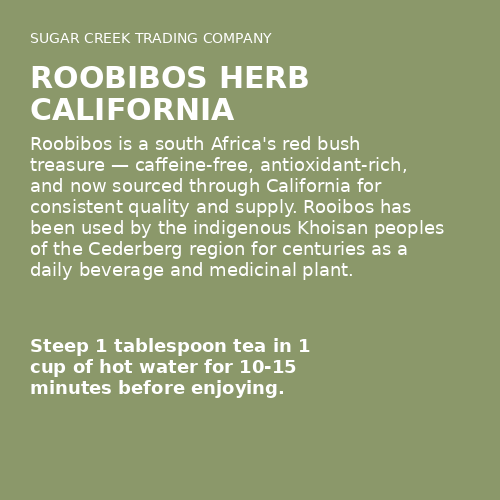
Rooibos Herb California
Rooibos Herb California
Impossibile caricare la disponibilità di ritiro
Aspalathus linearis
South Africa's red bush treasure — caffeine-free, antioxidant-rich, and now sourced through California for consistent quality and supply.
Botanical Identification
Species: Aspalathus linearis (Burm.f.) R.Dahlgren
Family: Fabaceae (Legume family)
Common names: Rooibos, Red Bush, Red Bush Tea, African Red Tea, Bush Tea
Part used: Leaves and fine stems, oxidized (red rooibos) or unoxidized (green rooibos)
Native range: Rooibos is endemic to the Cederberg mountain region of South Africa's Western Cape Province, a small geographic area roughly 200 km north of Cape Town. It grows nowhere else naturally on Earth, thriving in the acidic, nutrient-poor sandy soils of the fynbos biome at elevations of 450-900 meters. The plant is a broom-like shrub growing 1-2 meters tall with needle-like leaves and small yellow flowers typical of the legume family.
California sourcing note: This product is rooibos processed and distributed through California-based facilities, ensuring domestic quality control, freshness testing, and reduced supply chain transit time from import to shelf. The raw plant material originates from South African rooibos farms, as A. linearis cannot be commercially cultivated outside its native fynbos ecosystem.
Cultural and Historical Use
Rooibos has been used by the indigenous Khoisan peoples of the Cederberg region for centuries as a daily beverage and medicinal plant. The Khoisan harvested wild rooibos, bruised the leaves with wooden hammers, fermented them in heaps to develop the characteristic red color and sweet flavor, and then sun-dried the result. This traditional processing method is essentially the same oxidation process used commercially today.
European settlers in the Cape Colony adopted rooibos as a substitute for expensive imported black tea in the 18th century. Commercial cultivation began in the 1930s, driven largely by the efforts of Russian immigrant Benjamin Ginsberg, who recognized the plant's commercial potential and worked with local botanist Dr. P. le Fras Nortier to develop cultivation techniques. For decades, rooibos remained largely unknown outside South Africa. Its global popularity surged in the early 2000s when research on its antioxidant properties and caffeine-free nature made it attractive to health-conscious consumers worldwide.
In South African folk medicine, rooibos tea is given to infants for colic and digestive discomfort — a practice that persists today and reflects the herb's extraordinary gentleness. It is one of the few herbal teas considered safe for all ages, including newborns, making it one of the most universally accessible botanical beverages in the world.
Key Bioactive Compounds
| Compound | Classification | Primary Action |
|---|---|---|
| Aspalathin | Dihydrochalcone (C-glucoside) | Unique to rooibos; potent antioxidant; blood sugar regulation; anti-inflammatory |
| Nothofagin | Dihydrochalcone (C-glucoside) | Antioxidant; anti-inflammatory; synergistic with aspalathin |
| Orientin & isoorientin | Flavone C-glycosides | Antioxidant; cardioprotective; anti-inflammatory |
| Vitexin & isovitexin | Flavone C-glycosides | Antispasmodic; anxiolytic; antioxidant |
| Rutin | Flavonol glycoside | Vascular protective; anti-inflammatory; capillary strengthening |
| Quercetin & luteolin | Flavonoids | Broad antioxidant; anti-allergic; anti-inflammatory |
| Phenylpyruvic acid-2-O-glucoside (PPAG) | Phenolic glucoside | Pancreatic beta-cell protective; blood sugar support |
Aspalathin is the signature compound of rooibos, found in no other known plant. It is present in highest concentrations in green (unoxidized) rooibos and is partially degraded during the oxidation process that produces traditional red rooibos. Even in red rooibos, however, significant levels of aspalathin and its metabolites remain.
How It Works in the Body
Rooibos operates primarily through broad-spectrum antioxidant and anti-inflammatory activity. Aspalathin, the most studied compound, acts as a free radical scavenger with particular affinity for reactive oxygen species (ROS) generated during metabolic stress. It also modulates several key inflammatory pathways, including NF-kB signaling, reducing the expression of pro-inflammatory cytokines such as TNF-alpha, IL-6, and IL-1-beta.
One of the most promising areas of rooibos research involves blood sugar regulation. Aspalathin has been shown to increase glucose uptake in muscle cells by stimulating AMPK (AMP-activated protein kinase) and enhancing insulin secretion from pancreatic beta cells. In animal models of type 2 diabetes, aspalathin-rich rooibos extract reduced fasting blood glucose, improved glucose tolerance, and protected beta cells from oxidative damage. PPAG, another rooibos-specific compound, has demonstrated independent beta-cell protective effects.
Rooibos flavonoids, particularly quercetin and luteolin, contribute antihistamine and anti-allergic activity by stabilizing mast cells and inhibiting histamine release. This may explain the traditional South African use of rooibos for allergies, eczema, and skin conditions. The antispasmodic flavonoids vitexin and isovitexin help relax smooth muscle, contributing to the herb's reputation for easing digestive cramps and colic.
Importantly, rooibos contains no caffeine, no oxalic acid, and very low tannin levels compared to Camellia sinensis tea. This makes it exceptionally gentle on the stomach, kidneys, and nervous system — suitable for people who cannot tolerate caffeinated beverages or who are sensitive to the astringency and oxalate content of conventional teas.
Dose Guidelines
| Form | Amount | Frequency |
|---|---|---|
| Standard tea infusion | 1-2 teaspoons per 8 oz boiling water, steeped 5-10 minutes | 3-6 cups daily (no upper limit concerns for most people) |
| Strong therapeutic infusion | 1 tablespoon per 8 oz boiling water, steeped 10-15 minutes | 2-3 times daily |
| Cold brew | 2 tablespoons per quart of cold water, refrigerated 8-12 hours | Drink throughout the day |
| Powdered rooibos (capsules or added to food) | 500-1,500 mg | 1-3 times daily |
| Topical (skin wash or bath) | Brew a strong quart-size infusion and apply or add to bathwater | As needed |
Rooibos is one of the safest herbs available and can be consumed liberally as a daily beverage. Unlike many medicinal herbs, there is no need to cycle or limit intake. Longer steeping times extract more antioxidant compounds without producing the bitterness associated with over-steeped black or green tea.
Preparation and Uses
- Daily beverage tea: Steep 1-2 teaspoons of rooibos in freshly boiled water for 5-10 minutes. Rooibos never becomes bitter, so steeping longer only increases antioxidant extraction. Enjoy plain, or with honey, lemon, milk, or plant-based milk. It has a naturally sweet, slightly nutty flavor with notes of vanilla and caramel.
- Iced rooibos: Brew a concentrated batch (double strength), allow to cool, then pour over ice. Add fresh mint, citrus slices, or a splash of fruit juice for a refreshing caffeine-free summer drink.
- Cold brew: Place 2 tablespoons of rooibos in a quart jar of cold water. Refrigerate for 8-12 hours. Strain and drink. Cold brewing produces a smoother, mellower flavor profile.
- Rooibos latte: Brew a strong cup of rooibos and combine with steamed milk or oat milk. Add honey or vanilla to taste. A caffeine-free alternative to chai or coffee lattes.
- Cooking and baking: Use brewed rooibos as a liquid base for smoothies, oatmeal, rice, or baked goods. The mild, sweet flavor complements both savory and sweet applications.
- Skin care: Brew a strong infusion, allow to cool, and use as a facial toner, compress for eczema or sunburn, or add to bathwater for full-body skin soothing. South African mothers traditionally bathe infants in rooibos water for diaper rash and irritated skin.
- Blending base: Rooibos makes an excellent base for herbal tea blends due to its mild, sweet flavor and lack of caffeine. Combine with dried fruit, cinnamon, ginger, cardamom, or lavender for custom blends.
Optimal Context for Use
- Daily antioxidant-rich beverage for general health and longevity
- Caffeine-free alternative for individuals who are caffeine-sensitive, pregnant, or breastfeeding
- Blood sugar support and metabolic health (complementary, not a replacement for medical treatment)
- Allergies, eczema, and histamine-related skin conditions
- Digestive comfort, particularly colic, cramping, and mild nausea
- Cardiovascular support through antioxidant and anti-inflammatory mechanisms
- Safe herbal tea for children and infants (a rarity among medicinal herbs)
- Evening relaxation beverage — no caffeine means no sleep disruption
- Hydration support for athletes and active individuals who want antioxidant-rich fluids
Sustainability and Ethical Harvesting
Rooibos cultivation is geographically limited to a small area of South Africa's Western Cape. The plant depends on the unique conditions of the fynbos biome — acidic sandy soils, winter rainfall, and specific mycorrhizal fungi — and attempts to cultivate it elsewhere have largely failed. This makes the sustainability of South African rooibos farming critically important. The Rooibos Council of South Africa oversees industry standards, and many farms operate under fair trade and organic certifications. Wild rooibos, which grows in more remote mountain areas and is considered superior in flavor by some connoisseurs, is sustainably harvested by local Khoisan communities under benefit-sharing agreements established following a landmark 2019 agreement recognizing indigenous knowledge rights. California processing ensures quality control at the point of distribution without disrupting the sustainable farming practices at the source.
Safety and Cautions
- Extremely safe profile: Rooibos is one of the safest herbal products available. It is caffeine-free, very low in tannins, and contains no oxalic acid. It is safe for pregnant women, breastfeeding mothers, infants, and children.
- Liver sensitivity (rare): There have been isolated case reports of hepatotoxicity associated with very high rooibos consumption in individuals with pre-existing liver conditions. While these cases are exceedingly rare and causation has not been definitively established, individuals with liver disease should consult their healthcare provider.
- Estrogenic activity: Some rooibos compounds have demonstrated mild estrogenic activity in vitro. While this has not proven clinically significant at normal consumption levels, individuals with estrogen-sensitive conditions (certain breast cancers, endometriosis) may wish to discuss rooibos use with their healthcare provider.
- Iron absorption: Unlike black and green tea, rooibos has minimal impact on non-heme iron absorption due to its low tannin content. However, individuals with iron deficiency anemia may still wish to separate rooibos consumption from iron-rich meals or supplements as a precaution.
- Drug interactions: No significant drug interactions have been documented at normal dietary intake levels. Rooibos does not contain caffeine or compounds known to interact with cytochrome P450 enzymes at relevant concentrations.
References
- Joubert, E., et al. (2008). "South African herbal teas: Aspalathus linearis, Cyclopia spp. and Athrixia phylicoides — a review." Journal of Ethnopharmacology, 119(3), 376-412.
- Muller, C.J.F., et al. (2012). "Acute assessment of an aspalathin-enriched green rooibos extract during oral glucose tolerance tests in healthy subjects." International Journal of Food Sciences and Nutrition, 63(2), 159-168.
- Son, M.J., et al. (2013). "Aspalathin improves hyperglycemia and glucose intolerance in obese diabetic ob/ob mice." European Journal of Nutrition, 52(6), 1607-1619.
- Snijman, P.W., et al. (2009). "Antioxidant activity of the dihydrochalcones aspalathin and nothofagin and their corresponding flavones." Journal of Agricultural and Food Chemistry, 57(15), 6678-6684.
- Joubert, E. & de Beer, D. (2011). "Rooibos (Aspalathus linearis) beyond the farm gate: from herbal tea to potential phytopharmaceutical." South African Journal of Botany, 77(4), 869-886.
- Hawkins, H.J., et al. (2011). "Sustainability of rooibos cultivation." South African Journal of Science, 107(3-4), 25-32.
Final Note
Rooibos is that rare thing in the herbal world: a plant that is both deeply medicinal and unconditionally gentle. Its unique chemistry — anchored by aspalathin, a compound found nowhere else in nature — delivers genuine antioxidant, anti-inflammatory, and metabolic benefits without caffeine, significant tannins, or oxalates. It can be given to a newborn or consumed in large quantities by adults without concern. This California-sourced rooibos ensures you receive a product that has been quality-tested domestically for freshness and purity, while honoring the South African farming communities and indigenous Khoisan knowledge that make this remarkable plant available to the world. Brew it freely and drink it often. This product is not intended to diagnose, treat, cure, or prevent any disease. Consult a qualified healthcare practitioner before use if you have any medical conditions or are taking medications.
Condividere