Sugar Creek Trading Company
Safflower
Safflower
Impossibile caricare la disponibilità di ritiro
Carthamus tinctorius - Safflower
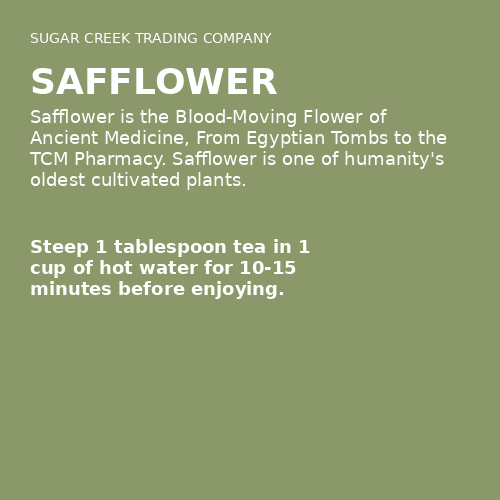
The Blood-Moving Flower of Ancient Medicine, From Egyptian Tombs to the TCM Pharmacy
Botanical Identification
Species: Carthamus tinctorius L.
Family: Asteraceae (Daisy family)
Common Names: Safflower, False Saffron, Bastard Saffron, Dyer's Saffron, Hong Hua (Chinese), Kusum (Hindi), Usfur (Arabic)
Parts Used: Dried florets (petals)
Origin: Native to arid regions of the Middle East and Central Asia; cultivated globally for millennia
Safflower is a thistle-like annual plant that produces brilliant orange-red florets atop spiny flower heads. The plant reaches 30-150 cm in height and thrives in dry, sunny conditions. Each flower head produces 15-20 small tubular florets, and it is these dried petals -- ranging from deep red to bright orange -- that constitute the medicinal product. In Traditional Chinese Medicine, the dried florets are known as Hong Hua (literally "red flower") and are among the most important herbs in the blood-moving category.
Cultural and Historical Use
Safflower is one of humanity's oldest cultivated plants. Garlands of safflower were found in the tomb of Pharaoh Tutankhamun (circa 1323 BCE), and ancient Egyptian textiles were dyed with its vivid pigments. The plant was cultivated across Mesopotamia, India, and China well before the Common Era.
In Traditional Chinese Medicine, Hong Hua has been documented since the Kai Bao Ben Cao (973 CE) and is classified as a blood-invigorating and stasis-removing herb. It enters the Heart and Liver meridians and is considered warm in nature with a pungent flavor. It is a key ingredient in iconic TCM formulas including Tao Hong Si Wu Tang (Four Substance Decoction with Safflower and Peach Kernel) for menstrual irregularity and blood stasis.
In Ayurvedic medicine, safflower (Kusum) was used for skin conditions, joint pain, and as a mild laxative. Persian and Arabic physicians including Avicenna described its uses for amenorrhea and as a circulatory stimulant. European herbalists adopted it primarily as a dye plant but also recognized its mild purgative and diaphoretic properties.
Historically, safflower was also used as a more affordable substitute for true saffron in cooking and dyeing, earning it the name "bastard saffron" -- though its medicinal profile is entirely distinct from Crocus sativus.
Key Bioactive Compounds
| Compound | Class | Known Activity |
|---|---|---|
| Hydroxysafflor Yellow A (HSYA) | Quinochalcone C-glycoside | Primary active; antiplatelet, neuroprotective, anti-inflammatory, antioxidant |
| Carthamin | Quinochalcone pigment | Red pigment; antioxidant, anti-inflammatory |
| Kaempferol | Flavonoid | Anti-inflammatory, cardioprotective, anticancer research |
| Quercetin | Flavonoid | Broad antioxidant; mast cell stabilizer; anti-inflammatory |
| Luteolin | Flavonoid | Anti-inflammatory; neuroprotective; supports healthy circulation |
| Safflower polysaccharides | Polysaccharides | Immunomodulatory; antioxidant |
| Serotonin derivatives | Indoleamines | Vasoactive; contribute to platelet and vascular effects |
How It Works in the Body
Hydroxysafflor Yellow A (HSYA) is safflower's most studied compound and the primary driver of its blood-moving reputation. HSYA inhibits platelet aggregation through multiple pathways, including suppression of thromboxane A2 synthesis and modulation of the arachidonic acid cascade. This antiplatelet action supports healthy blood flow and helps prevent pathological clotting -- the modern pharmacological explanation for the TCM concept of "moving blood stasis."
HSYA also demonstrates significant neuroprotective properties. Research indicates it reduces cerebral ischemia-reperfusion injury by attenuating oxidative stress, inhibiting neuronal apoptosis, and modulating inflammatory cytokines including TNF-alpha and IL-1beta. In China, injectable safflower preparations are used clinically for cerebrovascular conditions.
The flavonoid complex (kaempferol, quercetin, luteolin) provides broad anti-inflammatory and antioxidant activity, supporting cardiovascular health and modulating NF-kB signaling pathways. These compounds also contribute to safflower's traditional use for menstrual pain by relaxing smooth muscle and reducing prostaglandin-driven inflammation.
In TCM terms, safflower "invigorates blood, dispels stasis, unblocks the meridians, and alleviates pain" -- a description that aligns remarkably well with its measured antiplatelet, vasodilatory, and anti-inflammatory effects.
Dose Guidelines
| Form | Amount | Notes |
|---|---|---|
| TCM Decoction (Hong Hua) | 3-10 grams daily | Standard TCM dosing; lower doses invigorate blood, higher doses may also break stasis |
| Simple Infusion (Tea) | 1-3 grams steeped 10-15 min | Mild blood-moving and relaxing tea; pleasant golden-orange color |
| Tincture (1:5, 40%) | 2-4 mL, 2-3 times daily | Convenient liquid extract form |
| Culinary Use | Pinch to 1 gram | Used as a saffron substitute in rice, soups, and baked goods for color and mild flavor |
TCM Note: In classical formulation, safflower dosage is nuanced. Small doses (3-5g) gently activate blood circulation, while larger doses (6-10g) more aggressively break stasis. Practitioners adjust based on the patient's constitution and the severity of blood stagnation.
Preparation and Uses
- Hong Hua Tea: Steep 1-3 grams of dried florets in hot water for 10-15 minutes. Produces a beautiful golden-orange tea with a mild, slightly sweet, earthy taste. Traditionally taken for menstrual support and circulation.
- TCM Decoction: Combine with complementary herbs such as peach kernel (Tao Ren), Chinese angelica (Dang Gui), and Sichuan lovage (Chuan Xiong) for classic blood-moving formulas.
- Culinary Coloring: Add a pinch to rice dishes, broths, or baked goods for a warm golden hue similar to saffron at a fraction of the cost.
- Topical Infused Oil: Infuse florets in a carrier oil for 4-6 weeks; use as a massage oil for sore muscles and joints.
- Natural Dye: Safflower produces both yellow (water-soluble) and red (alkaline-extracted) dyes for textiles and cosmetics -- a practice thousands of years old.
Optimal Context for Use
Safflower is best suited for individuals experiencing signs of blood stasis in the TCM framework: fixed, stabbing pain; dark or clotted menstrual blood; delayed or painful periods; dark complexion or visible spider veins; and post-traumatic bruising. It is a warming, moving herb and is most appropriate for stagnant, cold, or sluggish constitutions.
As a daily wellness tea, small amounts of safflower may support healthy circulation, particularly during colder months. It pairs well with goji berries, jujube dates, and rose petals for a nourishing, blood-supporting tea blend.
Sustainability and Ethical Harvesting
Safflower is widely cultivated as an agricultural crop across Asia, the Middle East, North Africa, and the Americas. It is primarily grown for its oil-rich seeds, with the florets collected as a secondary product. Because it is a cultivated annual rather than a wildcrafted species, sustainability concerns are minimal. The plant is drought-tolerant and well-adapted to marginal agricultural land, making it an ecologically sound crop choice in arid regions.
Safety and Cautions
- Contraindicated in pregnancy. Safflower is a uterine stimulant and blood mover; it should be strictly avoided during all stages of pregnancy due to risk of miscarriage.
- Anticoagulant interaction: Due to its antiplatelet effects, safflower should not be combined with blood-thinning medications (warfarin, heparin, aspirin, clopidogrel) without medical supervision.
- Discontinue use at least two weeks before scheduled surgery
- Use with caution in individuals with bleeding disorders or heavy menstrual bleeding (menorrhagia) -- safflower moves blood and may increase flow
- Those with known allergies to Asteraceae family plants (ragweed, daisies, chrysanthemums) may experience cross-reactivity
- Not recommended for long-term unsupervised use at high doses
- This product is not intended to diagnose, treat, cure, or prevent any disease
References
- Chinese Pharmacopoeia Commission. Pharmacopoeia of the People's Republic of China, Volume I, 2020 edition.
- Ao, H., et al. "Hydroxysafflor Yellow A: A Promising Therapeutic Agent for a Broad Spectrum of Diseases." Evidence-Based Complementary and Alternative Medicine, 2018.
- Zhou, X., et al. "Safflower: A comprehensive review of its traditional uses, phytochemistry, pharmacology, and toxicology." Journal of Ethnopharmacology, 249, 2020.
- Bensky, D., Clavey, S., and Stoger, E. Chinese Herbal Medicine: Materia Medica, 3rd ed. Eastland Press, 2004.
- Li, H.B., et al. "Antioxidant properties of safflower petal extracts." Journal of Agricultural and Food Chemistry, 56(16), 2008.
Final Note: Safflower -- Hong Hua -- is one of Traditional Chinese Medicine's great blood-moving herbs, backed by thousands of years of clinical use and an expanding body of modern pharmacological research. Whether used in a classical TCM formula, sipped as a golden tea, or added to food for its warm color, safflower offers a potent yet accessible connection to one of the world's oldest continuous medical traditions. Respect its power, heed its contraindications, and let it do what it does best: keep things moving.
Condividere