Sugar Creek Trading Company
Shankhpushpi
Shankhpushpi
Impossibile caricare la disponibilità di ritiro
Convolvulus pluricaulis
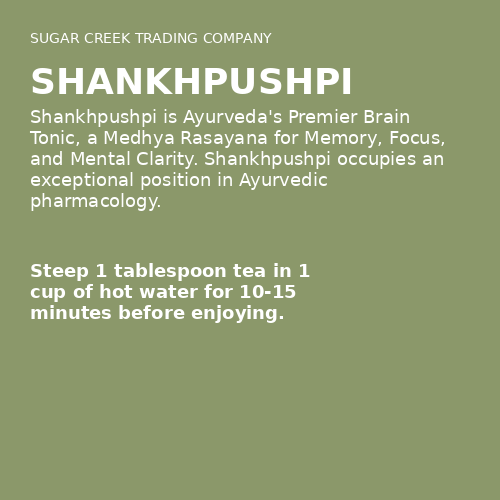
Shankhpushpi — Ayurveda's Premier Brain Tonic, a Medhya Rasayana for Memory, Focus, and Mental Clarity
Botanical Identification
Species: Convolvulus pluricaulis Choisy
Family: Convolvulaceae (Morning Glory family)
Common Names: Shankhpushpi, Shankhahuli, Shankha Pushpi, Vishnukranti (sometimes confused with Evolvulus alsinoides), Speed Wort, Aloe Weed
Part Used: Whole plant (herb) — stems, leaves, flowers, and roots are all used traditionally
Native Range: Indian subcontinent; grows wild across the plains and lower hills of India, Nepal, and Sri Lanka
Appearance: A low, spreading, perennial herb with multiple prostrate branches reaching 10-30 cm. Leaves are small, lanceolate, and covered with fine silky hairs. Flowers are small, funnel-shaped, and typically white or pale blue — their conch-shell shape gives the plant its Sanskrit name (Shankha = conch, Pushpi = flower).
Botanical Note: Several plants are sold as "Shankhpushpi" in different regions of India. The most authoritative identification, supported by the Ayurvedic Pharmacopoeia of India, is Convolvulus pluricaulis. Other species sometimes marketed under this name include Evolvulus alsinoides, Clitoria ternatea, and Canscora decussata. Each has its own pharmacological profile. This product is Convolvulus pluricaulis, the classical Shankhpushpi of the major Ayurvedic texts.
Cultural and Historical Use
Shankhpushpi occupies an exceptional position in Ayurvedic pharmacology. It is classified as one of the four Medhya Rasayanas — the elite category of herbs specifically designated for enhancing Medha (intellect, memory, and cognitive function). This classification comes directly from the Charaka Samhita (ca. 300 BCE - 200 CE), the foundational text of Ayurvedic medicine, where the sage Charaka lists only four plants in this supreme nootropic category: Shankhpushpi (Convolvulus pluricaulis), Brahmi (Bacopa monnieri), Mandukaparni (Centella asiatica), and Yashtimadhu (Glycyrrhiza glabra).
Charaka states that Shankhpushpi is the foremost among the Medhya Rasayanas — in other words, the single best herb for the mind in the entire Ayurvedic materia medica. The Bhavaprakash Nighantu (16th century) elaborates that Shankhpushpi enhances memory, improves voice, complexion, and digestive power, and is a supreme Rasayana (rejuvenative). The Sushruta Samhita prescribes it for Unmada (psychosis/mental disorders) and Apasmara (epilepsy), indicating its traditional use extends beyond simple cognitive enhancement to serious neurological and psychiatric conditions.
In traditional village practice across rural India, Shankhpushpi paste or juice is given to school children during examination periods to improve memory and concentration — a practice that continues to this day and has motivated considerable modern pharmacological research.
Key Bioactive Compounds
| Compound Class | Primary Constituents | Relevance |
|---|---|---|
| Tropane alkaloids | Shankhpushpine, convolamine, convoline, convolvine | Neuroactive alkaloids with potential anxiolytic and memory-enhancing activity |
| Flavonoids and glycosides | Kaempferol, sterols, and their glycosides | Antioxidant and neuroprotective effects; support cerebral blood flow |
| Coumarins | Scopoletin, scopolin | Anti-inflammatory and mild sedative activity; may modulate GABAergic signaling |
| Triterpenoids | Shankhpushpine (also classified here by some authors), phytosterols | Contribute to adaptogenic and anti-stress properties |
| Volatile compounds | Various terpenoids | May contribute to the calming sensory profile of the herb |
| Carbohydrates and glycosides | D-glucose, rhamnose, sucrose conjugates | May serve as carrier molecules enhancing bioavailability of active constituents |
How It Works in the Body
Modern pharmacological studies — primarily from Indian research institutions — have identified several mechanisms that support Shankhpushpi's traditional Medhya Rasayana classification:
Cholinergic Enhancement: Shankhpushpi extracts have demonstrated acetylcholinesterase (AChE) inhibitory activity in multiple in vitro and animal studies. By slowing the breakdown of acetylcholine — the primary neurotransmitter of learning and memory — Shankhpushpi may support cholinergic transmission in the hippocampus and cortex, the brain regions most critical for memory formation and recall. This mechanism parallels the action of pharmaceutical nootropics like donepezil.
Anxiolytic and GABAergic Activity: Animal studies have shown that Shankhpushpi extract produces significant anxiolytic effects comparable to the benzodiazepine diazepam, but without the sedative motor impairment. The coumarins scopoletin and scopolin are thought to modulate GABA-A receptor activity, promoting calm without cognitive dulling. This dual action — enhanced cognition and reduced anxiety — is the hallmark of a true Medhya Rasayana.
Neuroprotection: The flavonoids and alkaloids in Shankhpushpi have shown protective effects against oxidative stress in brain tissue, reducing lipid peroxidation and increasing endogenous antioxidant enzymes (superoxide dismutase, catalase, glutathione peroxidase) in animal models of neurotoxicity. This suggests a role in protecting neurons from age-related and stress-related damage.
Thyroid Modulation: Notably, some studies have reported that Shankhpushpi extract can reduce circulating T3 and T4 thyroid hormone levels in animal models. This is an important pharmacological observation — while it may be beneficial in hyperthyroid conditions, it requires awareness in hypothyroid individuals (see Safety section).
Anticonvulsant Activity: Animal research has confirmed traditional claims of anti-epileptic activity, with Shankhpushpi extracts raising the seizure threshold in multiple experimental models — consistent with its classical use for Apasmara.
Dose Guidelines
| Form | Adult Dose | Timing | Notes |
|---|---|---|---|
| Dried whole herb powder | 3-6 g daily | Divided into 2 doses, morning and evening | Traditional method: mix with warm milk or water and honey |
| Fresh juice (Swarasa) | 10-20 mL | Once or twice daily | The classical Ayurvedic preparation; fresh juice considered most potent |
| Decoction (Kwatha) | 50-100 mL of prepared decoction | Twice daily | Boil 5-10 g of dried herb in 200 mL water, reduce to half |
| Standardized extract | 250-500 mg | Once or twice daily | Follow manufacturer specifications for extract ratio |
Traditional Ayurvedic Vehicle: Shankhpushpi is classically taken with warm milk and ghee — the lipid medium is said to enhance absorption of the fat-soluble active compounds and carry them to brain tissue (Majja Dhatu).
Preparation and Uses
- Shankhpushpi Milk (Traditional Method): Mix 3-5 g of Shankhpushpi powder into a cup of warm milk with 1/2 teaspoon of ghee and honey to taste. Drink in the evening for calm mental clarity and restful sleep, or in the morning for focus and memory support.
- Simple Tea/Decoction: Simmer 3-5 g of the dried herb in 250 mL of water for 10-15 minutes. Strain and drink warm. Can be enhanced with a small piece of fresh ginger and honey.
- Brahmi-Shankhpushpi Combination: The two premier Medhya Rasayanas are often combined for synergistic cognitive support. Mix equal parts Shankhpushpi and Brahmi powder (1.5-3 g of each) and take with warm milk or water.
- Study and Exam Preparation: In the traditional practice, students take Shankhpushpi daily for several weeks before examinations. The herb is said to improve retention, recall, and mental endurance during intensive study periods.
- Capsules: For those who prefer to avoid the taste, fill capsules with Shankhpushpi powder. The mild, slightly bitter flavor is not unpleasant but is unfamiliar to Western palates.
- Shankhpushpi Ghee (Medicated Ghee): An advanced Ayurvedic preparation where the herb is cooked into clarified butter over low heat. This Ghrita preparation is considered the most effective delivery form for brain-targeting herbs in classical Ayurveda.
Optimal Context for Use
- Cognitive enhancement and memory support: This is Shankhpushpi's primary domain — improving learning, memory consolidation, recall, and mental clarity.
- Anxiety and mental restlessness: The combination of nootropic and anxiolytic effects makes Shankhpushpi valuable for individuals whose cognitive performance is hindered by anxiety, stress, or racing thoughts.
- Students and knowledge workers: Those engaged in intensive study, creative work, or knowledge-intensive professions may benefit from daily Shankhpushpi supplementation.
- Age-related cognitive support: The neuroprotective and antioxidant properties make Shankhpushpi relevant for supporting cognitive function in aging individuals.
- Sleep quality: Despite being a cognitive enhancer, Shankhpushpi has a calming rather than stimulating quality. Taking it in the evening may improve sleep quality and next-day mental clarity — a rare combination among nootropic herbs.
- Adjunct in stress-related mental fatigue: The adaptogenic and anxiolytic properties help restore cognitive function depleted by chronic stress.
Sustainability and Ethical Harvesting
Convolvulus pluricaulis is an abundant, weedy, fast-growing herb that colonizes roadsides, field margins, and waste ground across the Indian plains. It is not a rare or threatened species. Increasing commercial demand has led to cultivation programs in several Indian states, reducing pressure on wild populations. The plant's vigorous growth habit and ability to thrive in poor soils make it highly amenable to sustainable cultivation. Our Shankhpushpi is sourced from Indian suppliers who utilize a combination of cultivated and sustainably wild-collected material.
Safety and Cautions
- Thyroid interaction: This is the most important safety consideration. Animal studies have shown that Shankhpushpi may suppress thyroid hormone (T3 and T4) levels. Individuals with hypothyroidism or those taking thyroid replacement therapy (levothyroxine) should use Shankhpushpi only under the guidance of a qualified practitioner and with monitoring of thyroid function.
- Pregnancy and breastfeeding: Avoid during pregnancy due to insufficient safety data and potential hormonal effects. Not recommended during breastfeeding without professional guidance.
- Drug interactions: Due to its GABAergic and sedative properties, Shankhpushpi may potentiate the effects of benzodiazepines, barbiturates, and other CNS depressants. Use caution with anti-epileptic medications. The thyroid-suppressing effect may interact with thyroid medications and antithyroid drugs.
- Botanical identity: Ensure your Shankhpushpi is correctly identified as Convolvulus pluricaulis. Several unrelated species are sold under the same common name in different regions of India, each with different safety profiles.
- Generally well-tolerated: At traditional doses, Shankhpushpi has a long history of safe use in Ayurvedic practice. Side effects at normal doses are uncommon. Some individuals may experience mild drowsiness, which typically resolves with dose adjustment.
This product is sold as a botanical specimen and herbal supplement. These statements have not been evaluated by the FDA. This product is not intended to diagnose, treat, cure, or prevent any disease. Consult a qualified healthcare provider before use, especially if you have thyroid conditions or are taking medications.
References
- Sethiya, N. K., et al. "An Update on Shankhpushpi, a Cognition-Boosting Ayurvedic Medicine." Journal of Chinese Integrative Medicine, 7(11):1001-1022, 2009.
- Malik, J., et al. "Shankhpushpi (Convolvulus pluricaulis): Traditional, Phytochemical, and Pharmacological Properties." International Journal of Pharmaceutical Sciences Review and Research, 48(1):188-196, 2018.
- Nahata, A., et al. "Effect of Convolvulus pluricaulis on Learning and Memory in Rats." Natural Product Research, 22(16):1472-1482, 2008.
- Sharma, P. V. Charaka Samhita: Text with English Translation. Chaukhambha Orientalia, Varanasi, 2001.
- Patel, D. K., et al. "Shankhpushpi as a Brain Tonic: A Review." Journal of Herbal Medicine and Toxicology, 5(2):19-23, 2011.
- Bhowmik, D., et al. "Traditional and Medicinal Uses of Convolvulus pluricaulis." Journal of Chemical and Pharmaceutical Research, 4(12):5003-5007, 2012.
- Ayurvedic Pharmacopoeia of India. Part I, Vol. II: Shankhpushpi Monograph. Government of India, Ministry of Health and Family Welfare.
Final Note
Shankhpushpi stands at the pinnacle of Ayurveda's cognitive pharmacology — the single herb that Charaka, the father of Ayurvedic medicine, named as the foremost Medhya Rasayana above all others. What makes it remarkable in modern terms is the rare combination of cognitive enhancement without stimulation: it sharpens memory and learning while simultaneously calming anxiety and promoting mental tranquility. Most nootropic substances sacrifice one for the other. Shankhpushpi, supported by a growing body of pharmacological research, appears to improve both sides of the equation. For students, professionals, aging individuals, or anyone seeking clearer thinking with a calmer mind, this ancient brain tonic deserves serious consideration — and the respect of proper dosing, awareness of thyroid interactions, and realistic expectations grounded in its traditional context.
Condividere