Sugar Creek Trading Company
Smoking Mixture Herbal Tea
Smoking Mixture Herbal Tea
Impossibile caricare la disponibilità di ritiro
Smoking Mixture Herbal Tea
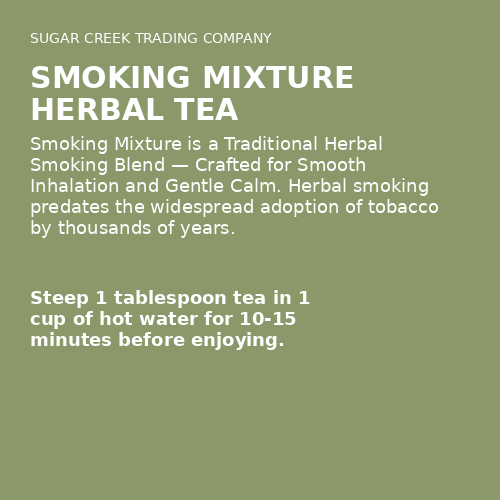
A Traditional Herbal Smoking Blend — Crafted for Smooth Inhalation and Gentle Calm
Botanical Identification
This herbal smoking mixture is a carefully formulated blend of dried botanicals traditionally used for inhalation. While specific formulations vary, classic herbal smoking blends draw from a core group of well-documented smoking herbs. Common base herbs include mullein (Verbascum thapsus), which provides a smooth, light-bodied smoke and is traditionally considered soothing to the respiratory tract. Supporting herbs typically include coltsfoot (Tussilago farfara), an expectorant with a mild, pleasant flavor; damiana (Turnera diffusa), a nervine and mild euphoric; skullcap (Scutellaria lateriflora), a calming nervine sedative; and raspberry leaf (Rubus idaeus), which provides body and smooth burn characteristics. Additional herbs such as mugwort (Artemisia vulgaris), marshmallow leaf (Althaea officinalis), lavender (Lavandula angustifolia), or peppermint (Mentha piperita) may be included for flavor, aroma, and specific herbal effects. This blend contains no tobacco, no nicotine, and no synthetic additives.
Cultural and Historical Use
Herbal smoking predates the widespread adoption of tobacco by thousands of years. Archaeological evidence from sites across Europe, Asia, and the Americas confirms that humans have been burning and inhaling aromatic plant materials for ceremonial, medicinal, and recreational purposes since the Neolithic period. Indigenous peoples of North America developed sophisticated smoking traditions using kinnikinnick blends — mixtures of bearberry (Arctostaphylos uva-ursi), red willow bark, and other local plants — that served as sacred offerings, communal bonds, and medicines long before European contact introduced tobacco.
In European folk medicine, smoking coltsfoot through a pipe was a standard remedy for asthma and persistent cough from at least the Roman era through the early 20th century. Dioscorides, writing in the 1st century CE, recommended inhaling coltsfoot smoke for dry cough. In the English countryside, mullein leaves were smoked by those with respiratory congestion — a practice known as "poor man's tobacco." Damiana was smoked by the Maya and other Mesoamerican peoples as a mild relaxant and aphrodisiac.
The modern revival of herbal smoking blends reflects a growing interest in tobacco-free alternatives for those seeking to reduce or eliminate nicotine dependence, as well as those who value the ritual of smoking for its meditative and social qualities without the addictive and carcinogenic profile of commercial cigarettes.
Key Bioactive Compounds
| Compound | Source Herb | Primary Activity |
|---|---|---|
| Mucilage | Mullein, Marshmallow | Respiratory demulcent, smooth smoke texture |
| Saponins (verbascosaponin) | Mullein | Expectorant, mild bronchodilator |
| Pyrrolizidine alkaloids (trace in coltsfoot) | Coltsfoot | Antitussive (see Safety section for important notes) |
| Tussilagone | Coltsfoot | Smooth muscle relaxation, cough suppression |
| Damianin (arbutin derivative) | Damiana | Mild euphoric, nervine relaxant |
| Apigenin, Luteolin | Damiana, Chamomile | Anxiolytic, mild sedative, anti-inflammatory |
| Baicalin, Wogonin | Skullcap | GABA modulation, anxiolytic, calming |
| Linalool, Linalyl acetate | Lavender | Aromatic, calming, smooth flavor note |
| Menthol | Peppermint (if included) | Cooling sensation, bronchodilator, flavor |
How It Works in the Body
When herbs are combusted and inhaled, their volatile and semi-volatile compounds enter the lungs and are rapidly absorbed into the bloodstream through the alveolar membrane. This route of administration produces faster onset of effects than oral consumption — typically within 30 seconds to 2 minutes — because the compounds bypass first-pass liver metabolism and enter systemic circulation directly.
The mullein base provides a mild, smooth smoke that is well-tolerated by the respiratory tract. Its mucilage content, even when combusted, produces breakdown products that are less irritating than those of tobacco. The saponins in mullein have a gentle expectorant effect, which may help to mobilize respiratory secretions.
Damiana's active compounds, delivered through inhalation, produce a mild relaxing and subtly euphoric effect that many users describe as a gentle "lift" in mood without cognitive impairment. This effect is attributed to its flavonoid content and its interaction with dopaminergic and GABAergic pathways.
Skullcap's flavonoids — particularly baicalin and wogonin — contribute anxiolytic and sedative effects through GABA-A receptor modulation, producing noticeable calm within minutes of inhalation. The combined effect of these herbs creates a mildly relaxing, mood-smoothing experience without intoxication or impairment.
Aromatic herbs like lavender and peppermint contribute terpenes (linalool, menthol) that improve the sensory experience while providing their own mild calming and respiratory-opening effects.
Dose Guidelines
| Method | Suggested Amount | Notes |
|---|---|---|
| Rolled Cigarette / Herbal Joint | 0.5–1.0 grams per session | Use unbleached rolling papers or natural leaf wraps |
| Pipe | 1–2 small pinches per bowl | Glass or natural stone pipes are preferred for clean flavor |
| Brewed as Tea | 1–2 teaspoons per cup, steeped 8–10 minutes | This blend is dual-purpose — effective both smoked and brewed |
| Dry Herb Vaporizer | 0.3–0.5 grams per session | Set temperature between 150–200 C (300–390 F) for optimal release |
Start with a small amount to assess individual sensitivity. The effects are mild and should not produce impairment, but individual responses to inhaled herbs vary.
Preparation and Uses
- Roll-Your-Own Herbal Cigarette: Crumble the blend gently between your fingers to achieve an even consistency. Roll in unbleached hemp or rice rolling papers. Light and inhale gently — herbal blends burn cooler than tobacco and benefit from slow, deliberate draws.
- Pipe Smoking: Pack a small pipe bowl loosely with the blend. Draw slowly and gently. Herbal blends tend to extinguish more easily than tobacco, so relight as needed.
- Herbal Tea Infusion: This blend is specifically designed to serve double duty. Steep 1–2 teaspoons in freshly boiled water for 8–10 minutes, covered. Strain and drink for a calming, respiratory-supportive tea. The flavor profile is mild, slightly floral, and pleasantly herbaceous.
- Vaporization: Load a dry herb vaporizer with 0.3–0.5 grams of the blend. Vaporization releases active compounds at lower temperatures than combustion, reducing the production of carbon monoxide and tars while preserving more of the volatile terpenes and flavonoids.
- Transitional Smoking Aid: Use this blend as a tobacco replacement during nicotine cessation. The ritual of smoking is preserved while the addictive substance is removed, which many find helpful in managing the behavioral component of tobacco addiction.
Optimal Context for Use
- Tobacco Cessation Support: Provides a non-addictive, nicotine-free smoking experience that preserves the ritual and hand-to-mouth habit while removing the addictive compound.
- Relaxation and Unwinding: The combined nervine and mild euphoric properties make this blend suitable for evening relaxation or decompression after a stressful day.
- Meditative and Ceremonial Practice: Many traditions incorporate herbal smoke into contemplative practice, prayer, or ritual. This blend is well-suited for such purposes.
- Social Smoking: For those who enjoy the social aspect of smoking without seeking nicotine or cannabis, herbal blends offer a pleasant shared experience.
- Respiratory Support (as tea): When brewed and drunk, the blend's mullein and coltsfoot components provide gentle expectorant and demulcent support for seasonal respiratory complaints.
Sustainability and Ethical Harvesting
The herbs commonly used in smoking blends are predominantly cultivated species or abundant wild plants. Mullein is a ubiquitous roadside weed across North America and Europe and is not at risk of overharvesting. Damiana is cultivated commercially in Mexico and Central America. Skullcap, raspberry leaf, marshmallow, and lavender are all widely cultivated. Coltsfoot is considered invasive in parts of North America. Mugwort is similarly abundant and in no danger of depletion. Overall, herbal smoking blends place minimal pressure on wild plant populations when sourced from responsible suppliers. We prioritize organically cultivated or ethically wildcrafted ingredients and avoid using any at-risk species in our formulations.
Safety and Cautions
- Inhalation of Combusted Plant Material: Any smoked substance produces carbon monoxide, tars, and particulate matter. While herbal smoking blends lack the nicotine, heavy metals, and thousands of chemical additives found in commercial cigarettes, smoking any plant material carries inherent respiratory risk. This product is not "safe to smoke" in an absolute sense — it is a less harmful alternative to tobacco, not a risk-free one.
- Coltsfoot and Pyrrolizidine Alkaloids: Coltsfoot contains trace amounts of pyrrolizidine alkaloids (PAs), which are hepatotoxic in concentrated doses over prolonged periods. The levels in coltsfoot leaf used in smoking blends are extremely low, and occasional use is not considered dangerous. However, individuals with liver disease should exercise caution. Some modern formulations omit coltsfoot entirely.
- Pregnancy and Nursing: Do not smoke any herbal blend during pregnancy or breastfeeding. Combustion byproducts are harmful to fetal and infant development regardless of the plant source.
- Asthma and Respiratory Conditions: Individuals with asthma, COPD, or other chronic respiratory conditions should avoid inhaling smoke of any kind. The tea form of this blend may be a better option for these individuals.
- Allergic Reactions: Individuals with known allergies to plants in the Asteraceae (daisy) family should exercise caution, as coltsfoot and mugwort belong to this family.
- Not for Minors: This product is intended for adult use only.
- Legal Status: This blend contains no controlled substances. It is legal in all US states. However, its appearance when rolled may be mistaken for cannabis or tobacco — be aware of your context.
References
- Turker, A. U., and Gurel, E. (2005). "Common mullein (Verbascum thapsus L.): recent advances in research." Phytotherapy Research, 19(9), 733–739.
- Zhao, J., et al. (2007). "Tussilago farfara L.: A Review of Traditional Uses, Phytochemistry, Pharmacology, and Quality Control." Journal of Ethnopharmacology, 113(1), 1–18.
- Kumar, S., and Sharma, A. (2005). "Anti-anxiety activity studies on homoeopathic formulations of Turnera aphrodisiaca." Evidence-Based Complementary and Alternative Medicine, 2(1), 117–119.
- Brock, C., et al. (2014). "American Skullcap: A Randomised, Double-Blind Placebo-Controlled Crossover Study." Phytotherapy Research, 28(5), 692–698.
- Hiller, K. O., and Zetler, G. (1996). "Neuropharmacological studies on ethanol extracts of Valeriana officinalis, Scutellaria lateriflora." Phytotherapy Research, 10(8), 616–619.
- Siegel, R. K. (1976). "Herbal Intoxication: Psychoactive effects from herbal cigarettes, tea, and capsules." JAMA, 236(5), 473–476.
Final Note
This product is sold as a raw botanical blend for personal research and traditional use. It is not intended to diagnose, treat, cure, or prevent any disease. The information provided here is for educational purposes only and reflects historical use and available scientific literature. Inhaling combusted plant material carries inherent health risks. Always consult a qualified healthcare professional before adding any new supplement or herbal practice to your regimen, especially if you are pregnant, nursing, taking medications, or managing a chronic health condition.
Condividere