Sugar Creek Trading Company
Spearmint Leaf
Spearmint Leaf
Impossibile caricare la disponibilità di ritiro
Mentha spicata
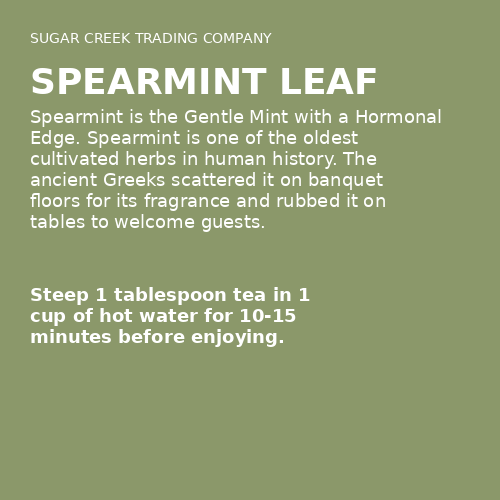
Spearmint Leaf — The Gentle Mint with a Hormonal Edge
Botanical Identification
- Common Names: Spearmint, Garden Mint, Lamb Mint, Green Mint, Spear Mint, Our Lady's Mint
- Latin Name: Mentha spicata (syn. Mentha viridis)
- Family: Lamiaceae (mint family)
- Part Used: Dried leaves
- Form: Cut and sifted leaf
- Origin: Native to Europe and the Mediterranean; widely cultivated worldwide
- Key Distinction: Unlike peppermint (Mentha x piperita), spearmint is carvone-dominant rather than menthol-dominant, making it gentler on the digestive tract and suitable where peppermint is too cooling or irritating
Cultural and Historical Use
Spearmint is one of the oldest cultivated herbs in human history. The ancient Greeks scattered it on banquet floors for its fragrance and rubbed it on tables to welcome guests. Pliny the Elder wrote that the scent of mint "stirs up the mind and appetite." Roman soldiers brought spearmint throughout the empire, and it naturalized across Northern Europe wherever they marched. The name Mentha derives from the Greek nymph Minthe, who in myth was transformed into the plant by Persephone.
In medieval monastery gardens, spearmint was a staple medicinal herb — prescribed for digestive complaints, headaches, and mouth sores. It was listed in the 9th-century Capitulare de Villis, Charlemagne's decree specifying which plants must be grown in imperial gardens. Middle Eastern and North African cultures have long brewed sweetened spearmint tea as a daily social beverage — Moroccan mint tea, made with gunpowder green tea and fresh spearmint, remains one of the world's most iconic herbal preparations.
In recent decades, spearmint has gained significant clinical attention for its anti-androgenic properties — a characteristic not shared by peppermint. Studies in women with polycystic ovary syndrome (PCOS) and hirsutism have shown that regular spearmint tea consumption can measurably reduce free testosterone levels, positioning this gentle herb as a valuable tool in hormonal support.
Key Bioactive Compounds
| Compound | Concentration (approx.) | Primary Activity |
|---|---|---|
| Carvone | 50–70% of essential oil | Carminative, antispasmodic, antifungal; defines spearmint's flavor profile |
| Limonene | 10–25% of essential oil | Gastroprotective, anti-inflammatory, solvent for gallstones |
| Rosmarinic acid | 2–6% of dry weight | Potent antioxidant, anti-inflammatory, anti-androgenic activity |
| Flavonoids (luteolin, apigenin, diosmin) | 1–3% total | Anti-inflammatory, estrogenic modulation, antioxidant |
| Menthol | 0.5–1.5% of essential oil (trace) | Mild cooling sensation — far less than peppermint's 30–50% |
| Caffeic acid and derivatives | Variable | Antioxidant, hepatoprotective |
| 1,8-Cineole | 1–5% of essential oil | Expectorant, antimicrobial |
How It Works in the Body
Spearmint's digestive benefits stem primarily from carvone, which relaxes smooth muscle in the gastrointestinal tract by modulating calcium channel activity. This antispasmodic action relieves bloating, cramping, gas, and nausea without the intense cooling or potential lower esophageal sphincter relaxation caused by peppermint's high menthol content. This makes spearmint the preferred mint for individuals with gastroesophageal reflux (GERD), where peppermint may worsen symptoms.
The anti-androgenic mechanism is primarily attributed to rosmarinic acid and related polyphenols. Research suggests that spearmint's compounds inhibit 5-alpha reductase, the enzyme that converts testosterone to the more potent dihydrotestosterone (DHT). A randomized controlled trial published in Phytotherapy Research (2010) found that women with PCOS who drank spearmint tea twice daily for 30 days showed significant reductions in free testosterone and increases in luteinizing hormone (LH), follicle-stimulating hormone (FSH), and estradiol. A second trial showed reductions in self-assessed hirsutism scores.
The high rosmarinic acid content also provides systemic antioxidant and anti-inflammatory effects, inhibiting cyclooxygenase (COX) and lipoxygenase (LOX) pathways. Emerging research on spearmint polyphenol extracts suggests benefits for working memory and cognitive function in older adults, though this work is still preliminary.
Dose Guidelines
| Use | Amount | Frequency | Notes |
|---|---|---|---|
| Digestive tea | 1–2 teaspoons dried leaf per 8 oz boiling water, steep 5–10 min | After meals or as needed | Gentle enough for daily use; safe for children in small amounts |
| Anti-androgenic support (PCOS/hirsutism) | 1 tablespoon dried leaf per 8 oz, steep 10 min | Twice daily for minimum 30 days | Based on clinical trial protocol; consistency is key |
| Tincture (1:5, 45% ethanol) | 2–4 mL (40–80 drops) | 3 times daily | Less studied for anti-androgenic use than tea |
| Cold infusion (iced tea) | 2 tablespoons per quart cold water | Steep 4–8 hours refrigerated | Refreshing summer beverage; preserves volatile aromatics |
| Steam inhalation (congestion) | Handful of leaves in bowl of hot water | As needed, 5–10 min sessions | Cover head with towel; breathe deeply |
Preparation and Uses
- Simple tea: Pour boiling water over 1 to 2 teaspoons of dried spearmint leaf. Cover and steep 5 to 10 minutes. Strain. Drink plain or with honey. The flavor is sweet, bright, and herbal — universally pleasant.
- Moroccan-style mint tea: Brew 1 teaspoon of gunpowder green tea with 2 tablespoons of spearmint leaf. Add sugar or honey to taste. Pour from a height to aerate. Serve in small glasses.
- Hormone-support blend: Combine equal parts spearmint, nettle leaf, and saw palmetto berry for a comprehensive anti-androgenic formula. Steep as tea twice daily.
- Culinary herb: Add dried spearmint to tabbouleh, yogurt sauces, lamb rubs, grain salads, and fruit salads. Excellent in homemade chocolate mint ice cream.
- Herbal bath: Add a strong spearmint infusion to bathwater for a refreshing, mildly analgesic soak that eases muscle tension.
Optimal Context for Use
- Women with PCOS seeking natural support for elevated androgens, hirsutism, or hormonal acne
- Digestive complaints — bloating, gas, nausea, mild cramping — especially where peppermint is too strong or aggravates reflux
- Daily herbal tea for pleasure and general wellness (one of the most universally enjoyed herbal teas)
- Children's digestive upset — gentler and lower in menthol than peppermint
- Mild respiratory congestion and sore throat soothing
- Cognitive support — emerging research on polyphenol-rich spearmint extracts and working memory
- Transitioning away from sugary or caffeinated beverages — spearmint tea is naturally sweet and caffeine-free
Sustainability and Ethical Harvesting
Spearmint is one of the easiest herbs to grow and one of the hardest to eradicate. It spreads aggressively via stolons (underground runners) and will colonize any moist, semi-shaded garden bed within a single season. It is widely cultivated commercially in the United States (particularly Washington, Oregon, and the Midwest), India, China, and the Mediterranean. There are no conservation concerns whatsoever with spearmint — the challenge is containing it, not protecting it. For home growers, plant in containers or bordered raised beds to prevent garden takeover. Commercial production is largely rain-fed or irrigated on existing farmland, with minimal environmental impact.
Safety and Cautions
- Generally Recognized as Safe (GRAS): Spearmint holds GRAS status with the FDA for food use. It is one of the safest herbs available.
- Pregnancy: Moderate culinary and tea use is considered safe during pregnancy. However, concentrated extracts or therapeutic anti-androgenic doses should be avoided during pregnancy due to potential hormonal effects.
- GERD-friendly: Unlike peppermint, spearmint's low menthol content means it is generally tolerated by those with acid reflux. However, individual responses vary.
- Iron absorption: The tannins and polyphenols in spearmint tea may reduce non-heme iron absorption when consumed with meals. Those with iron-deficiency anemia should drink spearmint tea between meals rather than with food.
- Hormonal medications: Due to its anti-androgenic effects, those taking hormonal contraceptives, anti-androgens (spironolactone, finasteride), or hormone replacement therapy should be aware of potential additive effects.
- Men: Men concerned about testosterone levels should be aware of spearmint's anti-androgenic research, though the clinical evidence is based on women with PCOS. Moderate culinary use is unlikely to cause significant hormonal changes in men.
References
- Grant, P. (2010). Spearmint herbal tea has significant anti-androgen effects in polycystic ovarian syndrome: a randomized controlled trial. Phytotherapy Research, 24(2), 186–188.
- Akdogan, M. et al. (2007). Effect of spearmint (Mentha spicata Labiatae) teas on androgen levels in women with hirsutism. Phytotherapy Research, 21(5), 444–447.
- McKay, D.L. & Blumberg, J.B. (2006). A review of the bioactivity and potential health benefits of spearmint tea (Mentha spicata): a focus on in vitro studies. Phytotherapy Research, 20(8), 619–633.
- Herrlinger, K.A. et al. (2018). Spearmint extract improves working memory in men and women with age-associated memory impairment. Journal of Alternative and Complementary Medicine, 24(1), 37–47.
- Tisserand, R. & Young, R. (2014). Essential Oil Safety, 2nd ed. Churchill Livingstone.
Final Note
Spearmint is the approachable, versatile mint — gentle enough for children, effective enough for hormonal support, and delicious enough to drink every single day. Its carvone-dominant essential oil profile makes it a kinder choice than peppermint for sensitive stomachs and reflux-prone individuals, while its rosmarinic acid content gives it a clinical edge that few culinary herbs can claim. Whether you are sipping it for pleasure, brewing it for PCOS support, or seasoning a lamb dish, spearmint delivers far more than its modest reputation suggests. This product is sold as a botanical specimen and herbal tea ingredient. It is not intended to diagnose, treat, cure, or prevent any disease.
Condividere