Sugar Creek Trading Company
Spirulina
Spirulina
Impossibile caricare la disponibilità di ritiro
SPIRULINA PLATENSIS (WHOLE BIOMASS)
(Spirulina, Arthrospira)
Kingdom: Bacteria (Cyanobacteria)
Family: Oscillatoriaceae
Part Used: Whole dried biomass
Energetics: Cooling to neutral, nutritive, building
Taste: Algal, mildly umami, mineral
ORGANISM IDENTIFICATION
Scientific Name: Spirulina platensis (syn. Arthrospira platensis)
Common Names: Spirulina
Family: Oscillatoriaceae
Morphology:
Spirulina is a filamentous, spiral-shaped cyanobacterium forming microscopic helical strands. It lacks a true nucleus (prokaryotic) and performs oxygenic photosynthesis. The organism’s vivid blue-green color comes from phycobiliproteins, especially phycocyanin.
Cellular structure:
A protein-rich cell wall without cellulose, allowing high digestibility compared to many algae. Bioactive compounds are distributed throughout the biomass.
HABITAT, RANGE, AND ADAPTATIONS
Native to alkaline soda lakes in Africa, Asia, and Central America, where high pH and mineral content limit competitors.
Key adaptations include:
-
Tolerance to extreme alkalinity
-
Rapid protein synthesis
-
Production of antioxidant pigments to buffer UV and oxidative stress
These adaptations underpin spirulina’s dense nutrient profile.
CULTIVATION AND ECOLOGY
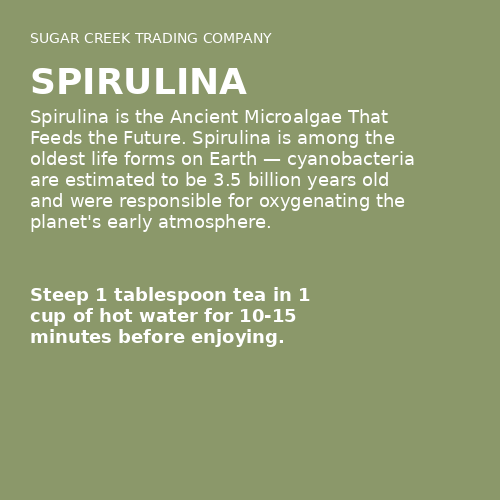
Spirulina is cultivated in controlled alkaline ponds worldwide. It grows rapidly, requires minimal land and water compared to terrestrial crops, and has one of the lowest ecological footprints per gram of protein.
Ecologically, spirulina represents a high-efficiency photosynthetic organism, converting sunlight into complete nutrition with minimal waste.
TRADITIONAL AND ETHNOBOTANICAL CONTEXT
Spirulina has been consumed for centuries by Aztec civilizations (as tecuitlatl) and by communities around Lake Chad, where it was dried into cakes.
While not part of classical herbal systems, spirulina is a traditional human food with deep roots in Indigenous nutrition and resilience during scarcity.
Modern use reframes spirulina as a functional food and metabolic support agent, especially for immune, inflammatory, and glycemic regulation.
KEY BIOACTIVE COMPOUNDS & BENEFITS
| Compound/Class | Location in Organism | Human Benefit | Role in Organism |
|---|---|---|---|
| Complete protein | Whole biomass | Muscle, tissue repair | Structural & enzymatic function |
| Phycocyanin | Cytoplasm | Anti-inflammatory, antioxidant, insulin-sensitizing | Light harvesting, oxidative buffering |
| Polysaccharides | Cell matrix | Immune modulation | Structural integrity |
| Gamma-linolenic acid (GLA) | Lipid fraction | Anti-inflammatory, metabolic support | Membrane fluidity |
| Micronutrients | Whole biomass | Iron, iodine (trace), B-complex | Cellular metabolism |
Phycocyanin is spirulina’s signature compound, driving many of its systemic effects.
HOW IT WORKS IN THE BODY
Metabolic & Glycemic Regulation:
Spirulina improves insulin sensitivity by reducing oxidative stress and inflammatory signaling that interferes with insulin receptor pathways. Clinical studies show reductions in fasting blood glucose, HbA1c, and insulin resistance markers in type 2 diabetes and metabolic syndrome.
Lipid Metabolism:
GLA and antioxidant pigments reduce triglycerides and LDL oxidation, indirectly improving glycemic control via hepatic lipid handling.
Immune Modulation:
Spirulina polysaccharides enhance macrophage and NK-cell activity while phycocyanin downregulates excessive inflammatory cytokines.
Detoxification Support:
Spirulina binds certain heavy metals and supports hepatic antioxidant capacity.
ACTIONS AND INDICATIONS
Spirulina platensis acts as a:
-
Nutritive tonic
-
Anti-inflammatory agent
-
Immune modulator
-
Insulin-sensitizing metabolic support
-
Antioxidant and detox adjunct
Indicated for:
-
Type 2 diabetes and prediabetes (adjunctive)
-
Metabolic syndrome
-
Dyslipidemia
-
Chronic inflammation
-
Nutrient deficiency or recovery states
PREPARATIONS AND DOSAGE
| Form | Preparation | Typical Dose | Notes |
|---|---|---|---|
| Powder | Mixed into water/food | 1–5 g daily | Start low |
| Tablets | Compressed biomass | 500 mg–1 g, 2–3× daily | Convenient |
| Capsules | Encapsulated powder | Per label | Neutral taste |
| Smoothies | Added to blends | As desired | Nutrient synergy |
Clinical metabolic studies often use 2–4 g/day.
SAFETY, CONTRAINDICATIONS, AND TOXICITY
Spirulina is generally very safe when sourced from reputable producers.
Cautions:
-
Avoid in phenylketonuria (PKU) due to phenylalanine content
-
Use caution with autoimmune conditions (immune stimulation)
-
Contaminated spirulina (microcystins, heavy metals) is a sourcing risk — quality control is critical
General Toxicological Reference (LD₅₀)
-
Whole Spirulina platensis biomass:
Acute oral LD₅₀ values in animal models reported >5,000 mg/kg -
Phycocyanin (isolated):
Oral LD₅₀ reported >3,000 mg/kg
Clinical relevance:
Toxicity risk is minimal; safety depends primarily on purity and cultivation standards, not intrinsic toxicity.
HARVEST AND PROCESSING
Harvested via filtration, washed, and dried at low temperatures to preserve pigments and enzymes. Proper drying maintains potency for 2–3 years when protected from heat and light.
SUSTAINABILITY AND ETHICS
Spirulina is among the most sustainable protein sources on Earth, requiring minimal land, water, and inputs. Ethical production prioritizes clean water, transparent testing, and avoidance of exploitative labor practices.
SUMMARY
Spirulina is nutritional intelligence condensed into biology—a photosynthetic organism that feeds metabolism, calms inflammation, and restores balance at the cellular level. Its value lies not in pharmacological force, but in system-wide nourishment and regulation.
As a metabolic ally, Spirulina platensis supports glycemic balance by lowering inflammatory noise and oxidative interference, allowing insulin signaling to function as intended. In a world of depletion, it offers abundance with restrain.
Condividere