Sugar Creek Trading Company
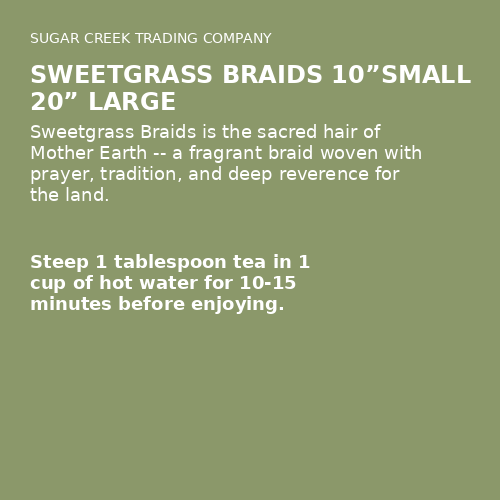
Sweetgrass Braids 10”small 20” Large
Sweetgrass Braids 10”small 20” Large
Impossibile caricare la disponibilità di ritiro
Hierochloe odorata
The sacred hair of Mother Earth -- a fragrant braid woven with prayer, tradition, and deep reverence for the land.
Botanical Identification
Common Names: Sweetgrass, Holy Grass, Vanilla Grass, Seneca Grass, Buffalo Grass, Zebrovka
Latin Name: Hierochloe odorata (syn. Anthoxanthum nitens)
Family: Poaceae (Grass family)
Parts Offered: Dried braided leaves, available in 10-inch (small) and 20-inch (large) braids
Appearance: Long, slender grass blades braided into a tight, three-strand plait. Color ranges from golden-green to straw-yellow when dried. Intensely sweet, vanilla-like fragrance.
Native Range: Circumboreal -- found across northern North America, northern Europe, and northern Asia in moist meadows, lake margins, and prairie edges
Cultural and Historical Use
Sweetgrass holds a position of profound spiritual significance among many Indigenous Nations of North America, including the Anishinaabe (Ojibwe), Lakota, Cree, Blackfoot, Cherokee, and many others. It is widely regarded as one of the four sacred medicines, alongside tobacco, sage, and cedar. In many traditions, sweetgrass is understood as the hair of Mother Earth, and braiding it is an act of prayer and connection to the land.
The braiding of sweetgrass into three strands carries symbolic meaning in numerous traditions, often representing mind, body, and spirit, or other trinities central to a Nation's teachings. When burned as a smudge, the sweet smoke is used to attract positive energies, invite benevolent spirits, and create a welcoming, purified space. Unlike sage, which is often used to clear away negative energy, sweetgrass is traditionally used to call in goodness and kindness.
Sweetgrass is also significant in European folk traditions. In northern Europe, it was strewn on church floors on saints' days, earning the name "holy grass." In Poland and Belarus, it has been used for centuries to flavor vodka, producing the spirit known as Żubrówka. Scandinavian and Baltic peoples used it in basket weaving and as a fragrant addition to stored linens.
A note on respect: We encourage all customers to approach sweetgrass with awareness of its deep cultural significance. If you are not Indigenous and wish to use sweetgrass, we recommend learning about the traditions from which this practice originates, supporting Indigenous-led education, and using it with sincere respect rather than casual appropriation. The sacred dimension of this plant is not separate from the plant itself.
Key Bioactive Compounds
| Compound | Activity | Notes |
|---|---|---|
| Coumarin | Responsible for the characteristic sweet, vanilla-like aroma; mild anti-inflammatory; historically used as a blood thinner | Released when dried or burned; the primary aromatic signature of sweetgrass |
| Phytol | Chlorophyll derivative with anti-inflammatory and antioxidant properties | Present in green portions of fresh or recently dried grass |
| Vanillin | Aromatic compound contributing to the vanilla scent | Minor constituent enhancing the overall fragrance profile |
| Alpha-terpineol | Antimicrobial and calming aromatic compound | Contributes to the complex scent when burned |
| Essential oil complex | Aromatic terpenes and coumarins released during smoldering create a calming, grounding atmosphere | The full aromatic profile is most apparent when the braid is slowly smoldered rather than openly burned |
How It Works in the Body
Sweetgrass is not primarily an ingestible herb in most traditions; its effects are experienced through aromatic exposure and ceremonial use. When the dried braid is lit and allowed to smolder, the released smoke contains coumarin and a complex mixture of volatile terpenes. Inhaling these aromatics at ambient concentrations engages the olfactory system, which has direct neurological connections to the limbic system, the brain's center for emotion, memory, and stress regulation.
The coumarin released during smoldering produces a grounding, calming sensory experience. Research on aromatic coumarin compounds suggests they may have mild anxiolytic effects when experienced through olfaction. The ritual act of smudging itself, involving intentional breathing, focused attention, and symbolic meaning, engages parasympathetic nervous system activation, promoting relaxation and present-moment awareness independent of the pharmacology of the smoke.
Sweetgrass smoke has also been studied for its antimicrobial properties. Research published by Nautiyal et al. (2007) found that medicinal smoke from traditional preparations significantly reduced airborne bacterial counts in enclosed spaces, suggesting a practical basis for the widespread cultural practice of ceremonial smoke cleansing.
Dose Guidelines
| Use | Method | Duration | Notes |
|---|---|---|---|
| Smudging / Smoke cleansing | Light the tip of the braid, blow out the flame, allow it to smolder | As needed | Use a fireproof dish or abalone shell to catch embers |
| Room fragrance | Place an unlit braid in a room, closet, or drawer | Continuous | The natural coumarin slowly releases its sweet scent over weeks to months |
| Bath or foot soak | Steep a small section in hot water | 15-20 minutes | Some herbalists use it this way for its aromatic and skin-soothing qualities |
| Offering or prayer | Place on an altar or in a sacred fire | As guided by tradition | Follow the customs of the specific tradition you are practicing within |
Preparation and Uses
- Smudging: Hold the braid at a 45-degree angle and light the cut end. Once it catches, gently blow out the flame so the braid smolders and produces a thin stream of sweet smoke. Carry it through a space or wave the smoke around yourself with a hand or feather. Extinguish by pressing the lit end into sand or earth in a fireproof container.
- Aromatic Sachet: Cut a small piece from the braid and place it inside a cloth sachet. Tuck into drawers, closets, or under a pillow for a gentle, naturally sweet fragrance.
- Wreaths and Crafts: Sweetgrass braids can be woven into decorative wreaths, baskets, or bundled with other dried herbs for fragrant arrangements.
- Herbal Infusion: While less common, a mild tea can be made by steeping a short length of sweetgrass in hot water. The resulting infusion is lightly aromatic and has been used in some folk traditions as a digestive calmative.
- Fire Ceremony: Sections of sweetgrass can be added to a ceremonial fire as an offering, releasing its sweet fragrance into the open air.
Optimal Context for Use
Sweetgrass is most meaningfully used in contexts of ceremony, prayer, space clearing, and creating a welcoming atmosphere. Many people light sweetgrass when moving into a new home, beginning a meditation practice, preparing for an important conversation, or simply wishing to invite a sense of calm and positivity into their environment. It pairs naturally with other cleansing practices: many traditions recommend smudging with sage first to clear away negativity, then following with sweetgrass to invite in positive energy. The unlit braid itself serves as a beautiful, fragrant presence in any room.
Sustainability and Ethical Harvesting
Sweetgrass is a perennial that spreads through rhizomes and benefits from careful, respectful harvesting. In many Indigenous traditions, harvesting sweetgrass is accompanied by an offering of tobacco and a prayer of gratitude. The grass is typically pulled rather than cut, which stimulates new rhizome growth and can actually help maintain healthy sweetgrass stands when done properly.
Wild sweetgrass populations have declined in some regions due to habitat loss, wetland drainage, and overharvesting by commercial operations lacking traditional ecological knowledge. Ethical sourcing means supporting harvesters who maintain sustainable stands, practice reciprocal land stewardship, and ideally come from communities with long-standing relationships to the plant. Cultivation efforts are underway in several regions to reduce pressure on wild populations while keeping this sacred plant accessible.
Safety and Cautions
- Smoke inhalation: As with any smudging or incense practice, use in well-ventilated areas. Individuals with asthma, COPD, or smoke sensitivities should exercise caution or enjoy sweetgrass in its unburned form.
- Fire safety: Always use a fireproof container when burning sweetgrass. Never leave a smoldering braid unattended. Keep away from flammable materials.
- Coumarin sensitivity: Individuals taking anticoagulant medications (such as warfarin) should be aware that coumarin compounds are present, though exposure through ambient smoke is minimal compared to ingestion.
- Not intended for heavy internal use: While mild teas have folk precedent, sweetgrass is not widely studied for internal consumption. Keep any ingestion minimal and occasional.
- Pregnancy: Due to limited safety data on coumarin exposure, pregnant individuals should limit exposure to occasional aromatic use.
References
- Kimmerer, Robin Wall. Braiding Sweetgrass: Indigenous Wisdom, Scientific Knowledge, and the Teachings of Plants. Milkweed Editions, 2013.
- Nautiyal, C.S., et al. "Medicinal Smoke Reduces Airborne Bacteria." Journal of Ethnopharmacology, 114(3), 2007.
- Moerman, D.E. Native American Ethnobotany. Timber Press, 1998.
- Shebitz, D.J., and Kimmerer, R.W. "Population Trends and Habitat Characteristics of Sweetgrass." Restoration Ecology, 13(4), 2005.
- Uprety, Y., et al. "Traditional Use of Medicinal Plants in the Boreal Forest of Canada." Journal of Ethnobiology and Ethnomedicine, 8(7), 2012.
Final Note: Sweetgrass braids are sold as a traditional ceremonial and aromatic botanical product. These statements have not been evaluated by the FDA. This product is not intended to diagnose, treat, cure, or prevent any disease. We honor the Indigenous Nations whose ancestral knowledge and ongoing stewardship have kept this sacred plant tradition alive. Please use sweetgrass with the reverence it deserves.
Condividere