Sugar Creek Trading Company
Thyme
Thyme
Impossibile caricare la disponibilità di ritiro
Thymus vulgaris — Thyme Leaf
Pure leaf, stripped and concentrated — the medicinal heart of thyme, freed from the stem.
Botanical Identification
Species: Thymus vulgaris L.
Family: Lamiaceae (Mint family)
Common Names: Common Thyme, Garden Thyme, French Thyme
Parts Offered: Dried leaves only — stems and flower buds removed
Native Range: Western Mediterranean basin, from the Iberian Peninsula through southern France to Italy
Botanical Description: The leaves of Thymus vulgaris are tiny (3–8 mm long), oval to lanceolate, with smooth upper surfaces of gray-green and densely hairy, silvery-white undersides. The leaf margins roll slightly inward, and the entire surface is dotted with oil glands visible under magnification. When rubbed between the fingers, the leaves release an immediate, potent burst of warm, phenolic aroma — more intense than handling the whole herb, because the leaves are where the essential oil glands are most densely concentrated.
Cultural and Historical Use
The medicinal use of thyme tracks back over 2,500 years to the physicians of ancient Greece and Egypt. While the full historical record is shared with our Thyme (Whole Herb) listing, the emphasis on leaf preparations specifically deserves attention. European pharmacopoeias — from the German Commission E to the European Medicines Agency — specify Thymi herba (thyme herb) for monograph purposes, but in practice, the highest-grade medicinal preparations have always favored leaf-rich material. Apothecaries and herbalists throughout history preferentially selected the leaves for tinctures, syrups, and concentrated infusions, knowing that the therapeutic volatile oils reside overwhelmingly in the leaf tissue.
In the 19th century, the isolation of thymol from thyme leaves transformed antiseptic medicine. Thymol was adopted into Lister's antiseptic surgical techniques and became a staple of early pharmaceutical chemistry. The compound remains in use today in products like mouthwash (Listerine's original formula included thymol) and topical antifungals. All of this stemmed from the concentrated chemistry of this small, unassuming leaf.
Key Bioactive Compounds
| Compound | Class | Primary Activity |
|---|---|---|
| Thymol | Monoterpene phenol | Broad-spectrum antimicrobial, antifungal, antioxidant |
| Carvacrol | Monoterpene phenol | Antimicrobial, anti-inflammatory, antispasmodic |
| p-Cymene | Monoterpene hydrocarbon | Analgesic, anti-inflammatory, synergist |
| Linalool | Monoterpene alcohol | Anxiolytic, sedative, anti-inflammatory |
| Rosmarinic acid | Polyphenol | Potent antioxidant, anti-inflammatory, antiallergic |
| Luteolin | Flavonoid | Anti-inflammatory, neuroprotective, antioxidant |
| Apigenin | Flavonoid | Anxiolytic, anti-inflammatory |
| Ursolic acid | Triterpene | Anti-inflammatory, hepatoprotective |
Leaf vs. Whole Herb: The chemical profile is identical in type but different in concentration. Gram for gram, dried thyme leaf contains a significantly higher percentage of volatile oils and flavonoids than whole herb material that includes the woody, low-oil stems. Published analyses show thyme leaf essential oil content ranges from 1.0–2.5% of dry weight, while whole herb (with stems) typically tests at 0.5–1.5%. This means a teaspoon of leaf delivers roughly 40–60% more active compounds than a teaspoon of whole herb.
How It Works in the Body
The pharmacology of thyme leaf centers on its volatile oil fraction and its polyphenolic compounds, working through several convergent mechanisms:
Respiratory system: Thymol and carvacrol are absorbed through the GI tract and partially excreted through the lungs, where they exert direct local effects on bronchial tissue. They relax bronchial smooth muscle (antispasmodic action), stimulate ciliary beat frequency to improve mucociliary clearance, and reduce the viscosity of mucus — collectively producing the expectorant and antitussive effects that underpin thyme's central role in European respiratory pharmacotherapy. Clinical trials have validated thyme extract, often combined with ivy leaf, as effective for acute bronchitis.
Antimicrobial action: Thymol disrupts bacterial cell membrane integrity by inserting into the lipid bilayer, causing loss of membrane potential and leakage of intracellular contents. This mechanism is effective against a wide range of pathogens, including antibiotic-resistant strains such as MRSA. Carvacrol operates through a similar but complementary mechanism, and the two compounds together demonstrate synergistic antimicrobial effects.
Anti-inflammatory and antioxidant: Rosmarinic acid inhibits complement activation and reduces histamine release from mast cells, contributing antiallergic effects. Luteolin and apigenin modulate NF-kB and COX-2 pathways. The combined antioxidant capacity of thyme leaf extract is among the highest of any culinary herb.
Digestive support: The volatile oils stimulate gastric motility and reduce gas formation through carminative action. They also promote bile secretion, aiding fat digestion.
Dose Guidelines
| Form | Typical Dose | Frequency | Notes |
|---|---|---|---|
| Leaf infusion (tea) | 1–1.5 g (about 1 tsp) per 8 oz boiling water, steeped 10–15 min covered | 3–4 cups/day | Always cover to retain volatile oils; slightly lower weight needed than whole herb due to higher concentration |
| Powder (capsules or food) | 500–1,000 mg | 2–3 times/day | Leaf grinds easily; suitable for encapsulation |
| Culinary use | Generous seasoning | Daily, as desired | Stripped leaves incorporate seamlessly into dishes |
| Gargle/mouthwash | Strong infusion (2 g per 8 oz), cooled | 3–4 times/day | For sore throat, gingivitis, oral infections |
Preparation and Uses
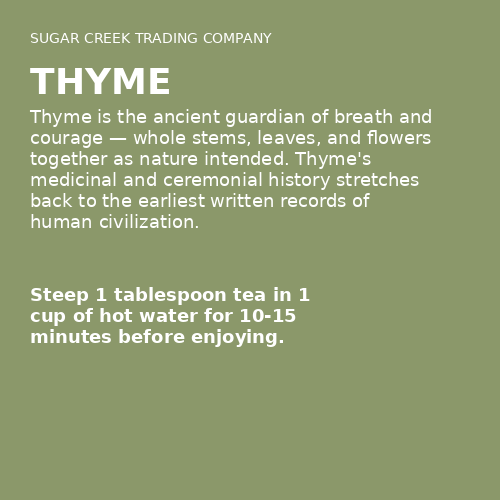
- Concentrated respiratory tea: Steep 1–1.5 g of dried thyme leaf in 8 oz of just-boiled water, covered, for 12–15 minutes. Because there are no stems diluting the material, this produces a more potent infusion than the same weight of whole herb. Ideal for acute coughs, bronchial congestion, and sore throats. Combine with honey and lemon for a classic cold-season remedy.
- Thyme leaf oxymel: Combine equal parts raw honey and apple cider vinegar, then infuse with a generous portion of thyme leaf for 2–4 weeks. Strain and take by the tablespoon for coughs and as an immune tonic. The leaf form infuses more efficiently than whole herb.
- Culinary seasoning: Stripped thyme leaves are the preferred form for direct addition to cooking — they measure more consistently, distribute evenly through dishes, and contain no woody stem pieces. Excellent in marinades, rubs, dressings, and compound butters.
- Antimicrobial gargle: A strong thyme leaf infusion, cooled to a comfortable temperature, makes an effective gargle for sore throats, mouth sores, and gum inflammation. The high thymol content provides direct contact antimicrobial action.
- Encapsulation: Dried thyme leaf can be ground to a fine powder and packed into capsules for those who prefer a standardized, tasteless delivery method. This is a practical option for daily use as an antioxidant and immune support supplement.
- Facial steam: Add 1–2 tablespoons of thyme leaf to a bowl of steaming water for an antimicrobial facial steam beneficial for acne, congested pores, and sinus pressure.
Optimal Context for Use
Choose Thyme Leaf over our Thyme (Whole Herb) when you want higher potency per gram, faster extraction, and cleaner preparations. The leaf form is the better choice for medicinal teas, tincture-making, capsule filling, and any application where stem material is undesirable. It dissolves and strains more cleanly, grinds more uniformly, and delivers a more concentrated dose. The whole herb form is preferable when you want intact sprigs for bouquet garni, bath sachets, or decorative culinary use where the visual structure of the whole plant matters.
Sustainability and Ethical Harvesting
Thyme is cultivated commercially on a large scale and is not threatened in the wild. As a drought-tolerant Mediterranean perennial, it requires minimal irrigation and thrives in poor, rocky soils where many other crops fail — making it an efficient, low-impact crop to produce. Our leaf product is sourced from farms practicing sustainable agriculture without synthetic pesticide application. The stripping of leaves from stems is a post-harvest processing step, typically performed mechanically, and results in two usable products: the premium leaf (sold here) and the stems (which are often composted or used in essential oil distillation).
Safety and Cautions
- Generally Recognized as Safe (GRAS). Thyme leaf is among the safest medicinal herbs available, with a centuries-long record of food and medicine use and a broad therapeutic window.
- Pregnancy: Culinary quantities are safe. Medicinal doses (concentrated teas, high-dose capsules) should be used cautiously during pregnancy due to potential uterine-stimulating effects of high thymol intake. Consult a healthcare provider.
- Lamiaceae allergy: Cross-reactivity is possible for those with known allergies to mint, oregano, basil, or other mint-family plants.
- Anticoagulant medications: Thyme may mildly potentiate blood-thinning drugs. Those on warfarin, heparin, or similar medications should discuss medicinal thyme use with their prescriber.
- Gastric sensitivity: The high volatile oil content of leaf-only preparations may cause mild stomach upset in sensitive individuals if taken on an empty stomach. Taking with food or reducing the dose typically resolves this.
- Not the essential oil: This product is dried thyme leaf. Thyme essential oil is a completely different concentration level and requires entirely different handling and dosing precautions.
References
- European Medicines Agency (EMA), Committee on Herbal Medicinal Products. (2013). "Assessment report on Thymus vulgaris L., herba." EMA/HMPC/342334/2013.
- Kemmerich, B., et al. (2006). "Efficacy and tolerability of a fluid extract combination of thyme herb and ivy leaves for acute bronchitis." Arzneimittelforschung, 56(9), 652-660.
- Marchese, A., et al. (2016). "Antibacterial and antifungal activities of thymol: A brief review of the literature." Food Chemistry, 210, 402-414.
- Salehi, B., et al. (2018). "Thymus spp. plants — Food applications and phytopharmacy properties." Trends in Food Science and Technology, 80, 12-22.
- German Commission E. (1990). "Thymi herba (Thyme) Monograph." Bundesanzeiger.
Final Note
When you strip the leaf from the stem, you are concentrating what matters most. This is thyme distilled to its medicinal essence — the oil-rich leaves where the plant stores its chemical defenses against pathogens, UV radiation, and herbivory. Those same defenses become your defenses when you steep them into tea, pack them into capsules, or simmer them into food. Thyme leaf is a workhorse herb: safe enough for daily use, potent enough to matter, and versatile enough to serve you from the kitchen to the medicine cabinet and back again.
Condividere