Sugar Creek Trading Company
Wild Lettuce
Wild Lettuce
Impossibile caricare la disponibilità di ritiro
Lactuca virosa L.
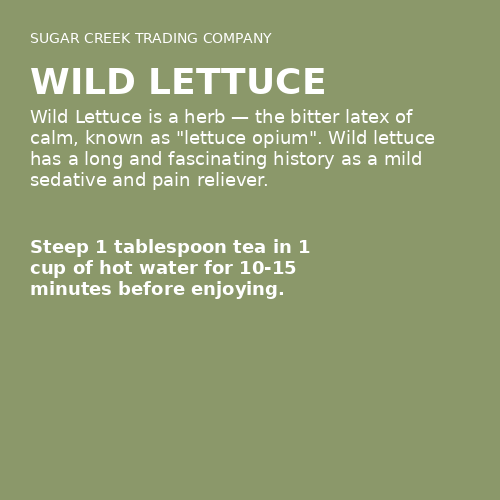
Wild Lettuce Herb — The Bitter Latex of Calm, Known as "Lettuce Opium"
Botanical Identification
- Common Names: Wild Lettuce, Bitter Lettuce, Prickly Lettuce, Lettuce Opium, Opium Lettuce, Lactucarium, Poor Man's Opium
- Latin Binomial: Lactuca virosa L. (also Lactuca serriola L., a closely related species often sold interchangeably)
- Family: Asteraceae (Compositae)
- Part Used: Aerial parts (leaves, stems); historically the dried latex (lactucarium) was most prized
- Origin: Southern and Central Europe, naturalized throughout North America
- Appearance: Dried green leaf and stem pieces, sometimes with visible milky latex residue
- Flavor: Intensely bitter, somewhat acrid
Cultural and Historical Use
Wild lettuce has a long and fascinating history as a mild sedative and pain reliever. Ancient Egyptian physicians referenced it in medical papyri, and the plant appears on carvings in the temple of the fertility god Min at Luxor, where it may have held symbolic associations with virility and altered states. Greek and Roman physicians including Dioscorides and Galen described the dried latex — called lactucarium — as a sleep aid and pain reliever for minor complaints.
The name "lettuce opium" arose in the 18th and 19th centuries when European physicians began formally investigating lactucarium as a gentle substitute for opium. Dr. J. R. Coxe published research in 1799 describing its sedative and analgesic properties. The substance was included in the U.S. Pharmacopeia from 1820 to 1926. Unlike opium, lactucarium was considered non-addictive, and it was widely prescribed for insomnia, restlessness, and cough — particularly in patients for whom opium was considered too strong or too risky.
Eclectic physicians in the United States valued wild lettuce highly. John King noted its particular usefulness for "nervous irritability and wakefulness" and for calming coughs of a spasmodic, nervous character. By the early 20th century, as pharmaceutical synthesis advanced, lactucarium fell out of favor in conventional practice but persisted in folk herbalism and has experienced a strong resurgence in contemporary herbal use.
Key Bioactive Compounds
| Compound | Class | Notes |
|---|---|---|
| Lactucin | Sesquiterpene lactone | Primary sedative and analgesic compound in the latex; demonstrated activity in animal models |
| Lactucopicrin (intybin) | Sesquiterpene lactone | Bitter principle; analgesic activity comparable to ibuprofen in some in vitro models |
| Lactucone | Triterpene | Contributes to overall sedative profile of lactucarium |
| Flavonoids (luteolin, quercetin) | Flavonoids | Anti-inflammatory and antioxidant; luteolin has documented anxiolytic properties |
| Coumarins (cichoriin, aesculin) | Coumarins | Antispasmodic; contribute to the relaxing quality of preparations |
| N-methyl-beta-phenethylamine | Trace amine | Trace quantities; may contribute to subtle mood effects |
How It Works in the Body
The sedative and analgesic properties of wild lettuce are attributed primarily to the sesquiterpene lactones lactucin and lactucopicrin, concentrated in the milky latex that exudes when stems are cut. Research published in the Journal of Ethnopharmacology (2006) demonstrated that these compounds produce measurable analgesic effects in animal models, with lactucopicrin showing activity comparable to ibuprofen in certain assays.
The mechanism of action remains under investigation. Unlike true opiates, lactucin and lactucopicrin do not appear to bind strongly to opioid receptors, despite the historical "lettuce opium" name. Current hypotheses suggest they may modulate GABAergic activity, reduce prostaglandin synthesis, and exert direct effects on the central nervous system through pathways distinct from opioid signaling. This likely explains why wild lettuce lacks the addictive potential and respiratory depression associated with opiates.
The flavonoid luteolin has demonstrated anxiolytic properties in multiple studies, acting through benzodiazepine binding sites on GABA-A receptors without the dependence profile of pharmaceutical benzodiazepines. Coumarins add antispasmodic effects, making the overall profile well-suited for nervous tension accompanied by muscle tightness or digestive spasm.
Dose Guidelines
| Preparation | Amount | Frequency / Notes |
|---|---|---|
| Dried herb infusion (tea) | 1-2 teaspoons per cup boiling water, steeped 10-15 minutes | 1-3 cups daily; flavor is very bitter — honey recommended |
| Tincture (1:5, 40-50% ethanol) | 2-4 mL (approx. 40-80 drops) | Up to 3 times daily; 30-60 minutes before bed for sleep support |
| Lactucarium extract (if available) | 0.3-1 gram of dried latex | Historical dosing from USP monographs; not commonly available in this form today |
| Smoke blend (traditional) | Small pinch of dried leaf | Some herbalists include wild lettuce in relaxing smoke blends; start very small |
Preparation and Uses
- Bitter Tea: Steep 1-2 teaspoons of dried wild lettuce herb in boiling water for 10-15 minutes. Cover the cup to retain volatile compounds. This tea is intensely bitter — combining with chamomile, lemon balm, or honey significantly improves palatability without reducing effectiveness.
- Sleep Blend: Wild lettuce combines well with valerian root, passionflower, hops, and California poppy for a synergistic sleep formula. Wild lettuce addresses the pain and tension component while the other herbs deepen relaxation.
- Pain Support Tea: For mild musculoskeletal discomfort or headache, combine wild lettuce with white willow bark and meadowsweet — this creates a gentle, multi-mechanism analgesic blend.
- Tincture: The tincture form is often preferred because it concentrates the active sesquiterpene lactones and avoids the extreme bitterness of the tea. Take in a small amount of water or juice.
- Topical Infused Oil: Some herbalists infuse wild lettuce into oil for external application on sore muscles and tension headaches, though this is a less common use.
Optimal Context for Use
- Insomnia and restlessness — especially when pain, tension, or a racing mind prevents sleep
- Mild to moderate pain: headaches, menstrual cramps, muscle aches, joint stiffness
- Nervous cough — the antispasmodic and gentle sedative action calms irritable airways
- Anxiety and nervous tension — as part of a calming formula
- For individuals seeking non-addictive alternatives to stronger sedatives and analgesics
Sustainability and Ethical Harvesting
Lactuca virosa and L. serriola are vigorous, weedy plants that grow abundantly in disturbed soils, roadsides, field edges, and waste places across Europe and North America. Neither species is threatened, and both can be cultivated easily from seed in gardens. Wild lettuce is sometimes considered a nuisance weed by farmers and land managers.
For wildcrafting, harvest the aerial parts when the plant is in flower and the latex flow is strongest — typically mid to late summer. Cutting the stem reveals the milky white sap that dries to a brownish resin (lactucarium). Ethical harvesting of this abundant plant poses minimal ecological concern, but as always, avoid harvesting from roadsides or areas treated with herbicides.
Safety and Cautions
- Allergies: Wild lettuce belongs to the Asteraceae (daisy) family. Individuals with known allergies to ragweed, chamomile, echinacea, or other composites should use caution.
- Sedation: Wild lettuce can cause drowsiness. Do not operate heavy machinery or drive after taking significant doses.
- Pregnancy and breastfeeding: Insufficient safety data. Avoid during pregnancy and nursing.
- Drug interactions: May potentiate the effects of sedative medications, anxiolytics, and sleep aids. Consult a healthcare provider if taking prescription sedatives.
- Not a true opiate: Despite the nickname "lettuce opium," wild lettuce does not contain opioid compounds and does not carry the same risk of addiction or respiratory depression. However, it should still be used responsibly and at recommended doses.
- Excessive doses may cause nausea, vomiting, dizziness, or anxiety. Start with the lower end of the dose range.
- Glaucoma: Some sources suggest wild lettuce may affect intraocular pressure. Those with glaucoma should consult their physician.
References
- Wesolowska, A., et al. "Analgesic and sedative activities of lactucin and some lactucin-like guaianolides in mice." Journal of Ethnopharmacology, 107(2), 2006.
- Besharat, S., et al. "Wild lettuce (Lactuca virosa) toxicity." BMJ Case Reports, 2009.
- King, J. The American Dispensatory, 8th edition. Wilstach, Baldwin & Co., 1870.
- Felter, H. W. and Lloyd, J. U. King's American Dispensatory, 18th edition. Ohio Valley Company, 1898.
- Coxe, J. R. "On the lactucarium, or concrete juice of the common lettuce." Transactions of the American Philosophical Society, 1799.
- Sessa, R. A., et al. "Metabolite profiling of sesquiterpene lactones from Lactuca species." Journal of Biological Chemistry, 275(35), 2000.
This product is sold as a dried herbal botanical. It is not intended to diagnose, treat, cure, or prevent any disease. Wild lettuce is not a narcotic and does not contain opioid compounds. Consult a qualified healthcare provider before use, especially if pregnant, nursing, or taking medications.
Condividere