Sugar Creek Trading Company
Boswellia Serrata Pieces, 65% Boswellic Acid
Boswellia Serrata Pieces, 65% Boswellic Acid
Couldn't load pickup availability
BOSWELLIA SERRATA — 65% BOSWELLIC ACID
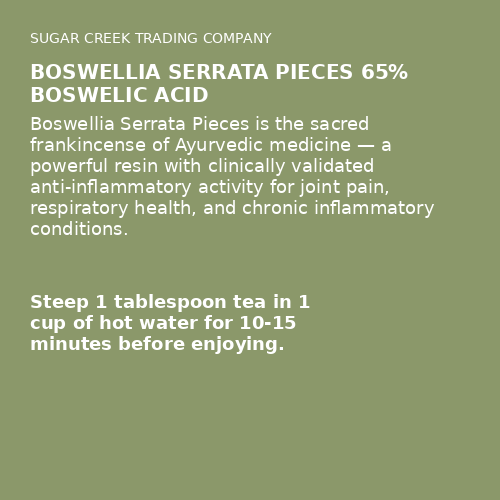
A high-potency, standardized frankincense extract delivering a concentrated 65% boswellic acid content for maximum anti-inflammatory support in joint, respiratory, and chronic inflammatory conditions.
BOTANICAL IDENTIFICATION
Scientific Name: Boswellia serrata Roxb. ex Colebr.
Common Names: Indian Frankincense, Salai Guggul, Shallaki, Indian Olibanum, Boswellia
Family: Burseraceae (Torchwood/Incense Tree family)
Standardization: 65% total boswellic acids — an enriched extract delivering significantly higher concentrations of the active anti-inflammatory compounds compared to raw, unstandardized resin (which typically contains 25-35% boswellic acids)
Boswellia serrata is a medium to large deciduous tree growing 12 to 18 meters tall with spreading crown and papery, peeling bark that flakes off in thin, ash-colored sheets. The compound, pinnate leaves bear 17 to 31 serrated leaflets. Small, white to pale green flowers appear in axillary racemes, followed by three-valved fruit capsules. The oleo-gum resin is harvested by making shallow incisions in the trunk bark, from which it exudes as a milky-white, viscous fluid that hardens into translucent, amber-to-golden pieces. This product is derived from that resin, then processed and concentrated to achieve a standardized 65% boswellic acid content.
Native to the dry, hilly regions of central and western India — Rajasthan, Madhya Pradesh, Gujarat, Jharkhand, and Chhattisgarh — Boswellia serrata thrives in arid to semi-arid climates on rocky, nutrient-poor slopes. It is remarkably drought-tolerant and fire-resistant, a keystone species in India's dry deciduous forest ecosystems.
CULTURAL AND HISTORICAL USE
Boswellia serrata has been a pillar of Ayurvedic medicine for thousands of years. The classical texts, including the Charaka Samhita and Sushruta Samhita (circa 600 BCE), document its resin under the name Shallaki, prescribing it for arthritis, diarrhea, pulmonary diseases, ringworm, and inflammatory conditions. In Ayurvedic philosophy, it pacifies Vata and Kapha doshas, reduces Ama (metabolic toxins), and is classified as an analgesic (Vedana-sthapana), anti-inflammatory (Shotha-hara), and rejuvenative (Rasayana). Joint diseases — Sandhivata (osteoarthritis) and Amavata (rheumatoid arthritis) — have been its primary indications for millennia.
The frankincense trade routes connecting India, Arabia, and East Africa to the Mediterranean were among history's most consequential commercial networks, with Boswellia resins among their most precious commodities. While Biblical frankincense is typically associated with Boswellia sacra from the Arabian Peninsula, Indian frankincense has served parallel sacred and medicinal roles on the subcontinent for an equally long history. The burning of Boswellia resin in Hindu temple ceremony for purification and spiritual elevation continues to the present day.
The modern chapter of Boswellia's story began in the 1980s when German and Indian pharmacologists isolated and characterized the boswellic acids, particularly AKBA (3-O-Acetyl-11-keto-beta-boswellic acid), and identified them as potent, specific inhibitors of the 5-lipoxygenase enzyme. This discovery launched decades of clinical research that has positioned standardized Boswellia extracts among the most evidence-backed botanical anti-inflammatories available. The development of standardized extracts like this 65% boswellic acid product represents the culmination of that research, delivering therapeutic concentrations in practical, consistent doses.
KEY BIOACTIVE COMPOUNDS & BENEFITS
| Compound/Class | Concentration in This Product | Human Benefit | Mechanism |
|---|---|---|---|
| Total boswellic acids (beta-boswellic acid, acetyl-beta-boswellic acid, KBA, AKBA, and others) | 65% (standardized) | Potent 5-LOX inhibition; broad-spectrum anti-inflammatory, anti-arthritic, and anti-tumor activity | Direct binding to and inhibition of 5-lipoxygenase enzyme active site |
| AKBA (3-O-Acetyl-11-keto-beta-boswellic acid) | Enriched fraction within the 65% total | The most potent and selective 5-LOX inhibitor among the boswellic acids; also modulates NF-kB | Direct, non-redox, non-competitive enzyme inhibition at the 5-LOX catalytic site |
| KBA (11-Keto-beta-boswellic acid) | Enriched fraction within the 65% total | Complementary 5-LOX inhibition; anti-proliferative activity in research models | Structural analog of AKBA with additional anti-inflammatory pathways |
| Tirucallic acids | Present in extract matrix | NF-kB pathway modulation; complementary anti-inflammatory support | Triterpene compounds contributing to resin's broad anti-inflammatory profile |
| Residual essential oils (incensole, incensole acetate) | Variable (reduced compared to raw resin) | Anxiolytic and neuroprotective effects; respiratory support | Volatile terpenes with demonstrated TRPV3 receptor activation |
At 65% total boswellic acids, this extract delivers approximately twice the active compound concentration of raw, unstandardized Boswellia resin. This means that gram-for-gram, it provides substantially more of the clinically studied anti-inflammatory compounds, allowing for more precise and potent dosing. The standardization also ensures batch-to-batch consistency, so each dose delivers a predictable level of therapeutic activity — an important advantage for those using Boswellia as part of a structured health protocol.
HOW IT WORKS IN THE BODY
This standardized Boswellia extract exerts its therapeutic effects through concentrated anti-inflammatory and tissue-protective mechanisms, with particular clinical relevance for joint, respiratory, gastrointestinal, and neurological conditions.
5-Lipoxygenase (5-LOX) Inhibition — The Primary Mechanism:
The boswellic acids, especially AKBA and KBA, are direct, specific, non-redox inhibitors of 5-lipoxygenase, the enzyme that converts arachidonic acid into leukotrienes. Leukotrienes are among the most powerful inflammatory mediators in the body, driving joint inflammation, bronchoconstriction, increased vascular permeability, and immune cell migration to inflamed tissues. By blocking 5-LOX at its catalytic site, Boswellia suppresses leukotriene synthesis at its origin. This mechanism is fundamentally different from NSAIDs (which target COX enzymes), making Boswellia a complementary rather than redundant approach to managing chronic inflammation. At 65% boswellic acid concentration, this extract delivers this mechanism with significantly greater potency per dose than raw resin.
NF-kB and Cytokine Modulation:
AKBA and tirucallic acids inhibit nuclear factor kappa-B (NF-kB), the master transcription factor governing hundreds of pro-inflammatory genes. This reduces production of TNF-alpha, IL-1beta, IL-6, and other inflammatory cytokines. This broad-spectrum downstream effect amplifies the anti-inflammatory impact beyond 5-LOX inhibition alone, providing systemic anti-inflammatory support across multiple tissue types.
Cartilage and Joint Tissue Protection:
Clinical research has demonstrated that standardized Boswellia extracts not only reduce joint pain and swelling but actively inhibit the enzymatic degradation of cartilage. Boswellic acids suppress matrix metalloproteinases (MMP-3, MMP-9, MMP-13) and the glycosaminoglycan-degrading enzymes responsible for cartilage breakdown in osteoarthritis. Multiple randomized controlled trials have shown significant improvements in knee pain scores, joint function, and walking distance in osteoarthritis patients taking standardized Boswellia extracts over 4 to 12 weeks.
Respiratory Anti-Inflammatory Activity:
By reducing leukotriene-mediated bronchoconstriction and airway inflammation, Boswellia has demonstrated clinical benefit in bronchial asthma. A landmark double-blind study showed that 70% of asthma patients taking Boswellia extract experienced improvement in symptoms, including reduced frequency of attacks and improved FEV1 lung function parameters.
DOSE GUIDELINES
| Preparation Type | Typical Dose | Purpose |
|---|---|---|
| Standardized extract pieces (oral) | 300-500 mg, 2-3 times daily (providing approximately 200-325 mg boswellic acids per dose) | Clinically studied dose range for osteoarthritis, inflammatory joint conditions, and asthma |
| Powdered and encapsulated | 300-500 mg capsules, 2-3 times daily with meals | Most common delivery method for standardized extracts; convenient, precise dosing |
| Dissolved in warm water or milk | 300-500 mg stirred into warm liquid, 2-3 times daily | Traditional Ayurvedic-style administration; fat in milk may enhance boswellic acid absorption |
Clinical trials demonstrating efficacy for osteoarthritis and asthma typically used total daily doses of 900-1,200 mg of standardized extract (providing approximately 600-800 mg of total boswellic acids) over treatment periods of 4 to 12 weeks. Benefits are cumulative and typically become apparent within 1 to 2 weeks, with maximum effect at 4 to 8 weeks of consistent use. Taking Boswellia with fat-containing foods significantly enhances the absorption of its lipophilic boswellic acids — a key practical consideration for optimal results.
PREPARATION AND USES
This 65% boswellic acid standardized extract comes in piece form and can be used in several ways. The most straightforward method is to grind the pieces into powder using a spice grinder, mortar and pestle, or coffee grinder (chilling the pieces first can make grinding easier) and then encapsulate the powder for consistent daily dosing. Standard "00" capsules hold approximately 500 mg of powder, making it easy to achieve clinically studied dose ranges.
The ground extract can also be stirred into warm milk or water with a small amount of ghee, coconut oil, or other healthy fat to enhance absorption of the lipophilic boswellic acids. This approach mirrors traditional Ayurvedic administration methods. For those who do not mind the taste — which is mildly bitter and balsamic — small pieces can be chewed directly, though the concentrated extract is more intensely flavored than raw resin. Unlike unstandardized resin pieces, this product is intended primarily for internal therapeutic use rather than as incense, as the extraction process alters its burning characteristics.
OPTIMAL CONTEXT FOR USE
Boswellia Serrata 65% Boswellic Acid extract is especially well-suited for individuals experiencing:
Osteoarthritis or rheumatoid arthritis with joint pain, stiffness, and functional limitation, particularly those seeking a clinically studied botanical alternative or complement to long-term NSAID use
Chronic inflammatory conditions including inflammatory bowel disease (Crohn's, ulcerative colitis), where leukotriene-mediated inflammation plays a key pathological role
Bronchial asthma or chronic respiratory inflammation, where leukotriene inhibition can reduce airway constriction and frequency of attacks
Need for a higher-potency, standardized form of Boswellia that delivers consistent, clinically relevant doses of boswellic acids without requiring the larger volumes of raw resin
Individuals already using raw Boswellia resin who want to step up to a more concentrated form for greater therapeutic intensity
This extract combines powerfully with Turmeric/Curcumin for synergistic multi-pathway anti-inflammatory support (5-LOX + COX + NF-kB inhibition), with Ashwagandha for inflammatory conditions with an autoimmune or stress component, and with Glucosamine or Collagen for comprehensive joint-rebuilding protocols. It is also an excellent addition to any anti-inflammatory dietary protocol.
SUSTAINABILITY AND ETHICAL HARVESTING
Boswellia serrata faces serious conservation challenges that make responsible sourcing a genuine ethical priority. The species is classified as threatened in multiple assessment frameworks, primarily due to overharvesting, habitat degradation, poor natural regeneration, and the impacts of fire and grazing on India's dry deciduous forests. Research published in Nature Sustainability has projected that Boswellia populations could decline by 50% or more within two decades without sustained intervention, as many populations show critically low seedling survival and recruitment rates.
Sustainable tapping practices — limiting the number and depth of bark incisions per tree, allowing multi-year rest periods between harvests, and protecting young trees from tapping — are essential for maintaining tree health and long-term resin production. Community-based forest management programs in Madhya Pradesh and Rajasthan are working to establish such protocols while improving the livelihoods of traditional resin tappers. The increased demand for standardized extracts places additional pressure on supply chains, making transparency and traceability all the more important. Sugar Creek Trading Company is committed to sourcing Boswellia through supply chains that prioritize tree health, sustainable harvest volumes, and fair treatment of harvesting communities.
SAFETY AND CAUTIONS
Standardized Boswellia serrata extracts have demonstrated a strong safety profile in multiple clinical trials, with adverse events generally comparable to placebo. However, the higher concentration of active compounds in this product warrants appropriate awareness:
Mild gastrointestinal effects (nausea, acid reflux, diarrhea, abdominal discomfort) may occur, particularly at higher doses or on an empty stomach. Taking with food generally prevents these effects.
Boswellia may have mild anticoagulant and antiplatelet properties. Individuals taking blood-thinning medications (warfarin, heparin, aspirin, clopidogrel) should consult a healthcare provider before use, and discontinue at least 2 weeks before scheduled surgery.
May interact with anti-inflammatory medications (NSAIDs, corticosteroids) through additive effects. While this can be therapeutically useful under practitioner supervision, concurrent use should be monitored to avoid excessive anti-inflammatory suppression.
Pregnant and nursing individuals should consult a qualified healthcare provider before use. Boswellia has traditionally been considered a mild emmenagogue, and standardized extracts deliver higher concentrations of active compounds than traditional preparations.
Individuals with compromised liver or kidney function should start with lower doses and monitor for tolerance, as the concentrated extract undergoes hepatic metabolism.
REFERENCES
Ammon, H.P.T. "Boswellic Acids and Their Role in Chronic Inflammatory Diseases." Advances in Experimental Medicine and Biology, 2016; 928: 291-327.
Sengupta, K., Alluri, K.V., Satish, A.R., et al. "A Double Blind, Randomized, Placebo Controlled Study of the Efficacy and Safety of 5-Loxin for Treatment of Osteoarthritis of the Knee." Arthritis Research & Therapy, 2008; 10(4): R85.
Gupta, I., Gupta, V., Parihar, A., et al. "Effects of Boswellia Serrata Gum Resin in Patients with Bronchial Asthma." European Journal of Medical Research, 1998; 3(11): 511-514.
Bongers, F., Groenendijk, P., Bekele, T., et al. "Frankincense in Peril." Nature Sustainability, 2019; 2: 602-610.
Yu, G., Xiang, W., Zhang, T., et al. "Effectiveness of Boswellia and Boswellia Extract for Osteoarthritis Patients: A Systematic Review and Meta-Analysis." BMC Complementary Medicine and Therapies, 2020; 20: 225.
FINAL NOTE
This 65% boswellic acid standardized extract represents the intersection of Ayurveda's ancient clinical wisdom and modern phytochemical precision. Where raw Boswellia resin delivers a broad, traditional experience, this concentrated form provides the therapeutic potency that clinical trials have validated for osteoarthritis, asthma, and chronic inflammatory conditions. For those managing persistent inflammation who want a botanical intervention backed by robust clinical evidence and delivered at clinically meaningful doses, this is Boswellia at its most purposeful and potent.
Share