Sugar Creek Trading Company
Grape Skin
Grape Skin
Couldn't load pickup availability
VITIS VINIFERA
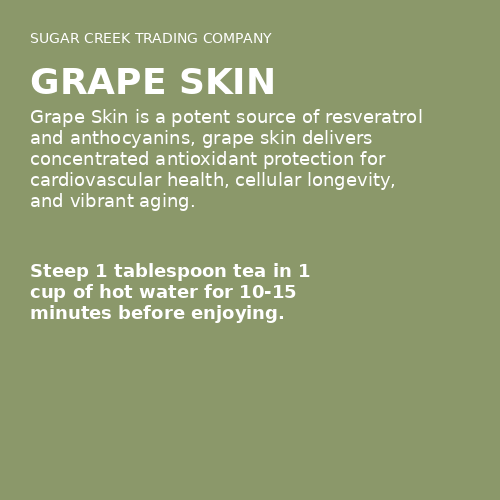
A potent source of resveratrol and anthocyanins, grape skin delivers concentrated antioxidant protection for cardiovascular health, cellular longevity, and vibrant aging.
BOTANICAL IDENTIFICATION
Scientific Name: Vitis vinifera L.
Common Names: Grape Skin, Red Grape Skin, Wine Grape, European Grape, Common Grape Vine
Family: Vitaceae
Vitis vinifera is a vigorous, woody, deciduous climbing vine that can reach lengths of 15 to 30 meters when supported. It produces broad, palmately lobed leaves with toothed margins and inconspicuous greenish flower clusters that develop into the familiar globular berries ranging from deep purple to red, green, or black. The skin of the grape berry is a thin but remarkably dense layer of pigmented tissue that concentrates the plant's most powerful protective compounds.
Native to the Mediterranean basin, Central Europe, and southwestern Asia, the grapevine thrives in temperate climates with warm, dry summers and mild winters. It is now cultivated on every continent except Antarctica, with major growing regions across Europe, the Americas, Australia, and South Africa.
CULTURAL AND HISTORICAL USE
The grape is one of humanity's oldest cultivated plants, with archaeological evidence of wine production dating back to 6000 BCE in the Caucasus region of modern-day Georgia. Ancient Egyptian, Greek, and Roman civilizations revered the grape not only as a source of wine but as a medicinal plant. Hippocrates recommended grape preparations for fever, digestive complaints, and wound healing. In Unani and Greco-Arabic medicine, grape skins and seeds were valued for their astringent and tonic properties.
European folk medicine traditions long recognized that the darkest-skinned grapes carried the strongest medicinal properties. Grape skins were applied as poultices for skin inflammation and consumed in various preparations to strengthen the blood and support the heart. The "French Paradox," observed in the 1990s, brought worldwide scientific attention to the protective compounds concentrated in red grape skins, particularly their role in cardiovascular health despite high dietary fat intake in French populations.
In Ayurvedic tradition, grapes (Draksha) are considered a rasayana, or rejuvenative tonic, prized for balancing Pitta and Vata doshas. Traditional Chinese Medicine classifies grapes as sweet and neutral, used to nourish Qi, tonify the blood, strengthen sinews and bones, and promote urination. Across cultures, the grape skin has emerged as a concentrated delivery system for the vine's most therapeutically significant chemistry.
KEY BIOACTIVE COMPOUNDS & BENEFITS
| Compound/Class | Location in Plant | Human Benefit | Role in Plant |
|---|---|---|---|
| Resveratrol (stilbene) | Skin (concentrated in outer epidermal cells) | Activates SIRT1 longevity pathways; cardioprotective; anti-inflammatory; neuroprotective | Phytoalexin produced in response to fungal infection, UV radiation, and stress |
| Anthocyanins (malvidin, delphinidin, peonidin) | Skin pigment layer | Powerful antioxidants; support vascular integrity; reduce oxidative stress; anti-inflammatory | UV-protective pigments that attract seed-dispersing animals |
| Proanthocyanidins (OPCs) | Skin and seed interface | Strengthen capillaries and connective tissue; potent free radical scavengers 20-50x stronger than vitamins C and E | Structural defense compounds; deterrents against herbivory |
| Quercetin and other flavonols | Skin | Anti-allergic; anti-inflammatory; supports healthy histamine response; synergizes with resveratrol | UV-absorbing screen; antioxidant defense in sun-exposed tissue |
| Ellagic acid and phenolic acids | Skin | Supports detoxification pathways; antimutagenic; protects DNA from oxidative damage | Antimicrobial defense; structural component of cell walls |
Together, these compounds create a remarkably synergistic antioxidant matrix. The anthocyanins and OPCs provide immediate free radical scavenging, while resveratrol activates deeper cellular defense mechanisms including sirtuin-mediated DNA repair and mitochondrial biogenesis. This multi-layered protection explains why whole grape skin preparations often outperform isolated compounds in research settings.
HOW IT WORKS IN THE BODY
Grape skin acts through multiple, overlapping mechanisms that support cardiovascular function, reduce oxidative stress, and promote healthy cellular aging.
Cardiovascular Protection:
Resveratrol and anthocyanins promote nitric oxide production in the vascular endothelium, encouraging blood vessel relaxation and healthy blood pressure. OPCs strengthen capillary walls and reduce LDL oxidation, a key driver of atherosclerosis. These compounds also modulate platelet aggregation, supporting healthy blood flow without excessive clotting.
Cellular Longevity and Sirtuin Activation:
Resveratrol activates SIRT1, a key enzyme in the sirtuin family that regulates cellular stress responses, DNA repair, mitochondrial function, and metabolic efficiency. This mechanism mimics some of the beneficial effects of caloric restriction, one of the most well-documented interventions for extending cellular lifespan.
Anti-Inflammatory and Immune Modulation:
Grape skin polyphenols inhibit NF-kB, a master inflammatory signaling pathway, and reduce the production of pro-inflammatory cytokines including TNF-alpha and IL-6. Quercetin stabilizes mast cells, helping to moderate histamine release and allergic responses.
Neuroprotection:
Resveratrol crosses the blood-brain barrier, where it may protect neurons from oxidative damage and support cognitive function. Anthocyanins also demonstrate neuroprotective properties by reducing neuroinflammation and supporting cerebral blood flow.
DOSE GUIDELINES
| Preparation Type | Typical Dose | Purpose |
|---|---|---|
| Grape skin powder | 1-3 grams daily | General antioxidant support and cardiovascular wellness |
| Capsules (powder-filled) | 500-1,000 mg, 1-3 times daily | Convenient daily supplementation |
| Decoction (simmered tea) | 1-2 teaspoons per cup, simmered 10-15 minutes | Gentle daily tonic; mild cardiovascular and digestive support |
| Smoothie or food addition | 1-2 tablespoons blended into beverages or foods | Whole-food antioxidant enrichment |
Grape skin is best used as a long-term daily tonic rather than an acute remedy. Benefits accumulate over weeks and months of consistent use. It pairs exceptionally well with other polyphenol-rich herbs for synergistic antioxidant coverage.
PREPARATION AND USES
Grape skin powder integrates easily into daily routines. It can be stirred into water, juice, or smoothies, or encapsulated for convenient dosing. For a simple antioxidant tea, simmer 1-2 teaspoons of grape skin in water for 10-15 minutes, strain, and drink warm or cool. The mildly astringent, slightly fruity flavor blends well with hibiscus, rosehip, or green tea for an enhanced polyphenol beverage.
Grape skin powder also works beautifully in culinary applications: add it to oatmeal, yogurt, energy balls, or baked goods for a nutritional boost. For topical use, grape skin can be mixed into face masks or poultices to deliver antioxidant protection directly to the skin. Some practitioners combine grape skin with turmeric or green tea extract for comprehensive anti-inflammatory protocols.
OPTIMAL CONTEXT FOR USE
Grape skin is especially well-suited for individuals experiencing:
Cardiovascular concerns including high blood pressure, elevated cholesterol, or a family history of heart disease
Premature aging, oxidative stress, or high exposure to environmental toxins and pollutants
Chronic low-grade inflammation or inflammatory conditions affecting joints, skin, or blood vessels
Cognitive decline concerns or desire to support long-term brain health and mental clarity
Poor circulation, capillary fragility, easy bruising, or varicose veins
Grape skin combines well with hawthorn berry for heart health, with turmeric for inflammation, and with ginkgo for cognitive support. It is an excellent foundational antioxidant for any wellness protocol.
SUSTAINABILITY AND ETHICAL HARVESTING
Grape skin is one of the most sustainable botanical products available. It is a byproduct of the wine and juice industry, where grape skins (pomace) are generated in enormous quantities during pressing. Repurposing this material into a health supplement gives new value to what would otherwise be agricultural waste, making it an ecologically sound choice.
Vitis vinifera is widely cultivated worldwide and faces no conservation concerns. Choosing grape skin powder supports circular agricultural practices and reduces waste in the wine production chain. No wild harvesting pressure exists for this product.
SAFETY AND CAUTIONS
Grape skin is generally recognized as safe and is widely consumed as both food and supplement with an excellent safety profile.
Individuals with grape or sulfite allergies should exercise caution, though allergic reactions to grape skin powder are rare.
Resveratrol and grape polyphenols may have mild blood-thinning effects. Those on anticoagulant medications (warfarin, heparin, aspirin) should consult a healthcare provider before using concentrated grape skin supplements.
Pregnant and nursing women should consult a healthcare provider before supplementing, though moderate dietary intake of grape products is considered safe.
Grape skin polyphenols may interact with medications metabolized by cytochrome P450 enzymes (CYP3A4). Those taking prescription medications should discuss supplementation with their healthcare provider.
REFERENCES
Baur, J.A. & Sinclair, D.A. (2006). "Therapeutic potential of resveratrol: the in vivo evidence." Nature Reviews Drug Discovery, 5(6), 493-506.
Xia, E.Q., Deng, G.F., Guo, Y.J., & Li, H.B. (2010). "Biological activities of polyphenols from grapes." International Journal of Molecular Sciences, 11(2), 622-646.
Nassiri-Asl, M. & Hosseinzadeh, H. (2016). "Review of the pharmacological effects of Vitis vinifera (Grape) and its bioactive constituents: an update." Phytotherapy Research, 30(9), 1392-1403.
FINAL NOTE
Grape skin represents thousands of years of viticultural wisdom distilled into a single, potent botanical. Every pigmented cell in that thin outer layer is a testament to the vine's remarkable ability to concentrate protective chemistry against sun, stress, and pathogen. When we consume grape skin, we inherit that same resilience, channeling it toward our own cardiovascular health, cellular vitality, and graceful aging. Few botanicals offer such a well-documented, deeply synergistic, and broadly accessible path to daily antioxidant protection.
Share