Sugar Creek Trading Company
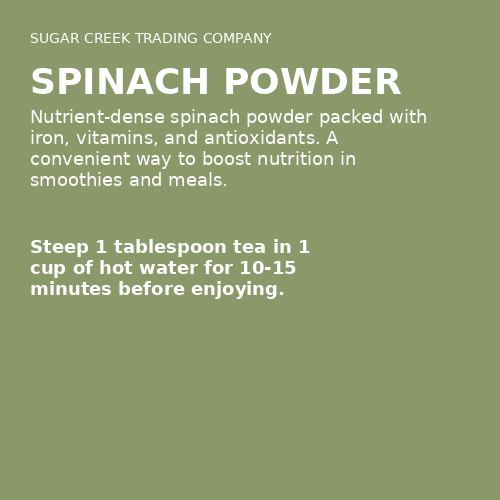
Spinach Powder
Spinach Powder
Couldn't load pickup availability
SPINACIA OLERACEA (LEAF)
(Spinach)
Family: Amaranthaceae
Part Used: Leaf (primary); young stems secondary
Energetics: Cooling, moistening, gently building
Taste: Mildly sweet, green, slightly mineral
BOTANICAL IDENTIFICATION
Scientific Name: Spinacia oleracea L.
Common Names: Spinach
Family: Amaranthaceae
Morphology:
Spinacia oleracea is a fast-growing annual leafy green, forming a basal rosette of smooth to slightly crinkled leaves that may be oval, triangular, or arrow-shaped depending on cultivar. Leaves are tender and succulent when young, becoming thicker with age. Flowering occurs as day length increases, producing small, greenish flowers on upright stalks (bolting).
Root system:
A shallow taproot with fibrous laterals, adapted for rapid nutrient uptake in cool soils.
HABITAT, RANGE, AND ADAPTATIONS
Spinach is native to ancient Persia (modern Iran) and spread through the Middle East into Europe and Asia, eventually becoming a global staple.
It thrives in cool, temperate climates, tolerating light frost and favoring nitrogen-rich soils. Adaptations include:
-
Rapid leaf expansion for early-season photosynthesis
-
High accumulation of nitrates and minerals to fuel growth
-
Production of oxalates to regulate calcium and deter herbivory
CULTIVATION AND ECOLOGY
Spinach is widely cultivated and among the most nutrient-dense leafy vegetables per calorie. It grows quickly, making it suitable for succession planting and regenerative systems.
Ecologically, spinach fits well into crop rotations, ground cover strategies, and cool-season polycultures.
TRADITIONAL AND ETHNOBOTANICAL USE
Historically, spinach was valued as a cooling, blood-building green. In Persian and Arabic medicine, it was used to relieve constipation, heat, and inflammation. Medieval European herbalism classified spinach as moistening and restorative, especially after illness.
In traditional diets, spinach served as a spring tonic, replenishing minerals and vitality after winter scarcity.
Modern nutritional science confirms spinach’s role as a foundational metabolic and micronutrient food rather than an acute medicinal herb.
KEY BIOACTIVE COMPOUNDS & BENEFITS
| Compound/Class | Location in Plant | Human Benefit | Role in Plant |
|---|---|---|---|
| Nitrates | Leaves | Improved blood flow, insulin sensitivity | Rapid growth signaling |
| Flavonoids | Leaves | Anti-inflammatory, antioxidant | UV protection |
| Carotenoids | Leaves | Vision, cellular antioxidant support | Photoprotection |
| Folate (B9) | Leaves | Methylation, cardiovascular & metabolic health | Cellular division |
| Minerals | Leaves | Magnesium, iron (non-heme), potassium | Enzymatic function |
| Thylakoids | Chloroplast membranes | Appetite and glycemic regulation | Photosynthesis |
Spinach thylakoids are increasingly recognized for post-prandial glucose control and satiety signaling.
HOW IT WORKS IN THE BODY
Metabolic & Glycemic Support:
Spinach supports glucose regulation indirectly through fiber, thylakoids, nitrates, and magnesium, which together improve insulin sensitivity, slow carbohydrate absorption, and reduce post-meal glucose spikes.
Circulatory & Endothelial Function:
Dietary nitrates increase nitric oxide bioavailability, improving blood flow and supporting glucose uptake in muscle tissue.
Anti-inflammatory & Antioxidant Effects:
Flavonoids and carotenoids reduce oxidative stress that interferes with insulin signaling and vascular health.
Digestive & Elimination Support:
Fiber and moisture content promote bowel regularity and gentle detoxification.
ACTIONS AND INDICATIONS
Spinacia oleracea functions as a:
-
Nutritive tonic
-
Mild anti-inflammatory food
-
Insulin-sensitizing dietary ally
-
Circulatory and endothelial support green
-
Cooling and moistening vegetable
Indicated for:
-
Metabolic syndrome and insulin resistance (dietary support)
-
Hypertension and vascular stress
-
Micronutrient deficiency
-
Constipation with heat or dryness
-
Recovery after illness
PREPARATIONS AND DOSAGE
| Form | Preparation | Suggested Use | Notes |
|---|---|---|---|
| Fresh raw | Salads, smoothies | Daily | Best for folate & enzymes |
| Lightly cooked | Steamed/sautéed | Regular | Reduces oxalates |
| Juice | Fresh-pressed | Short-term | Concentrated nitrates |
| Powder | Dried leaf | 1–3 g daily | Supplemental use |
Cooking reduces oxalate load and improves mineral bioavailability.
SAFETY, CONTRAINDICATIONS, AND TOXICITY
Spinach is extremely safe as a food.
Cautions:
-
High oxalate content may aggravate kidney stone risk in susceptible individuals
-
Very high nitrate intake from juice may not be appropriate for infants
-
Iron is non-heme; absorption improves with vitamin C
General Toxicological Reference (LD₅₀)
-
Whole Spinacia oleracea leaf (oral):
No toxic dose identified; whole-food consumption considered non-toxic -
Oxalic acid (isolated):
Oral LD₅₀ in rats approximately 375 mg/kg (not reflective of whole-leaf use)
Clinical relevance:
Safety is governed by digestive tolerance and mineral balance, not toxicity.
HARVEST AND STORAGE
Harvest young leaves for best flavor and nutrient density. Store refrigerated and consume promptly; nutrient content declines with prolonged storage.
SUSTAINABILITY AND ETHICS
Spinach is widely cultivated and environmentally low-impact. Sustainable practices include organic production, soil remineralization, and minimizing nitrogen runoff.
SUMMARY
Spinach is quiet metabolic medicine—cooling inflammation, restoring minerals, improving blood flow, and supporting glycemic balance through nourishment rather than force.
Spinacia oleracea reminds us that metabolic health is often built not with exotic interventions, but with consistent, mineral-rich greens that feed the body’s regulatory systems day after day.
Share