Sugar Creek Trading Company
Aloe Ferox
Aloe Ferox
Couldn't load pickup availability
ALOE FEROX
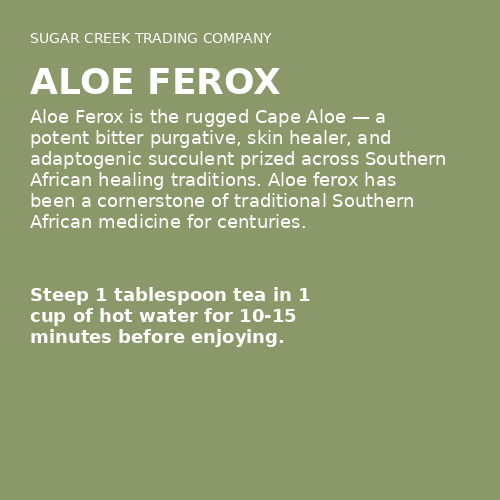
The rugged Cape Aloe — a potent bitter purgative, skin healer, and adaptogenic succulent prized across Southern African healing traditions.
BOTANICAL IDENTIFICATION
Scientific Name: Aloe ferox Mill.
Common Names: Cape Aloe, Bitter Aloe, Red Aloe, Tap Aloe
Family: Asphodelaceae (formerly Liliaceae)
Aloe ferox is a robust, single-stemmed succulent that can reach heights of 2 to 3 meters (6 to 10 feet). Its thick, fleshy leaves are arranged in a dense rosette and are armed with reddish-brown spines along the margins and sometimes on both surfaces. During winter and early spring, the plant produces striking candelabra-like racemes of bright orange-red to yellow tubular flowers that attract sunbirds and other pollinators.
Native to the rocky slopes, fynbos, and semi-arid regions of South Africa, Lesotho, and Swaziland, Aloe ferox thrives in well-drained soils and full sun. It is considerably hardier and larger than its cousin Aloe vera, tolerating frost, drought, and poor soils with remarkable resilience.
CULTURAL AND HISTORICAL USE
Aloe ferox has been a cornerstone of traditional Southern African medicine for centuries. The Khoisan and Zulu peoples used the bitter yellow latex — called "Cape aloes" in trade — as a powerful laxative and deworming agent. The leaf gel was applied topically to burns, wounds, and skin irritations. Dutch settlers at the Cape Colony began exporting dried Aloe ferox latex to Europe in the 1700s, and by the 19th century "Cape aloes" was an official drug in the British Pharmacopoeia, prescribed primarily as a stimulant laxative.
In the Western herbal tradition, Cape Aloe bitter latex has long been classified as a strong purgative and cholagogue (bile stimulant). It was a standard ingredient in "bitter" formulas designed to stimulate sluggish digestion and promote liver function. European apothecaries valued it as a reliable cathartic when gentler remedies failed.
Today, Aloe ferox is sustainably wild-harvested in the Eastern Cape and Western Cape provinces of South Africa, supporting rural livelihoods. The South African government regulates its harvest to ensure ecological sustainability. Its gel is increasingly recognized in the cosmetics industry as a richer, more mineral-dense alternative to Aloe vera gel, containing higher concentrations of amino acids and polysaccharides.
KEY BIOACTIVE COMPOUNDS & BENEFITS
| Compound/Class | Location in Plant | Human Benefit | Role in Plant |
|---|---|---|---|
| Aloin A & B (barbaloin) | Yellow latex (between rind and gel) | Stimulant laxative; promotes bowel motility | Bitter deterrent against herbivory |
| Acemannan (polysaccharide) | Inner leaf gel | Immune modulation; wound healing; prebiotic activity | Water retention and structural support |
| Aloesin (chromone) | Leaf exudate and gel | Tyrosinase inhibition (skin lightening); anti-inflammatory | UV protection and antioxidant defense |
| Phenolic compounds (aloe-emodin, chrysophanol) | Latex and leaf rind | Antimicrobial; antioxidant; hepatoprotective | Pathogen defense |
| Minerals (Ca, Mg, K, Fe, Zn) | Throughout leaf gel | Nutritive support; enzymatic cofactors | Essential metabolic functions |
Aloe ferox contains a notably higher concentration of aloin and total phenolics compared to Aloe vera, making its latex more potent as a bitter and purgative. The gel, meanwhile, delivers a broad-spectrum matrix of polysaccharides, amino acids, and minerals that support tissue repair and immune function. This dual nature — bitter latex and soothing gel — defines Cape Aloe's versatile therapeutic profile.
HOW IT WORKS IN THE BODY
Aloe ferox exerts its effects through two distinct tissue fractions: the bitter latex and the inner mucilaginous gel, each operating through different physiological pathways.
Digestive Stimulation and Laxative Action:
The anthraquinone glycosides (primarily aloin) in the latex are converted by colonic bacteria into aloe-emodin and other aglycones. These compounds stimulate peristalsis by irritating the colonic mucosa and inhibiting water and electrolyte reabsorption, producing a bowel movement typically within 6 to 12 hours of ingestion. This mechanism classifies Aloe ferox latex as a stimulant laxative.
Wound Healing and Skin Repair:
The acemannan polysaccharides in the gel activate macrophages and stimulate fibroblast proliferation, accelerating the production of collagen and granulation tissue. Topically, the gel forms a protective, moisture-retaining barrier over wounds while delivering anti-inflammatory and antimicrobial compounds directly to damaged tissue.
Immune Modulation:
Acemannan has been shown to enhance phagocytic activity and stimulate cytokine release, supporting innate immune responses. The polysaccharides also serve as prebiotics, nourishing beneficial gut bacteria and contributing to mucosal immune health in the gastrointestinal tract.
Hepatobiliary Support:
The bitter compounds in Aloe ferox stimulate bile secretion (cholagogue action), supporting fat digestion and liver detoxification pathways. The anthraquinones and phenolics also exhibit hepatoprotective effects in laboratory models, helping to mitigate oxidative stress in liver tissue.
DOSE GUIDELINES
| Preparation Type | Typical Dose | Purpose |
|---|---|---|
| Dried latex powder (bitter) | 50–200 mg before bed | Stimulant laxative; constipation relief |
| Whole leaf powder (gel + latex) | 250–500 mg, 1–2x daily | Digestive bitters; general tonic |
| Gel powder (latex-free) | 500 mg–1 g daily | Immune support; skin health from within |
| Topical gel (fresh or reconstituted) | Apply liberally as needed | Burns, cuts, skin irritation, moisturizing |
When used as a laxative, Aloe ferox latex should be employed only for short-term relief of occasional constipation (no longer than 7 to 10 consecutive days). Always start with the lowest effective dose. The gel fraction, by contrast, is suitable for daily long-term use as a nutritive tonic.
PREPARATION AND USES
Aloe ferox powder can be stirred into water, juice, or smoothies. For laxative use, the bitter latex powder is typically taken in capsules (to bypass the intensely bitter taste) with a full glass of water before bedtime. For general digestive support, whole leaf powder can be blended into beverages or added to food. The powder can also be reconstituted into a gel-like paste with water for topical application on minor burns, sunburn, insect bites, and dry skin.
In traditional South African practice, the fresh leaves are cut and the yellow latex is collected and dried into dark, glassy chunks called "lump aloes," which are then powdered for medicinal use. The clear inner gel is scooped out separately and applied directly to the skin or consumed fresh. For tea preparations, a small pinch of the bitter powder (approximately 100 mg) can be steeped in hot water as a digestive bitter before meals.
OPTIMAL CONTEXT FOR USE
This herb is especially well-suited for individuals experiencing:
Occasional constipation unresponsive to dietary fiber and gentler laxatives
Sluggish digestion, poor appetite, or insufficient bile flow
Minor skin wounds, burns, or irritations requiring topical soothing
A desire for immune support through polysaccharide-rich supplementation
Interest in a sustainably harvested, potent alternative to standard Aloe vera products
Aloe ferox works well alongside dietary improvements, adequate hydration, and complementary digestive herbs such as ginger, peppermint, or fennel for comprehensive gastrointestinal support.
SUSTAINABILITY AND ETHICAL HARVESTING
Aloe ferox is one of the few commercially traded aloe species that is still predominantly wild-harvested rather than cultivated. The South African government regulates its collection under the Biodiversity Act, requiring permits and sustainable harvesting protocols. Harvesters remove only the lower, mature leaves from each plant, allowing the rosette to continue growing — a practice that supports both the plant population and the livelihoods of rural communities in the Eastern and Western Cape.
Aloe ferox is listed under CITES Appendix II, meaning international trade is monitored but permitted with proper documentation. Current population assessments indicate that wild stocks remain healthy when harvest regulations are followed. The species is not considered threatened, and its cultivation is expanding in response to growing international demand.
SAFETY AND CAUTIONS
The gel fraction of Aloe ferox is generally recognized as safe for both internal and topical use. The latex fraction, however, requires careful dosing and awareness of contraindications.
Laxative overuse: Prolonged use of anthraquinone laxatives (more than 10 days) can lead to electrolyte imbalances (particularly potassium depletion), dependency, and melanosis coli (harmless darkening of the colon lining). Use only for short-term relief.
Pregnancy and nursing: Aloe ferox latex is contraindicated during pregnancy due to its potential to stimulate uterine contractions. It should also be avoided while breastfeeding, as anthraquinones may pass into breast milk.
Drug interactions: The laxative action may reduce absorption of oral medications. Potassium depletion from overuse can potentiate cardiac glycosides (e.g., digoxin) and interact with diuretics and corticosteroids.
Kidney and intestinal disorders: Avoid in cases of intestinal obstruction, Crohn's disease, ulcerative colitis, appendicitis, or kidney disease.
REFERENCES
Chen, W., et al. "Aloe-emodin and aloin: versatile bioactive anthraquinones from Aloe." Journal of Ethnopharmacology, 292, 2022, 115171.
Femenia, A., et al. "Chemical composition of the cell walls of Aloe ferox leaf parenchyma." Carbohydrate Polymers, 39(2), 1999, 109–117.
Van Wyk, B.-E., Van Oudtshoorn, B., & Gericke, N. Medicinal Plants of South Africa. 2nd ed. Briza Publications, 2009.
European Medicines Agency. "Community herbal monograph on Aloe barbadensis and Aloe capensis (Cape Aloe), folii succus siccatus." HMPC, 2016.
Grace, O.M., et al. "Phytochemistry and bioactivity of Aloe ferox." South African Journal of Botany, 74(2), 2008, 163–169.
FINAL NOTE
Aloe ferox is a plant of striking duality — its bitter latex purges and stimulates, while its soothing gel heals and nourishes. Among the aloes, it stands apart for its wild resilience, its higher potency, and its deep roots in Southern African healing tradition. For those seeking a more robust, uncompromising aloe experience, Cape Aloe delivers with the same toughness that allows it to thrive on sun-scorched African hillsides.
Share