Sugar Creek Trading Company
Arnica Flower
Arnica Flower
Couldn't load pickup availability
ARNICA MONTANA
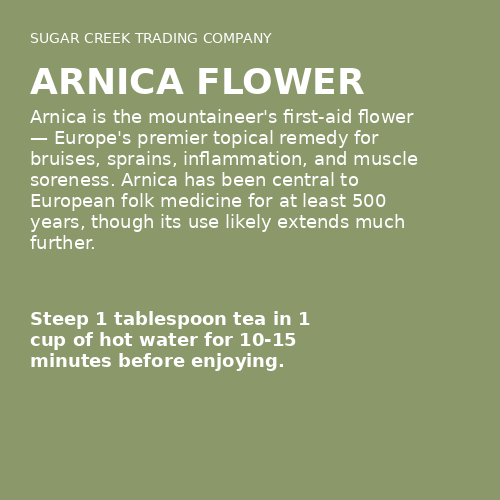
The mountaineer's first-aid flower — Europe's premier topical remedy for bruises, sprains, inflammation, and muscle soreness.
BOTANICAL IDENTIFICATION
Scientific Name: Arnica montana L.
Common Names: Arnica, Mountain Arnica, Leopard's Bane, Wolf's Bane, Mountain Tobacco, Mountain Daisy
Family: Asteraceae (Compositae)
Arnica montana is a perennial herbaceous plant growing 30 to 60 centimeters tall from a short, dark brown rhizome. It produces a basal rosette of oval, hairy leaves and one to three bright golden-yellow, daisy-like flower heads approximately 6 to 8 centimeters in diameter. The ray florets are distinctively toothed at their tips, and the entire plant is aromatic with a slightly spicy, sage-like fragrance when handled.
Native to the mountain meadows and open woodlands of Europe — from Scandinavia through the Alps, Pyrenees, and Carpathian ranges — arnica thrives in nutrient-poor, acidic, siliceous soils at elevations of 500 to 2,800 meters. It requires well-drained, undisturbed grassland and does not tolerate heavy fertilization or intensive agriculture, which has contributed to its decline in many lowland habitats.
CULTURAL AND HISTORICAL USE
Arnica has been central to European folk medicine for at least 500 years, though its use likely extends much further. Mountain communities in the Alps, Pyrenees, and Carpathians relied on arnica flower poultices and infused oils as their primary remedy for falls, bruises, and overexertion injuries. German folk medicine traditions placed particular emphasis on arnica — it was called "Fallkraut" (fall herb) and "Wundkraut" (wound herb) — and it was among the most commonly wildcrafted medicinal plants in Central European mountain communities.
Arnica gained formal recognition in European phytotherapy through the writings of the 18th-century Viennese physician Johann Storch, who documented its use for bruising and trauma. Samuel Hahnemann, the founder of homeopathy, adopted Arnica montana as one of the foundational remedies in his system, where it remains the most widely used homeopathic medicine for trauma and shock worldwide. In the 19th and early 20th centuries, arnica tinctures were standard items in pharmacies across Germany, Austria, Switzerland, and France.
Today, arnica is recognized by the German Commission E and the European Medicines Agency (EMA) as an approved topical remedy for blunt injuries, bruises, sprains, insect bites, and inflammatory conditions of the skin and mucous membranes. It remains one of the best-selling herbal remedies in Europe and has gained significant popularity in North America for sports medicine and post-surgical recovery.
KEY BIOACTIVE COMPOUNDS & BENEFITS
| Compound/Class | Location in Plant | Human Benefit | Role in Plant |
|---|---|---|---|
| Sesquiterpene Lactones (Helenalin, Dihydrohelenalin) | Flower heads | Potent anti-inflammatory; inhibit NF-kB pathway; reduce edema and pain | Chemical defense against herbivory |
| Flavonoids (Hispidulin, Quercetin, Isorhamnetin) | Flower heads, leaves | Antioxidant; vascular protective; reduce capillary fragility | UV protection, pollinator attraction |
| Thymol Derivatives (Thymol methyl ether) | Flower heads (essential oil) | Antimicrobial; anti-inflammatory; warming analgesic effect | Antimicrobial volatile defense |
| Polysaccharides (Inulin-type fructans) | Roots, flower receptacle | Immune-modulating; support tissue healing | Energy storage |
| Carotenoids (Arnidiol, Faradiol) | Flower heads | Anti-inflammatory; promote wound healing; support skin repair | Pigmentation for pollinator signaling and photoprotection |
The anti-inflammatory power of arnica flower is primarily driven by the sesquiterpene lactone helenalin, one of the most potent natural NF-kB inhibitors identified in botanical research. This compound works synergistically with the flower's flavonoids, carotenoids, and thymol derivatives to create a multi-target anti-inflammatory effect that reduces swelling, resolves bruising, and alleviates pain when applied topically. These same compounds make arnica toxic when taken internally in crude herbal doses, which is why its primary use is external.
HOW IT WORKS IN THE BODY
Arnica flower acts through topical absorption, delivering its bioactive compounds to the subcutaneous tissue, muscles, and local vasculature beneath the application site.
Inflammation and NF-kB Inhibition:
Helenalin and dihydrohelenalin directly inhibit NF-kB (nuclear factor kappa-B), a master transcription factor that drives the expression of pro-inflammatory cytokines, prostaglandins, and enzymes including COX-2 and iNOS. By blocking NF-kB activation at the molecular level, arnica reduces the inflammatory cascade at its source rather than merely masking symptoms. Research published in the Journal of Pharmacy and Pharmacology has demonstrated that helenalin's anti-inflammatory potency is comparable to corticosteroids in topical models.
Bruise and Edema Resolution:
The flavonoids and carotenoid esters (particularly faradiol) in arnica strengthen capillary walls, reduce vascular permeability, and promote the reabsorption of blood and fluid from bruised tissue. Faradiol has been shown in studies to inhibit croton oil-induced edema with efficacy comparable to indomethacin. This combination of vascular protection and anti-edema activity explains arnica's legendary effectiveness for bruising and swelling.
Pain Modulation:
The thymol derivatives and sesquiterpene lactones provide local analgesic effects through both anti-inflammatory pathways and mild counter-irritant activity. By reducing the prostaglandin and bradykinin production that sensitizes pain receptors, arnica diminishes pain at the injury site. The mild warming effect from thymol compounds adds an additional analgesic dimension.
Tissue Repair and Wound Healing:
Arnica polysaccharides and carotenoids support local immune function and fibroblast activity, promoting efficient tissue repair. These compounds are particularly relevant for post-surgical applications, where controlled inflammation and efficient healing are desired.
DOSE GUIDELINES
| Preparation Type | Typical Dose | Purpose |
|---|---|---|
| Infused oil (topical) | Apply liberally to affected area 2-4 times daily | Bruises, sprains, muscle soreness, joint pain |
| Compress (topical) | Steep 2 tablespoons flowers in 500 mL hot water, cool, soak cloth, apply 15-20 minutes | Acute swelling, bruises, sprains |
| Tincture (topical dilution) | Dilute 1 part tincture in 3-10 parts water, apply with cloth | Topical anti-inflammatory for larger areas |
| Salve or cream (topical) | Apply thin layer to unbroken skin, 2-3 times daily | Post-exercise recovery, chronic joint discomfort |
Arnica is used on an acute or short-term basis for specific injuries and pain episodes. For chronic conditions, it can be applied topically as needed over extended periods. Always use on intact, unbroken skin only. Do not apply to open wounds, mucous membranes, or near the eyes.
PREPARATION AND USES
The most traditional preparation of arnica flower is an infused oil: fill a clean jar loosely with dried arnica flowers, cover completely with olive oil or another stable carrier oil, and allow to infuse in a warm location for 4 to 6 weeks, shaking periodically. Strain through cheesecloth and store in a dark bottle. This infused oil can be used directly for massage or as the base for salves and balms — melt beeswax at a ratio of approximately 1 part wax to 4 parts arnica oil for a firm, portable salve.
For quick use, an arnica compress is highly effective: steep 2 tablespoons of dried flowers in 500 mL of just-boiled water, cover and let cool to a comfortable temperature, soak a clean cloth in the infusion, and apply to the bruised or swollen area for 15 to 20 minutes. Repeat several times daily for acute injuries. Arnica tincture (made by macerating flowers in 70% alcohol for 2 to 4 weeks) should always be diluted before topical application — typically 1 part tincture to 3 to 10 parts water. Never apply undiluted tincture directly to skin, as it may cause irritation.
OPTIMAL CONTEXT FOR USE
This herb is especially well-suited for individuals experiencing:
Acute bruising, contusions, or blunt-force trauma to soft tissue
Sprains, strains, and musculoskeletal injuries from sports or physical labor
Post-surgical swelling and bruising (applied to unbroken skin surrounding the surgical site)
Chronic joint discomfort from osteoarthritis or repetitive strain
Post-exercise muscle soreness and delayed onset muscle soreness (DOMS)
Insect bites and minor inflammatory skin conditions
For best results, apply arnica preparations as soon as possible after injury and combine with rest, ice (for acute injuries), compression, and elevation as appropriate.
SUSTAINABILITY AND ETHICAL HARVESTING
Arnica montana is classified as a vulnerable or protected species in many European countries due to habitat loss from agricultural intensification, overharvesting, and changes in traditional grassland management. Wild populations have declined significantly in lowland areas across Germany, France, and the Benelux countries. The plant is listed under CITES Appendix II in some regions and is protected by national legislation in multiple European nations.
Sustainable sourcing of arnica requires attention. Commercial arnica is increasingly cultivated, though Arnica montana is notoriously difficult to farm at scale due to its preference for poor, acidic, undisturbed soils. Arnica chamissonis, a North American relative with a similar phytochemical profile, is more amenable to cultivation and is now widely used as a sustainable alternative in commercial preparations. When purchasing wild-harvested Arnica montana, seek suppliers who participate in certified sustainable wildcrafting programs that monitor wild populations and limit harvest quantities.
SAFETY AND CAUTIONS
Arnica flower is safe and effective when used topically on intact skin at recommended dilutions. It is one of the most widely used topical herbal remedies in the world with a strong safety record in external application.
External use only: Arnica should not be taken internally in crude herbal form. Helenalin is cardiotoxic and hepatotoxic when ingested in significant quantities. Homeopathic preparations (which contain highly diluted amounts) are a separate category and are taken internally under different principles.
Open wounds: Do not apply arnica to broken skin, open wounds, or mucous membranes, as it can cause irritation and delayed healing.
Asteraceae allergy: Individuals allergic to plants in the daisy family (chamomile, ragweed, chrysanthemum, echinacea) may experience contact dermatitis from arnica. Perform a patch test on a small area of skin before widespread use.
Prolonged use: Extended continuous application to the same area of skin may cause contact dermatitis, eczema, or blistering in sensitive individuals. Use for specific episodes rather than continuously.
Pregnancy and nursing: Topical use of arnica is generally considered safe during pregnancy and nursing when applied to intact skin at standard dilutions, but avoid use on the breast area during lactation.
REFERENCES
Lyss, G., et al. (1997). "The anti-inflammatory sesquiterpene lactone helenalin inhibits the transcription factor NF-kB." Journal of Biological Chemistry, 272(52), 32770-32774.
Klaas, C.A., et al. (2002). "Studies on the anti-inflammatory activity of phytopharmaceuticals prepared from Arnica flowers." Planta Medica, 68(5), 385-391.
European Medicines Agency (EMA). (2014). "Assessment report on Arnica montana L., flos." EMA/HMPC/198793/2012.
Blumenthal, M., et al. (1998). The Complete German Commission E Monographs: Therapeutic Guide to Herbal Medicines. American Botanical Council.
FINAL NOTE
Arnica montana has earned its place as the quintessential topical trauma herb through centuries of mountain folk use and decades of modern pharmacological validation. Its helenalin-driven NF-kB inhibition represents one of the most powerful anti-inflammatory mechanisms found in the plant kingdom, and its effectiveness for bruising, swelling, and muscle pain is supported by both tradition and clinical evidence. Keep arnica oil or salve in your home apothecary and travel kit — it is the herb you will reach for first when bumps, bruises, and sore muscles are part of the day.
Share