Sugar Creek Trading Company
Arrowroot Thickener
Arrowroot Thickener
Couldn't load pickup availability
MARANTA ARUNDINACEA
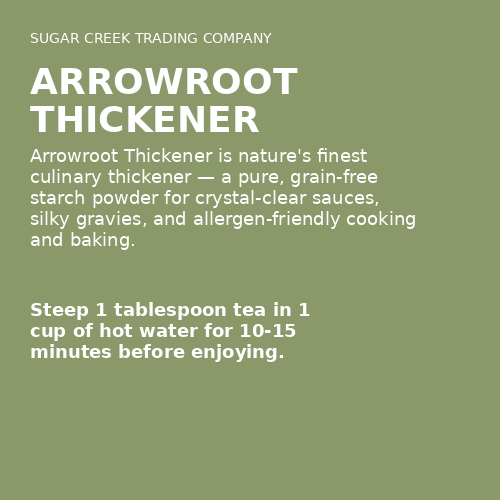
Nature's finest culinary thickener — a pure, grain-free starch powder for crystal-clear sauces, silky gravies, and allergen-friendly cooking and baking.
BOTANICAL IDENTIFICATION
Scientific Name: Maranta arundinacea L.
Common Names: Arrowroot, West Indian Arrowroot, Maranta Starch, Bermuda Arrowroot, Araruta
Family: Marantaceae
Maranta arundinacea is a tropical perennial herb growing 60 to 120 centimeters tall, producing fleshy, elongated rhizomes that serve as the source of its renowned starch. The plant bears broad, lance-shaped leaves on slender stems and produces small, delicate white flowers. The rhizomes are harvested at full maturity (10 to 12 months), washed, pulped, and the starch is separated by water extraction and dried into the fine, snow-white powder used in cooking and natural health.
Indigenous to the tropical lowlands of Central and South America, arrowroot is now cultivated worldwide in tropical zones including the Caribbean (especially St. Vincent and the Grenadines), Southeast Asia, East Africa, and northern Australia. It grows best in warm, humid conditions with rich, well-drained soil and tolerates partial shade, making it well-adapted to understory cultivation.
CULTURAL AND HISTORICAL USE
The Arawak peoples of the Caribbean were the original cultivators of arrowroot, using it as a dietary staple and a wound-healing poultice. The name "arrowroot" may derive from the Arawak "aru-aru" (meal of meals) or from the traditional practice of using the rhizome to treat arrow wounds. When European colonists arrived in the Caribbean, they quickly adopted arrowroot as both a food and a medicine, exporting the starch to Europe where it became a pantry essential in 18th- and 19th-century kitchens.
Victorian-era cooks prized arrowroot as the superior thickening agent for delicate sauces, fruit glazes, puddings, and blancmanges — applications where the neutral flavor and crystal-clear gel of arrowroot outperformed flour and other starches. Mrs. Beeton's Book of Household Management (1861) and Fannie Farmer's Boston Cooking-School Cook Book (1896) both featured arrowroot prominently in their thickening and baking recipes. Simultaneously, physicians prescribed arrowroot gruel as the ideal food for invalids and infants, valued for its exceptional digestibility.
The rise of industrially produced cornstarch in the 20th century temporarily displaced arrowroot from mainstream kitchens, but the modern clean-eating movement, paleo diet, and growing awareness of food allergies have driven a powerful resurgence. Arrowroot is now recognized as the gold-standard grain-free, gluten-free, non-GMO thickener — essential for those with celiac disease, corn allergies, and anyone seeking minimally processed, single-ingredient cooking starches.
KEY BIOACTIVE COMPOUNDS & BENEFITS
| Compound/Class | Location in Plant | Human Benefit | Role in Plant |
|---|---|---|---|
| Native Starch (high amylose, ~85% carbohydrate) | Rhizome | Clean thickening with neutral taste; produces glossy, clear gels; easy to digest | Energy reserve for rhizome growth and sprouting |
| Resistant Starch (RS2 fraction) | Rhizome | Prebiotic fiber; feeds beneficial gut bacteria; produces butyrate in the colon | Portion of starch in crystalline form less available to enzymes |
| Potassium (454 mg per 100g) | Rhizome | Electrolyte balance; supports healthy blood pressure and muscle function | Osmotic regulation in plant cells |
| Iron (2.2 mg per 100g) | Rhizome | Supports oxygen transport and energy metabolism | Enzymatic cofactor in chlorophyll synthesis |
| Folate (338 mcg per 100g fresh rhizome) | Rhizome | Essential for DNA synthesis and cell division; critical during pregnancy | Coenzyme in nucleotide metabolism |
The culinary superiority of arrowroot starch lies in the physical properties of its granules — they are smaller and more uniform than corn, wheat, or potato starch granules, which allows them to gelatinize at lower temperatures, produce a smoother texture, and create a translucent rather than opaque gel. Unlike cornstarch, arrowroot does not impart a chalky mouthfeel, does not break down in acidic liquids, and freezes and thaws without weeping. These properties are direct reflections of the plant's unique starch chemistry.
HOW IT WORKS IN THE BODY
Arrowroot thickener functions in the body primarily as a highly digestible carbohydrate source with gentle demulcent properties and prebiotic potential.
Rapid, Gentle Digestion:
Arrowroot starch is hydrolyzed efficiently by salivary and pancreatic amylase due to the small, uniform size of its granules and its complete gelatinization at relatively low temperatures. This means the body can extract energy from arrowroot with minimal digestive effort — a property that makes it particularly valuable for individuals with compromised digestion, whether from illness, surgery, aging, or gastrointestinal conditions. It is one of the first solid foods tolerated during recovery from gastroenteritis.
Demulcent Mucosal Coating:
When mixed with warm liquid, arrowroot starch creates a smooth, mucilaginous gel that physically coats and soothes the mucous membranes of the digestive tract. This demulcent action helps protect irritated tissue from gastric acid and digestive enzymes, providing symptomatic relief in conditions such as gastritis, acid reflux, and inflammatory bowel disease.
Prebiotic Fermentation:
The resistant starch fraction of arrowroot survives digestion in the small intestine and reaches the colon, where it is fermented by beneficial bacteria including Bifidobacterium and Lactobacillus species. This fermentation produces short-chain fatty acids — particularly butyrate — which nourish the colonocytes (colon lining cells), reduce inflammation, and support healthy bowel function.
Allergen-Free Nutrition:
As a single-ingredient, minimally processed plant starch, arrowroot is free from gluten, corn proteins, soy, dairy, nuts, and all other major allergens. This makes it an essential dietary tool for individuals managing multiple food allergies or autoimmune conditions requiring strict elimination diets.
DOSE GUIDELINES
| Preparation Type | Typical Dose | Purpose |
|---|---|---|
| Culinary thickener | 1 tablespoon per cup of liquid (make slurry with cold water first, then stir into hot liquid) | Thickening sauces, gravies, soups, pie fillings, glazes |
| Baking substitute | Replace cornstarch 1:1; replace flour at roughly 1 tablespoon arrowroot per 1 tablespoon flour for thickening | Gluten-free and grain-free baking and cooking |
| Digestive gruel | 1-2 tablespoons stirred into 1 cup warm water, milk, or broth | Soothing inflamed digestion; convalescent nutrition |
| Body powder | Apply directly to skin as needed | Natural moisture-absorbing powder; talc alternative |
Arrowroot can be used daily without restriction as a food ingredient. For culinary thickening, add the arrowroot slurry at the end of cooking and avoid prolonged boiling, as extended high heat can cause the starch gel to thin. Arrowroot thickens at a lower temperature than cornstarch and produces a glossy, transparent result.
PREPARATION AND USES
For sauces and gravies, the essential technique is the cold-water slurry: combine 1 tablespoon of arrowroot powder with 1 to 2 tablespoons of cold water and stir until completely smooth. Add this slurry to your hot (but not boiling) liquid in the final minutes of cooking, stirring constantly. The sauce will thicken within 1 to 2 minutes into a glossy, clear gel. Remove from heat promptly — unlike cornstarch, arrowroot breaks down with prolonged boiling. For fruit pie fillings and glazes, arrowroot is superior to cornstarch because it produces a sparkling, jewel-like clarity that showcases the fruit's natural color.
In gluten-free baking, arrowroot powder can be blended with other grain-free flours (almond flour, coconut flour, tapioca starch) to improve texture and binding. It creates a lighter, crispier coating for fried foods compared to wheat flour. Beyond the kitchen, arrowroot powder serves as an excellent natural body powder — it absorbs moisture effectively, does not clog pores, and provides a talc-free alternative for personal care. It can also be used as a base for homemade dry shampoo, deodorant, and baby powder formulations.
OPTIMAL CONTEXT FOR USE
This product is especially well-suited for individuals seeking:
A clean, single-ingredient thickener free from gluten, corn, grains, and all major allergens
Crystal-clear thickening for fruit sauces, glazes, and delicate preparations where cornstarch produces unwanted opacity
A grain-free baking staple for paleo, AIP (autoimmune protocol), Whole30, or elimination diets
A gentle, easily digestible food for recovering from illness, food poisoning, or digestive upset
A natural, talc-free body powder or base for DIY personal care products
A freeze-thaw stable thickener for make-ahead meals and frozen sauces that will not separate upon reheating
For those managing food sensitivities, arrowroot provides peace of mind as a minimally processed, single-origin starch with no hidden additives, anti-caking agents, or processing residues.
SUSTAINABILITY AND ETHICAL HARVESTING
Arrowroot is a sustainable tropical crop with a low environmental footprint. It grows well with minimal inputs, requires no synthetic fertilizers or pesticides in traditional farming systems, and thrives in intercropped agroforestry settings alongside cacao, banana, and other tropical perennials. The plant regenerates readily from rhizome fragments left in the soil after harvest, ensuring continuous production without replanting.
St. Vincent and the Grenadines remains the world's most recognized source of premium arrowroot starch, where the crop has been cultivated continuously since the 18th century and supports rural farming communities. Other significant producers include India, Thailand, and various Caribbean and Pacific Island nations. The traditional water-extraction processing method used for arrowroot starch is inherently clean — it uses no chemical solvents or harsh processing agents — resulting in a pure, minimally processed final product.
SAFETY AND CAUTIONS
Arrowroot thickener is exceptionally safe and is suitable for virtually all individuals, including infants (under pediatric guidance), pregnant and nursing women, the elderly, and those with complex food allergies.
Allergens: Arrowroot is free from all major allergens including gluten, wheat, corn, soy, dairy, eggs, nuts, and fish. Allergic reactions to arrowroot itself are virtually unknown in the medical literature.
Drug interactions: No known drug interactions. As with any demulcent food, consuming large quantities simultaneously with oral medications could theoretically slow drug absorption. Take medications separately as a routine precaution.
Blood sugar considerations: Arrowroot is a starch and will raise blood sugar. People with diabetes should count it as a carbohydrate source in their meal planning. However, its glycemic impact is generally moderate, and the resistant starch fraction may help moderate the blood sugar response compared to refined grain starches.
Adulteration: Some commercial "arrowroot" products are actually made from cassava (tapioca), potato, or other cheaper starches. True Maranta arundinacea starch has a distinctively fine, silky texture and a pure white color. Purchase from reputable suppliers who specify the botanical source.
REFERENCES
Hoover, R. (2001). "Composition, molecular structure, and physicochemical properties of tuber and root starches: a review." Carbohydrate Polymers, 45(3), 253-267.
Erdman, M.D. (1986). "Starch from arrowroot (Maranta arundinacea) grown at Tifton, Georgia." Cereal Chemistry, 63(3), 277-279.
Topping, D.L., & Clifton, P.M. (2001). "Short-chain fatty acids and human colonic function: roles of resistant starch and nonstarch polysaccharides." Physiological Reviews, 81(3), 1031-1064.
Davidson, A. (2006). The Oxford Companion to Food. Oxford University Press. (Arrowroot entry.)
FINAL NOTE
Arrowroot thickener represents the intersection of culinary excellence and gentle healing — a kitchen staple that happens to be one of the most soothing substances you can offer a troubled digestive system. Its crystal-clear thickening, neutral flavor, and complete freedom from allergens make it indispensable for modern clean cooking, while its centuries-long history as a convalescent food reminds us that the best nutrition is sometimes the simplest. This is one powder that earns its place in both the spice rack and the home apothecary.
Share