Sugar Creek Trading Company
Artichoke Leaf
Artichoke Leaf
Couldn't load pickup availability
CYNARA SCOLYMUS
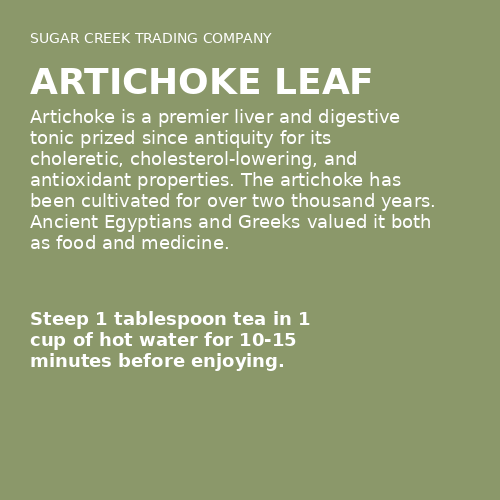
A premier liver and digestive tonic prized since antiquity for its choleretic, cholesterol-lowering, and antioxidant properties.
BOTANICAL IDENTIFICATION
Scientific Name: Cynara scolymus L.
Common Names: Artichoke, Globe Artichoke, Garden Artichoke, Alcachofa, Carciofo
Family: Asteraceae (Compositae)
Artichoke is a robust, thistle-like perennial growing 1 to 2 meters tall with a stout, grooved stem and large, deeply lobed, silvery-green basal leaves that can reach up to 80 cm in length. The plant produces large, globular flower heads composed of tightly packed, fleshy bracts surrounding a mass of violet-blue florets. The immature flower head is the familiar culinary artichoke, while the broad, bitter leaves are the primary part used in herbal medicine.
Native to the Mediterranean basin and North Africa, artichoke thrives in well-drained, fertile soils in full sun. It is now cultivated commercially in Italy, Spain, France, Egypt, Argentina, and California. The plant is frost-sensitive and favors mild, maritime climates with cool, wet winters and warm, dry summers.
CULTURAL AND HISTORICAL USE
The artichoke has been cultivated for over two thousand years. Ancient Egyptians and Greeks valued it both as food and medicine. The Greek physician Dioscorides described the juice of artichoke root as a remedy for foul body odor and as a diuretic in the first century CE. Roman naturalist Pliny the Elder also documented its culinary and therapeutic properties, noting its usefulness for digestive complaints and liver ailments.
During the Renaissance, artichoke gained prominence in European herbal medicine as a cholagogue and hepatoprotectant. French and Italian physicians prescribed artichoke leaf preparations for jaundice, dropsy, and chronic digestive weakness. In traditional North African and Middle Eastern medicine, artichoke leaf tea was used to calm the stomach, improve appetite, and support kidney function.
By the mid-20th century, European phytotherapy had embraced artichoke leaf extract as one of the most well-documented botanical liver remedies. German Commission E approved artichoke leaf for dyspeptic complaints, and it became a mainstay in the European pharmacopoeia. Today, artichoke leaf remains one of the best-studied digestive botanicals in clinical research, with dozens of human trials confirming its traditional applications.
KEY BIOACTIVE COMPOUNDS & BENEFITS
| Compound/Class | Location in Plant | Human Benefit | Role in Plant |
|---|---|---|---|
| Cynarin (dicaffeoylquinic acid) | Leaves, stems | Stimulates bile production; supports cholesterol metabolism and liver regeneration | UV protection and antioxidant defense |
| Chlorogenic acid | Leaves | Antioxidant; supports healthy blood sugar and lipid levels | Phenolic defense against herbivory and pathogens |
| Luteolin and luteolin-7-O-glucoside | Leaves, bracts | Anti-inflammatory; hepatoprotective; inhibits LDL oxidation | UV-filtering pigment and antimicrobial agent |
| Sesquiterpene lactones (cynaropicrin) | Leaves, latex | Bitter digestive stimulant; anti-inflammatory; potential anti-tumor activity | Herbivore deterrent (bitter defense compounds) |
| Inulin (fructo-oligosaccharides) | Roots, stems | Prebiotic fiber supporting beneficial gut bacteria | Carbohydrate storage |
Together, these compounds create a synergistic profile that is particularly effective for hepatobiliary and digestive support. The caffeoylquinic acids (cynarin, chlorogenic acid) drive the choleretic and antioxidant effects, while the flavonoids (luteolin) provide anti-inflammatory protection to liver cells. The bitter sesquiterpene lactones stimulate the entire upper digestive tract, and the prebiotic inulin supports lower-gut microbial health.
HOW IT WORKS IN THE BODY
Artichoke leaf exerts its effects through several interconnected physiological pathways, centered on the liver and digestive system.
Hepatobiliary Support and Bile Production:
Cynarin and chlorogenic acid stimulate hepatocytes to increase bile acid synthesis and secretion (choleresis). Enhanced bile flow improves the digestion and absorption of dietary fats and fat-soluble vitamins (A, D, E, K). Increased bile output also promotes the excretion of cholesterol metabolites, contributing to artichoke's well-documented cholesterol-lowering effects. Luteolin acts as a direct hepatoprotectant, shielding liver cells from oxidative damage caused by toxins, alcohol, and metabolic byproducts.
Lipid Metabolism and Cardiovascular Health:
Artichoke leaf compounds inhibit HMG-CoA reductase, the same enzyme targeted by statin drugs, reducing endogenous cholesterol synthesis. Clinical trials have demonstrated reductions in total cholesterol, LDL cholesterol, and triglycerides following supplementation with artichoke leaf extract. Luteolin further protects cardiovascular health by inhibiting the oxidation of LDL particles, a key step in atherosclerotic plaque formation.
Digestive Stimulation and Gastroprotection:
The bitter sesquiterpene lactones, particularly cynaropicrin, activate bitter taste receptors (T2Rs) on the tongue and throughout the GI tract, triggering a reflexive increase in gastric acid, pepsin, and pancreatic enzyme secretion. This bitter reflex improves the breakdown of proteins and complex foods. Artichoke leaf also exhibits antispasmodic activity on smooth muscle in the gut, helping to relieve bloating, flatulence, and functional dyspepsia.
Antioxidant and Anti-inflammatory Activity:
The phenolic compounds in artichoke leaf scavenge reactive oxygen species and upregulate endogenous antioxidant enzymes including superoxide dismutase and glutathione peroxidase. Luteolin inhibits NF-kB signaling, reducing the production of pro-inflammatory cytokines such as TNF-alpha and IL-6, which helps protect tissues from chronic inflammation.
DOSE GUIDELINES
| Preparation Type | Typical Dose | Purpose |
|---|---|---|
| Dried leaf tea (infusion) | 1-4 g of dried leaf steeped in hot water, 3 times daily | General digestive and liver support |
| Powdered leaf (capsules) | 500-1,500 mg, 2-3 times daily with meals | Digestive bitters, mild choleretic effect |
| Tincture (1:5, 45% ethanol) | 2-4 mL, 3 times daily before meals | Concentrated bitter and choleretic support |
Artichoke leaf is best used as a regular daily tonic taken before or with meals, rather than as an acute remedy. Most clinical trials showing benefit used daily supplementation over 6 to 12 weeks. The bitter properties are most effective when the preparation contacts the tongue, so teas and tinctures may offer superior digestive stimulation compared to capsules.
PREPARATION AND USES
For a simple artichoke leaf tea, steep 1 to 4 grams of the dried, cut leaf in 250 mL of just-boiled water for 10 to 15 minutes. The resulting infusion will be noticeably bitter, which is integral to its digestive action. Honey or lemon may be added if desired without diminishing the medicinal value. Drink 15 to 30 minutes before meals for optimal bitter-reflex stimulation.
Artichoke leaf also lends itself well to tincture preparation. Combine the dried leaf with 45% ethanol at a 1:5 ratio and macerate for 2 to 4 weeks, shaking daily. Strain and dose at 2 to 4 mL before meals. For those who prefer encapsulated forms, the dried leaf may be powdered and packed into capsules. Artichoke leaf blends well with other hepatic and digestive herbs such as milk thistle seed, dandelion root, turmeric, peppermint, and gentian root.
OPTIMAL CONTEXT FOR USE
Artichoke leaf is especially well-suited for individuals experiencing:
Functional dyspepsia, bloating, or sluggish digestion, particularly after fatty meals
Elevated cholesterol or triglyceride levels, especially when seeking a complementary botanical approach
Mild to moderate liver congestion or exposure to environmental toxins, alcohol, or pharmaceutical metabolites
Irritable bowel syndrome (IBS) with predominant symptoms of bloating, early satiety, and nausea
General interest in long-term hepatoprotection and antioxidant support
For comprehensive liver and digestive support, artichoke leaf pairs well with milk thistle (Silybum marianum) for hepatoprotection, dandelion root (Taraxacum officinale) for additional bile support, and a balanced whole-foods diet rich in fiber and cruciferous vegetables.
SUSTAINABILITY AND ETHICAL HARVESTING
Artichoke is a widely cultivated agricultural crop with no conservation concerns. Global production exceeds 1.5 million tons annually, primarily for the food industry, with the leaf material used in herbal medicine largely sourced as a secondary product from food-grade cultivation. Italy, Spain, Egypt, and Argentina are the leading producers.
Because artichoke is grown from seed or root divisions in managed agricultural settings, wild harvesting pressure is negligible. Ethical sourcing considerations focus on sustainable farming practices, including minimal pesticide use and soil health management. Organically certified artichoke leaf is readily available and represents the highest-quality option for herbal preparations.
SAFETY AND CAUTIONS
Artichoke leaf is generally considered safe and well-tolerated, with a long history of food and medicinal use. It holds Generally Recognized as Safe (GRAS) status and is approved by the German Commission E and the European Medicines Agency (EMA) for dyspeptic complaints.
Asteraceae allergy: Individuals with known allergies to plants in the daisy family (Asteraceae/Compositae) -- including ragweed, chamomile, chrysanthemum, and echinacea -- should exercise caution, as cross-reactivity is possible.
Bile duct obstruction: Because artichoke leaf stimulates bile production and flow, it is contraindicated in individuals with bile duct obstruction, gallstones, or acute gallbladder disease. The increased bile output could worsen these conditions.
Pregnancy and nursing: Insufficient safety data exists for use during pregnancy and lactation. While no adverse effects have been documented, caution is advised and consultation with a healthcare provider is recommended.
Drug interactions: Artichoke leaf may enhance the effects of cholesterol-lowering medications (statins) and anticoagulant drugs. It may also affect the metabolism of drugs processed through cytochrome P450 pathways. Consult a healthcare professional if you take prescription medications.
REFERENCES
Kraft, K. (1997). "Artichoke leaf extract -- Recent findings reflecting effects on lipid metabolism, liver, and gastrointestinal tracts." Phytomedicine, 4(4), 369-378.
Bundy, R., Walker, A.F., Middleton, R.W., et al. (2008). "Artichoke leaf extract (Cynara scolymus) reduces plasma cholesterol in otherwise healthy hypercholesterolemic adults: A randomized, double blind placebo controlled trial." Phytomedicine, 15(9), 668-675.
Holtmann, G., Adam, B., Haag, S., et al. (2003). "Efficacy of artichoke leaf extract in the treatment of patients with functional dyspepsia: A six-week placebo-controlled, double-blind, multicentre trial." Alimentary Pharmacology & Therapeutics, 18(11-12), 1099-1105.
European Medicines Agency (EMA). (2018). "Assessment report on Cynara scolymus L., folium." EMA/HMPC/150218/2009.
Ben Salem, M., Affes, H., Ksouda, K., et al. (2015). "Pharmacological studies of artichoke leaf extract and their health benefits." Plant Foods for Human Nutrition, 70(4), 441-453.
FINAL NOTE
Artichoke leaf stands as one of the most thoroughly validated botanicals in modern phytotherapy, with clinical evidence firmly supporting what Mediterranean healers observed for millennia. Its ability to simultaneously stimulate bile flow, protect liver cells, lower cholesterol, and improve digestive comfort makes it an exceptionally versatile herb. Whether taken as a bitter tea before meals or as a standardized supplement, artichoke leaf offers reliable, gentle support for anyone seeking to strengthen their digestive and hepatic foundation.
Share