Sugar Creek Trading Company
Ash Bark
Ash Bark
Couldn't load pickup availability
FRAXINUS SPP.
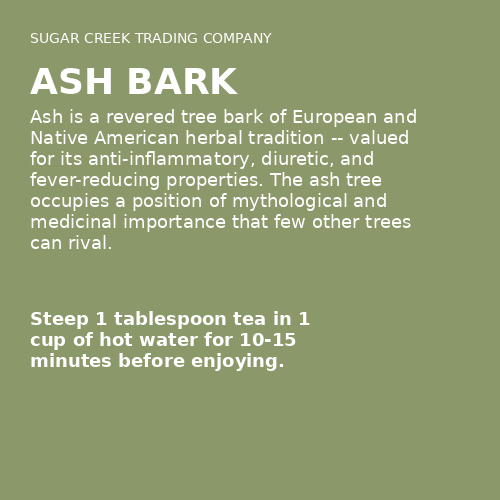
A revered tree bark of European and Native American herbal tradition -- valued for its anti-inflammatory, diuretic, and fever-reducing properties.
BOTANICAL IDENTIFICATION
Scientific Name: Fraxinus excelsior L. (European Ash), Fraxinus americana L. (White Ash), Fraxinus nigra Marshall (Black Ash), and related species
Common Names: Ash, European Ash, Common Ash, White Ash, Black Ash, Weeping Ash, Bird's Tongue
Family: Oleaceae (Olive family)
Ash trees are large, deciduous hardwoods that can reach 20 to 35 meters in height, with straight trunks and broad, rounded crowns. The bark is pale gray and relatively smooth on young trees, developing a distinctive pattern of tight, interlocking diamond-shaped ridges as the tree matures. Leaves are pinnately compound with 5 to 13 leaflets, arranged oppositely on the branches. Small clusters of purplish to greenish flowers appear before or with the leaves in spring, followed by winged samaras (keys) that disperse by wind in autumn.
Fraxinus species are distributed widely across temperate regions of the Northern Hemisphere. European ash is found throughout Europe and into western Asia. North American species range across the eastern United States and Canada. Ash trees prefer moist, well-drained soils in bottomlands, slopes, and mixed hardwood forests, often growing alongside oak, maple, and hickory.
CULTURAL AND HISTORICAL USE
The ash tree occupies a position of mythological and medicinal importance that few other trees can rival. In Norse mythology, Yggdrasil -- the great World Tree connecting the nine realms of existence -- is traditionally identified as an ash. The tree symbolized cosmic order, resilience, and the interconnection of all life. In Celtic tradition, ash was one of the three "chieftain trees" and was associated with protection, healing, and prophetic vision. Druids carved their wands from ash wood, and in British folk tradition, passing a sick child through a split ash trunk was believed to cure rickets and hernias.
Medicinally, ash bark has a documented history extending back to ancient Greek and Roman practice. Hippocrates recommended ash bark preparations for gout and joint pain. Dioscorides described ash bark decoctions for snakebite, edema, and ear infections. In medieval European herbalism, ash bark was widely used as a fever reducer (febrifuge) and diuretic, and was considered a poor man's alternative to cinchona bark (quinine) before that remedy became widely available. The 17th-century English herbalist Nicholas Culpeper wrote that ash bark "abates the swelling of the spleen" and was useful for dropsy and jaundice.
Native American peoples made extensive use of North American ash species. The Iroquois, Ojibwe, Cherokee, and many other nations used ash bark decoctions as a laxative, tonic, and remedy for fever, sore eyes, and skin sores. Black ash bark was particularly valued for basket-making, and the inner bark was chewed or brewed as a bitter tonic for digestive weakness. Eclectic physicians in 19th-century America prescribed Fraxinus americana bark for uterine conditions, particularly uterine fibroids, leading to its prominence in the Eclectic materia medica.
KEY BIOACTIVE COMPOUNDS & BENEFITS
| Compound/Class | Location in Plant | Human Benefit | Role in Plant |
|---|---|---|---|
| Hydroxycoumarins (fraxin, fraxetin, esculin, esculetin) | Bark, leaves | Anti-inflammatory, antioxidant, venotonic, UV-protective | UV-screening pigments and antimicrobial defense |
| Secoiridoid glycosides (oleuropein, ligstroside) | Bark, leaves | Anti-inflammatory, antihypertensive, antimicrobial | Bitter defense compounds against herbivory |
| Phenylethanoids (verbascoside/acteoside) | Bark | Potent antioxidant, anti-inflammatory, hepatoprotective, antimicrobial | Phenolic defense and wound response |
| Flavonoids (quercetin, kaempferol, rutin) | Bark, leaves | Capillary strengthening, antioxidant, anti-allergic | UV protection and pollinator signaling |
| Tannins (condensed and hydrolyzable) | Bark | Astringent, antimicrobial, anti-diarrheal, wound-healing | Antimicrobial defense and structural rigidity |
Ash bark's therapeutic profile is anchored by its hydroxycoumarins, particularly fraxin and esculin, which are relatively uncommon in the plant kingdom and give ash bark its distinctive pharmacological character. These compounds work synergistically with secoiridoids (shared with the closely related olive tree), phenylethanoid antioxidants, and tannins to produce broad anti-inflammatory, diuretic, and tonifying effects. The presence of oleuropein-type compounds links ash bark pharmacologically to olive leaf, one of the most studied botanicals in cardiovascular and metabolic medicine.
HOW IT WORKS IN THE BODY
Ash bark acts through several complementary mechanisms that support musculoskeletal health, kidney function, and inflammatory balance.
Anti-inflammatory and Analgesic Action:
The hydroxycoumarins fraxetin and esculetin inhibit cyclooxygenase (COX) and lipoxygenase (LOX) enzymes, reducing the production of prostaglandins and leukotrienes that drive pain and inflammation. Verbascoside adds further anti-inflammatory potency by suppressing NF-kB signaling, a master regulator of inflammatory gene expression. This dual mechanism underlies the traditional use of ash bark for gout, arthritis, and rheumatic pain. Clinical studies on Fraxinus excelsior bark extract have shown measurable reductions in joint pain and improvements in mobility.
Diuretic and Kidney Support:
Ash bark has well-documented mild diuretic properties, promoting the excretion of excess fluid and uric acid through the kidneys. This action is attributed primarily to the flavonoid and coumarin fractions, which increase renal blood flow and glomerular filtration. The diuretic effect is gentle and potassium-sparing compared to pharmaceutical diuretics, making it suitable for long-term use. This property supports its traditional use for gout (where uric acid excretion is crucial), edema, and urinary tract health.
Venotonic and Circulatory Effects:
Esculin and esculetin, the coumarin glycosides particularly concentrated in ash bark, strengthen capillary walls and reduce vascular permeability. These compounds are used in European phytopharmaceutical preparations for chronic venous insufficiency, varicose veins, and hemorrhoids. They reduce edema and inflammation in venous tissue while improving microcirculation.
Fever Reduction and Immune Modulation:
The traditional use of ash bark as a febrifuge is supported by its anti-inflammatory and mild diaphoretic properties. By reducing inflammatory mediators and promoting gentle perspiration, ash bark helps the body manage febrile responses more efficiently. The tannins and secoiridoids also contribute antimicrobial activity against common bacterial pathogens.
DOSE GUIDELINES
| Preparation Type | Typical Dose | Purpose |
|---|---|---|
| Decoction (simmered bark tea) | 1-2 tablespoons (5-10 g) bark simmered in 2 cups water for 15-20 minutes, strained; 1-3 cups daily | Joint pain, gout, fever, general tonic |
| Tincture (1:5, 50% ethanol) | 2-5 mL, 3 times daily | Anti-inflammatory, diuretic, uterine tonic |
| Powdered bark (capsules) | 500-1,500 mg, 2-3 times daily | Joint support, metabolic support |
| External wash or compress | Strong decoction (double strength) applied topically | Wounds, skin inflammation, varicose veins |
Ash bark is best prepared as a decoction (simmered tea) rather than a simple infusion, as the harder bark tissue requires sustained heat to extract its compounds effectively. For joint and inflammatory conditions, a course of 4-8 weeks of daily use is typical. The bark can also be combined with other anti-rheumatic herbs in formula for enhanced effect. The taste is moderately bitter and astringent, with a slightly woody character.
PREPARATION AND USES
To prepare a standard decoction, add 1-2 tablespoons of dried ash bark to 2 cups of cold water in a saucepan. Bring to a gentle boil, then reduce heat and simmer covered for 15-20 minutes. Strain and drink warm, up to three cups daily. The decoction has a clean, moderately bitter and astringent taste with subtle woody notes. It can be sweetened with honey if desired, and blends well with other barks and roots such as willow bark, devil's claw, or celery seed in anti-rheumatic formulas.
For topical use, prepare a double-strength decoction and use it as a wash for wounds, skin irritations, or inflammatory skin conditions. Soak a clean cloth in the warm decoction and apply as a compress to painful or swollen joints, varicose veins, or hemorrhoidal tissue. Ash bark tincture is prepared by macerating the bark in 50% ethanol for 4-6 weeks. The Eclectic physicians specifically favored the tincture of white ash bark (Fraxinus americana) for uterine fibroids and pelvic congestion, typically prescribing 20-60 drops three times daily.
OPTIMAL CONTEXT FOR USE
Ash bark is especially well-suited for individuals experiencing:
Joint pain, stiffness, or swelling associated with osteoarthritis, rheumatoid conditions, or gout
Fluid retention, mild edema, or the need for gentle diuretic support without potassium depletion
Chronic venous insufficiency, varicose veins, or hemorrhoids where venotonic support is desired
Fever management in the context of colds, flu, or acute infections (as part of a broader protocol)
Uterine fibroids or pelvic congestion, following the Eclectic tradition of Fraxinus americana bark use
Ash bark combines well with willow bark and meadowsweet for pain and inflammation, with nettle leaf for gout and uric acid excretion, and with horse chestnut for venous insufficiency and hemorrhoids.
SUSTAINABILITY AND ETHICAL HARVESTING
Ash trees across the Northern Hemisphere face an unprecedented ecological crisis due to the emerald ash borer (Agrilus planipennis), an invasive beetle from East Asia that has devastated North American ash populations since its detection in Michigan in 2002. Tens of millions of ash trees have been killed across the United States and Canada, and the pest has now reached Europe, threatening Fraxinus excelsior populations as well. In Europe, ash dieback disease (caused by the fungus Hymenoscyphus fraxineus) has further compounded the threat.
In this context, responsible sourcing of ash bark is critically important. Bark should be harvested from sustainably managed woodlots, from trees already being removed for other reasons, or from branches pruned during normal arboricultural management -- never from wild trees in threatened populations. Sugar Creek Trading Company takes the conservation status of ash seriously and works with suppliers who harvest responsibly, prioritizing bark from cultivated or managed sources.
SAFETY AND CAUTIONS
Ash bark has a long history of safe traditional use when taken in standard doses. However, the following cautions should be observed:
Oleaceae allergy: Individuals with allergies to olive, lilac, privet, or other members of the Oleaceae family should use ash bark with caution, as cross-reactivity is possible, particularly with pollen allergens.
Coumarin sensitivity: Although ash bark coumarins are not the same as the anticoagulant drug warfarin, individuals on blood-thinning medications should consult their healthcare provider before use, as additive anticoagulant effects are theoretically possible.
Pregnancy and nursing: Due to traditional reports of uterine-stimulating properties (particularly with white ash bark), ash bark should be avoided during pregnancy. Insufficient data exists for use during lactation.
Kidney conditions: While ash bark's mild diuretic properties are generally beneficial, individuals with severe kidney disease should consult a healthcare provider before use.
Drug interactions: Ash bark may interact with diuretic medications, anticoagulants, and drugs for gout (such as allopurinol). Consult your healthcare provider if taking prescription medications.
REFERENCES
European Medicines Agency (EMA). "Assessment report on Fraxinus excelsior L. or Fraxinus angustifolia Vahl, folium." EMA/HMPC/240420/2009.
Kostova, I., and Iossifova, T. "Chemical components of Fraxinus species." Fitoterapia, 78(2), 85-106, 2007.
Pagnotta, M.A., et al. "Hydroxycinnamic derivatives and secoiridoids from Fraxinus: Traditional uses and biological activities." Phytochemistry Reviews, 16, 159-178, 2017.
Felter, H.W., and Lloyd, J.U. King's American Dispensatory, 18th ed. Cincinnati: Ohio Valley Company, 1898. (Entry on Fraxinus americana.)
Moerman, D.E. Native American Ethnobotany. Portland: Timber Press, 1998. (Entries on Fraxinus spp.)
FINAL NOTE
Ash bark carries the weight of Norse cosmology, Celtic reverence, and centuries of practical herbal medicine in its tight-ridged fibers. Its unique coumarin and secoiridoid chemistry -- shared in part with its Oleaceae cousin, the olive tree -- makes it a distinctly effective anti-inflammatory, diuretic, and venotonic remedy with few true equivalents in the Western herbal pharmacopoeia. In an era when ash trees themselves face existential threats from invasive pests and disease, using this bark mindfully and sourcing it responsibly is not just good practice -- it is an act of reciprocity toward one of the most storied trees on Earth.
Share