Sugar Creek Trading Company
Bala Country Mallow Herb
Bala Country Mallow Herb
Couldn't load pickup availability
SIDA CORDIFOLIA
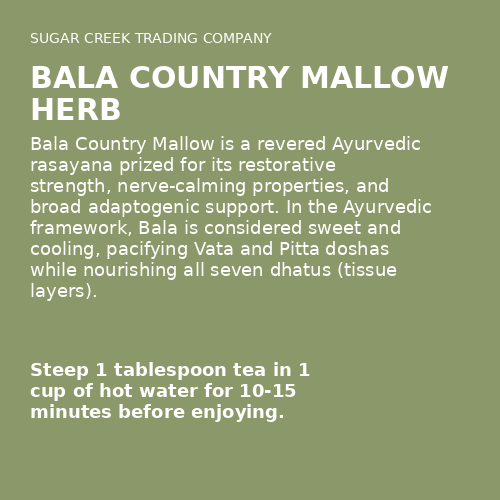
A revered Ayurvedic rasayana prized for its restorative strength, nerve-calming properties, and broad adaptogenic support.
BOTANICAL IDENTIFICATION
Scientific Name: Sida cordifolia L.
Common Names: Bala, Country Mallow, Heart-leaf Sida, Flannel Weed, Bala Herb
Family: Malvaceae (Mallow family)
Bala is a perennial subshrub that typically reaches 0.5 to 1.5 meters in height. It bears soft, heart-shaped leaves covered in fine velvety hairs, giving the plant a flannel-like texture. Its small, pale yellow flowers bloom singly from leaf axils, producing characteristic segmented seed capsules that split into multiple mericarps at maturity.
Native to tropical and subtropical regions of India, Bala thrives in waste places, roadsides, and open disturbed ground across South Asia, Africa, and parts of the Americas. It favors warm climates with well-drained soils and tolerates drought conditions remarkably well.
CULTURAL AND HISTORICAL USE
Bala holds a distinguished place in Ayurvedic medicine, where its Sanskrit name literally translates to "strength." Classical Ayurvedic texts including the Charaka Samhita and Sushruta Samhita classify it among the most important rasayana (rejuvenative) herbs, prescribing it to build ojas (vital essence), strengthen muscle tissue, and calm the nervous system. In the Ayurvedic framework, Bala is considered sweet and cooling, pacifying Vata and Pitta doshas while nourishing all seven dhatus (tissue layers). It was traditionally administered as a medicated oil (Bala Taila) for massage, as a decoction for internal use, and as a paste for topical wound care.
Beyond Ayurveda, Sida cordifolia appears in Brazilian folk medicine (known as "malva branca"), where it has been used for centuries to address bronchial congestion, inflammation, and urinary complaints. African traditional healers have employed various Sida species for treating fevers, diarrhea, and skin conditions. In the Western herbal tradition, Country Mallow gained attention in the early 2000s for its naturally occurring ephedrine-type alkaloids, leading to significant research interest in its pharmacological profile.
The plant's mucilaginous properties also made it useful historically in fiber production. In parts of India, the stem fibers were woven into rope and coarse cloth, earning it additional folk names related to its textile utility. This dual identity as both medicine and material underscores the deep cultural integration of Bala across multiple societies.
KEY BIOACTIVE COMPOUNDS & BENEFITS
| Compound/Class | Location in Plant | Human Benefit | Role in Plant |
|---|---|---|---|
| Ephedrine alkaloids (ephedrine, pseudoephedrine) | Leaves, seeds, roots | Bronchodilation, mild sympathomimetic stimulation, nasal decongestion | Herbivore deterrent, nitrogen storage |
| Phytosterols (beta-sitosterol, stigmasterol) | Whole herb | Anti-inflammatory activity, cholesterol modulation, immune support | Cell membrane structure and signaling |
| Mucilage polysaccharides | Leaves, stems, roots | Soothing to mucous membranes, digestive support, emollient properties | Water retention, wound sealing |
| Flavonoids (kaempferol, quercetin derivatives) | Leaves, flowers | Antioxidant protection, capillary strengthening, anti-inflammatory action | UV protection, pollinator attraction |
| Ecdysteroids (20-hydroxyecdysone) | Roots, leaves | Anabolic support, protein synthesis promotion, adaptogenic activity | Insect molting disruption, pest defense |
Together, these compounds create a multi-system restorative profile. The alkaloids provide gentle stimulation and respiratory support, the mucilage delivers demulcent soothing action, the phytosterols and flavonoids contribute anti-inflammatory and antioxidant effects, and the ecdysteroids underpin Bala's traditional reputation as a strength-building tonic. This combination explains why Ayurveda considers Bala one of its most versatile single herbs.
HOW IT WORKS IN THE BODY
Bala exerts its effects across multiple physiological systems, reflecting its classification as a broad-spectrum rasayana in Ayurvedic pharmacology.
Nervous System and Adaptogenic Support:
The plant's alkaloid and ecdysteroid content work synergistically to modulate stress responses. Ecdysteroids have been shown to support protein synthesis and help maintain homeostasis under physical and mental stress, while the mild stimulant action of ephedrine alkaloids can improve alertness without the harsh excitatory effects of stronger sympathomimetics. Research published in the Journal of Ethnopharmacology has confirmed anxiolytic and analgesic properties in animal models.
Musculoskeletal and Connective Tissue:
The ecdysteroids in Bala promote anabolic activity, supporting lean muscle maintenance and recovery. Phytosterols contribute anti-inflammatory action that may benefit joint comfort. This dual mechanism supports Bala's traditional use for strengthening the body and alleviating musculoskeletal discomfort, particularly in Vata-type conditions characterized by weakness and wasting.
Respiratory System:
Ephedrine alkaloids act as bronchodilators by relaxing smooth muscle in the airways, while the mucilage coats and soothes irritated respiratory membranes. This combination makes Bala useful for addressing bronchial congestion, mild asthma symptoms, and upper respiratory discomfort.
Reproductive and Urinary Systems:
In Ayurveda, Bala is considered a premier herb for reproductive vitality in both men and women. Its nourishing, ojas-building quality is thought to support fertility, libido, and overall reproductive tissue health. The mucilage content also provides a gentle soothing effect on the urinary tract.
DOSE GUIDELINES
| Preparation Type | Typical Dose | Purpose |
|---|---|---|
| Herbal infusion (tea) | 1-2 teaspoons dried herb per cup, steeped 10-15 minutes | General tonic, nervous system support, respiratory relief |
| Decoction | 1 tablespoon dried herb simmered in 2 cups water for 15-20 minutes | Deeper extraction of mucilage and alkaloids for musculoskeletal and respiratory support |
| Powdered herb | 1-3 grams, taken with warm milk or honey, 1-2 times daily | Traditional Ayurvedic rasayana application for building strength and vitality |
| Tincture (1:5, 40% ethanol) | 2-4 mL, up to three times daily | Convenient concentrated extract for adaptogenic and respiratory uses |
Bala is traditionally used as a long-term restorative tonic, often taken daily for several weeks to months as part of a broader rejuvenation protocol. For acute respiratory support, shorter-term use at the higher end of dosing ranges may be appropriate. As with all herbs containing ephedrine alkaloids, starting at lower doses and gradually increasing is advisable.
PREPARATION AND USES
The whole dried herb can be prepared as a simple infusion by steeping one to two teaspoons in freshly boiled water for ten to fifteen minutes, then straining. For a stronger preparation that better extracts the mucilaginous and alkaloid constituents, a decoction method is preferred: simmer the herb in water on low heat for fifteen to twenty minutes. The powdered form mixes well into warm milk with honey or ghee, which is the most traditional Ayurvedic method of administration and is believed to enhance absorption of the plant's fat-soluble compounds.
Externally, Bala is widely used in Ayurvedic massage oils. A homemade infused oil can be prepared by gently warming the dried herb in sesame or coconut oil on very low heat for several hours, then straining. This oil is applied to sore muscles, stiff joints, and along the spine to calm Vata. The herb can also be incorporated into poultices for topical wound care, taking advantage of its demulcent and mild antimicrobial properties.
OPTIMAL CONTEXT FOR USE
This herb is especially well-suited for individuals experiencing:
General debility, fatigue, or recovery from illness where rebuilding strength and vitality is the primary goal
Nervous exhaustion, stress-related tension, or Vata-type anxiety characterized by restlessness and depletion
Respiratory congestion, mild bronchial constriction, or chronic cough with need for both bronchodilation and mucosal soothing
Musculoskeletal discomfort, joint stiffness, or muscle wasting, particularly when aggravated by cold or dry conditions
Desire for a traditional Ayurvedic rejuvenative tonic to support overall stamina, reproductive health, and resilience
Bala pairs well with Ashwagandha for enhanced adaptogenic support, with Licorice root for respiratory applications, and with Shatavari for reproductive nourishment. It is often combined with warming spices like ginger when used in Vata-pacifying formulations.
SUSTAINABILITY AND ETHICAL HARVESTING
Sida cordifolia is an abundant, fast-growing plant that readily colonizes disturbed habitats across the tropics. It is not considered threatened or at risk of overharvesting, and in many regions it is classified as a common weed. The plant's vigorous growth habit and prolific seed production make it highly sustainable as a harvested botanical.
Commercial Bala is primarily cultivated or wild-collected in India, where it grows in abundance. Ethical sourcing practices should ensure that wild-harvested material comes from areas free of pesticide drift and heavy metal contamination, particularly roadsides where pollutant accumulation can be a concern. Supporting suppliers who work directly with Indian farming communities helps maintain fair trade practices and quality control throughout the supply chain.
SAFETY AND CAUTIONS
Bala is generally well-tolerated when used at traditional doses, but its alkaloid content warrants specific awareness.
Ephedrine alkaloid content: While present at lower levels than in Ephedra sinica, the ephedrine-type alkaloids in Bala can cause elevated heart rate, increased blood pressure, and restlessness in sensitive individuals or at high doses. Those with cardiovascular conditions, hypertension, or anxiety disorders should exercise particular caution.
Drug interactions: Bala may interact with MAO inhibitors, cardiac glycosides, stimulant medications, and blood pressure drugs. Concurrent use with caffeine or other sympathomimetics may amplify stimulant effects. Consult a healthcare provider before combining with pharmaceutical medications.
Pregnancy and nursing: Due to the presence of ephedrine alkaloids and uterine-stimulating potential, Bala should be avoided during pregnancy. Nursing mothers should consult a qualified practitioner before use.
Regulatory note: Some countries regulate or restrict the sale of Sida cordifolia due to its ephedrine content. Users should be aware of local regulations. This product is sold as a botanical specimen and herbal tea ingredient.
REFERENCES
Kanth, V.R., & Diwan, P.V. (1999). "Analgesic, anti-inflammatory and hypoglycaemic activities of Sida cordifolia." Phytotherapy Research, 13(1), 75-77.
Franzotti, E.M., et al. (2000). "Anti-inflammatory, analgesic and acute toxicity of Sida cordifolia L." Journal of Ethnopharmacology, 72(1-2), 273-278.
Auddy, B., et al. (2003). "Screening of antioxidant activity of three Indian medicinal plants traditionally used for the management of neurodegenerative diseases." Journal of Ethnopharmacology, 84(2-3), 131-138.
Sharma, P.V. (2002). Charaka Samhita: Text with English Translation. Chaukhambha Orientalia, Varanasi.
Williamson, E.M. (2002). Major Herbs of Ayurveda. Churchill Livingstone, Edinburgh.
FINAL NOTE
Bala stands as one of Ayurveda's most complete rejuvenative herbs, earning its name "strength" through millennia of consistent clinical use. Its rare combination of gentle stimulation, deep tissue nourishment, and nervous system calming makes it uniquely suited for our modern epidemic of exhausted vitality. Whether taken as a warming milk decoction or applied as a soothing massage oil, Bala offers the kind of steady, foundational support that builds resilience from the inside out.
Share