Sugar Creek Trading Company
Balsam Fir Needles
Balsam Fir Needles
Couldn't load pickup availability
ABIES BALSAMEA
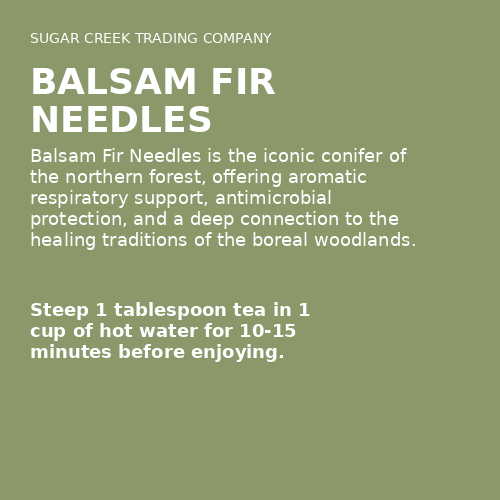
The iconic conifer of the northern forest, offering aromatic respiratory support, antimicrobial protection, and a deep connection to the healing traditions of the boreal woodlands.
BOTANICAL IDENTIFICATION
Scientific Name: Abies balsamea (L.) Mill.
Common Names: Balsam Fir, Canadian Balsam, Eastern Fir, Blister Pine, Balm of Gilead Fir, Sapin Baumier
Family: Pinaceae (Pine family)
Balsam Fir is a medium-sized evergreen conifer that typically reaches 15 to 20 meters in height, with a narrow, symmetrical spire-shaped crown that gives it the classic "Christmas tree" silhouette. Its needles are flat, dark green on top with two silvery-white stomatal bands beneath, arranged in a flat spray along the branches. The bark is smooth and gray on young trees, studded with distinctive resin blisters that contain the clear, fragrant oleoresin known as Canada balsam. Small, upright purple cones appear on the upper branches and disintegrate on the tree at maturity.
Native to the boreal and northern temperate forests of eastern and central North America, Balsam Fir ranges from Labrador and the Maritime Provinces west to Alberta and south through the Appalachians to Virginia. It thrives in cool, moist environments, often forming dense stands in bogs, stream valleys, and shaded north-facing slopes. It is one of the most cold-hardy conifers on the continent, tolerating winter temperatures well below minus forty degrees.
CULTURAL AND HISTORICAL USE
Balsam Fir holds a position of central importance in the medicinal traditions of nearly every Indigenous nation within its range. The Wabanaki, Mi'kmaq, Cree, Ojibwe, Algonquin, and Haudenosaunee peoples all employed the needles, resin, and inner bark extensively. Needle teas were a primary winter medicine for colds, coughs, and chest congestion. The resin from bark blisters was applied directly to cuts, burns, sores, and skin infections as a natural antiseptic bandage. Poultices of chewed or pounded needles were placed on the chest for pneumonia and on joints for rheumatic pain. The aromatic boughs were burned as smudge for ceremonial purification and to cleanse sickrooms.
European explorers and settlers quickly adopted Balsam Fir medicine from Indigenous teachers. The needle tea proved critical in preventing scurvy during harsh northern winters, as the needles contain significant vitamin C. Jacques Cartier's 1535 expedition was famously saved from scurvy by an Indigenous-prepared conifer tea, widely believed to have been made from either Balsam Fir or a closely related species. By the 18th century, Canada balsam (the oleoresin) had become an internationally traded commodity, prized not only medicinally but as an optical cement for microscope lenses and as an artists' medium due to its exceptional clarity.
In the Western herbal tradition, Balsam Fir needles have been valued as an aromatic respiratory herb, a warming circulatory stimulant, and a mild diuretic. The Eclectic physicians documented the oleoresin's use for bronchitis, cystitis, and gonorrhea. Today, Balsam Fir needles are widely used in herbal teas, steam inhalations, bath preparations, and aromatic products, and the tree remains one of the most culturally significant conifers in North American life, inseparable from the sensory experience of the northern forest.
KEY BIOACTIVE COMPOUNDS & BENEFITS
| Compound/Class | Location in Plant | Human Benefit | Role in Plant |
|---|---|---|---|
| Monoterpenes (alpha-pinene, beta-pinene, limonene, camphene) | Needles, resin | Expectorant, bronchodilator, antimicrobial, uplifting aromatic | Herbivore deterrent, antimicrobial defense |
| Sesquiterpenes (beta-caryophyllene, humulene) | Needles, resin | Anti-inflammatory, analgesic, CB2 receptor modulation | Insect deterrent, pathogen resistance |
| Bornyl acetate | Needles | Sedative-like calming, anti-inflammatory, muscle relaxant properties | Volatile defense compound, ecological signaling |
| Vitamin C (ascorbic acid) | Fresh and dried needles | Immune support, antioxidant protection, collagen synthesis | Antioxidant defense, metabolic function |
| Resin acids (abietic acid, dehydroabietic acid) | Resin, needle surfaces | Antimicrobial and antifungal activity, topical wound protection | Wound sealing, pathogen defense after bark injury |
The terpene-rich volatile oil of Balsam Fir needles is the primary driver of their therapeutic activity. Alpha-pinene and beta-pinene alone have been extensively studied for their bronchodilatory, anti-inflammatory, and antimicrobial properties. Bornyl acetate, which is particularly abundant in Abies species compared to other conifers, contributes a distinctive calming quality that distinguishes Balsam Fir from more stimulating conifer teas. The combination of respiratory-opening terpenes, immune-supporting vitamin C, and calming bornyl acetate makes these needles uniquely suited for winter wellness applications.
HOW IT WORKS IN THE BODY
Balsam Fir needles deliver their benefits through both ingestion (as tea) and inhalation of volatile aromatic compounds, creating a dual-pathway mechanism particularly effective for respiratory and immune support.
Respiratory System:
When brewed as a tea or used in steam inhalation, the volatile monoterpenes -- particularly alpha-pinene, beta-pinene, and limonene -- are released and delivered directly to the respiratory mucosa. Alpha-pinene has been shown in published research to act as a bronchodilator, relaxing airway smooth muscle and increasing airflow. These same terpenes stimulate mucociliary clearance, helping the body move phlegm and debris out of the bronchial passages. The combined expectorant, bronchodilatory, and antimicrobial actions make Balsam Fir one of the most effective conifer species for addressing respiratory congestion.
Immune Support:
The vitamin C content of Balsam Fir needles supports immune cell function, including the activity of neutrophils and lymphocytes critical to fighting respiratory infections. The antimicrobial terpenes and resin acids provide complementary direct-action defense against airborne pathogens. Traditional use of Balsam Fir tea during cold and flu season reflects centuries of empirical observation of this immune-supporting activity.
Nervous System and Mood:
Bornyl acetate, abundant in Balsam Fir, has demonstrated sedative and anxiolytic properties in animal studies. Inhalation of Balsam Fir aroma has been associated with reduced stress markers, lower cortisol levels, and improved mood in aromatherapy research. The Japanese practice of "shinrin-yoku" (forest bathing) is grounded in part on the documented physiological benefits of inhaling conifer terpenes, and Balsam Fir-dominant forests are among the richest sources of these airborne compounds.
Circulatory and Musculoskeletal:
When used in bath preparations or applied topically as an infused oil, the warming terpenes stimulate local blood flow, helping to ease muscle tension and joint stiffness. The anti-inflammatory sesquiterpenes beta-caryophyllene and humulene contribute analgesic effects, making Balsam Fir a useful addition to warming liniments and bath soaks for cold-weather aches.
DOSE GUIDELINES
| Preparation Type | Typical Dose | Purpose |
|---|---|---|
| Herbal infusion (tea) | 1-2 tablespoons dried needles per cup, steeped covered 15-20 minutes | Respiratory support, immune boosting, vitamin C intake, winter wellness |
| Steam inhalation | 2-3 tablespoons dried needles in a bowl of hot water, inhale 10-15 minutes | Sinus and bronchial congestion relief, aromatic therapy |
| Bath preparation | 1-2 cups dried needles in a muslin bag, placed in hot bath water | Muscle relaxation, respiratory opening, stress relief, circulation support |
| Tincture (1:5, 50% ethanol) | 2-4 mL, up to three times daily | Concentrated respiratory and immune support during acute illness |
Balsam Fir needle tea is safe for regular daily use as a pleasant, aromatic beverage with immune-supporting benefits. During acute respiratory illness, increase frequency to three to four cups per day. The needles require a covered steep to retain the volatile terpenes -- do not boil them in an open pot, as this drives off the most active aromatic compounds.
PREPARATION AND USES
For a simple needle tea, place one to two tablespoons of dried Balsam Fir needles in a mug, pour just-boiled water over them, cover tightly, and steep for fifteen to twenty minutes. The cover is essential to capture the volatile terpene-rich steam that would otherwise escape. Strain and drink as is, or add honey and a squeeze of lemon. The flavor is mildly resinous, bright, and refreshing with a distinctive forest character. Some people prefer a lighter brew at one tablespoon per cup; others enjoy a stronger, more aromatic preparation.
For a powerful steam inhalation, place two to three tablespoons of needles in a large bowl, pour boiling water over them, and lean over the bowl with a towel draped over your head. Breathe deeply for ten to fifteen minutes, keeping your face at a comfortable distance from the steam. This method delivers concentrated terpenes directly to the sinuses and bronchial passages and provides rapid relief during head colds and chest congestion. The needles can also be added to homemade fire starters, sachets, and potpourri blends for a natural forest fragrance. For topical use, infuse the needles in olive or jojoba oil for two to four weeks to create a warming massage oil for sore muscles and stiff joints.
OPTIMAL CONTEXT FOR USE
This herb is especially well-suited for individuals experiencing:
Chest colds, bronchial congestion, sinus stuffiness, or persistent cough where respiratory opening and expectorant support are needed
Weakened immunity during cold and flu season, or desire for a daily vitamin C-rich herbal tea for winter wellness
Stress, mental fatigue, or low mood where the calming, grounding aroma of conifer terpenes provides psychological benefit
Sore muscles, joint stiffness, or poor circulation that responds to warming aromatic bath preparations or topical oil applications
A desire for a sustainably sourced, wild-crafted North American conifer tea with deep roots in Indigenous and folk healing traditions
Balsam Fir needles pair well with Peppermint and Eucalyptus for enhanced respiratory blends, with Elderberry and Rose Hips for immune-boosting winter teas, and with Chamomile or Lavender for calming bedtime preparations. In bath blends, they combine beautifully with Epsom salts, Juniper berries, and Pine needles.
SUSTAINABILITY AND ETHICAL HARVESTING
Balsam Fir is one of the most abundant conifer species in eastern North America, with vast stands spanning millions of acres of boreal forest. The species regenerates prolifically in logged and disturbed areas and is extensively planted in Christmas tree farms and reforestation projects. It is not threatened or at risk from needle harvesting, which involves clipping small branch tips and does not damage the tree when done responsibly.
Ethical harvesting of Balsam Fir needles follows the same principles that govern all sustainable wildcrafting: take only what is needed, never strip more than a small fraction of any individual tree's foliage, harvest from the lower and interior branches where the impact is minimal, and avoid harvesting from trees showing signs of stress or disease. The species' abundance and fast growth make it one of the most ecologically sustainable botanicals available. Supporting wildcrafters who follow these principles helps maintain healthy forest ecosystems and rural livelihoods.
SAFETY AND CAUTIONS
Balsam Fir needles are generally regarded as safe for tea, culinary, and topical use, with a long history of consumption across cultures.
Kidney and urinary conditions: The terpene content may be irritating to individuals with pre-existing kidney inflammation or severe urinary tract conditions. Those with kidney disease should consult a healthcare provider before regular use.
Allergies: Individuals with known allergies to conifers, pine pollen, or turpentine-related products should use caution and start with a small test amount. Skin contact with the resin or concentrated oil may cause contact dermatitis in sensitive individuals.
Pregnancy and nursing: While occasional use of Balsam Fir needle tea is considered low-risk by most herbalists, regular or large doses have not been formally studied in pregnancy. Pregnant or nursing individuals should consult a healthcare provider and use moderately.
Species identification: When wildcrafting, ensure correct identification. Balsam Fir should not be confused with yew (Taxus spp.), which is toxic. Balsam Fir needles are flat with two white stripes on the underside and have a pleasant, resinous fragrance when crushed.
REFERENCES
Pichette, A., et al. (2006). "Composition and antibacterial activity of Abies balsamea essential oil." Phytotherapy Research, 20(5), 371-373.
Nam, S.Y., et al. (2014). "The therapeutic efficacy of alpha-pinene in an experimental mouse model of allergic rhinitis." International Immunopharmacology, 23(1), 304-311.
Li, Q. (2010). "Effect of forest bathing trips on human immune function." Environmental Health and Preventive Medicine, 15(1), 9-17.
Moerman, D.E. (1998). Native American Ethnobotany. Timber Press, Portland, OR.
Arnason, T., et al. (1981). "Use of plants for food and medicine by Native peoples of eastern Canada." Canadian Journal of Botany, 59(11), 2189-2325.
FINAL NOTE
Balsam Fir needles are the boreal forest in a cup -- aromatic, cleansing, and quietly restorative. For thousands of years, the peoples of the northern woodlands have turned to this tree when winter closes in and the body needs respiratory clearing, immune reinforcement, and the deep calming presence that only a forest can provide. A covered cup of Balsam Fir tea, steeped long enough to fill the room with its resinous warmth, remains one of the simplest and most effective herbal medicines available to anyone with access to the northern forest.
Share