Sugar Creek Trading Company
Barberry Root Bark
Barberry Root Bark
Couldn't load pickup availability
BERBERIS VULGARIS
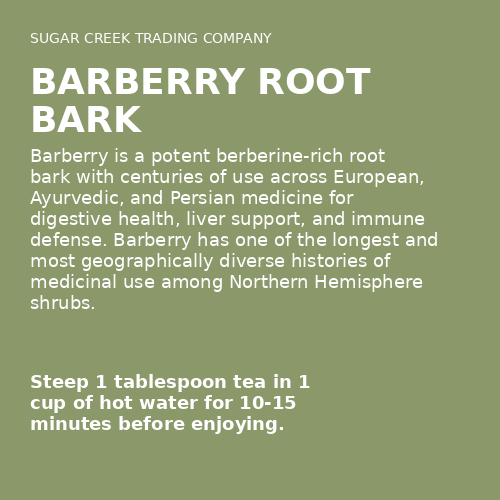
A potent berberine-rich root bark with centuries of use across European, Ayurvedic, and Persian medicine for digestive health, liver support, and immune defense.
BOTANICAL IDENTIFICATION
Scientific Name: Berberis vulgaris L.
Common Names: Barberry, Common Barberry, European Barberry, Jaundice Berry, Pepperidge Bush, Holy Thorn
Family: Berberidaceae (Barberry family)
Barberry is a thorny, deciduous shrub growing 1 to 3 meters tall, with arching branches armed with sharp, three-pronged spines at the leaf nodes. The leaves are small, oval, and finely serrated, appearing in clusters from short shoots. In spring, the plant produces drooping racemes of small, bright yellow flowers that mature into elongated, bright red berries by autumn. The inner bark and wood are a distinctive deep yellow color, a visual indicator of the plant's high alkaloid content.
Native to central and southern Europe, northwest Africa, and western Asia, barberry has naturalized widely across temperate regions of North America. It thrives in well-drained soils in hedgerows, woodland margins, rocky hillsides, and disturbed areas, tolerating both full sun and partial shade. The root bark, which is the primary medicinal part, is harvested from mature plants and dried for use.
CULTURAL AND HISTORICAL USE
Barberry has one of the longest and most geographically diverse histories of medicinal use among Northern Hemisphere shrubs. Ancient Egyptian physicians reportedly used barberry fruit preparations to prevent plague, and the plant appears in Assyrian medical texts dating to the 7th century BCE, where it was referenced as a blood-purifying agent. In the classical Greek tradition, Dioscorides mentioned barberry preparations for their cooling and astringent properties, recommending them for digestive and inflammatory complaints.
In Persian and Unani medicine, barberry (known as zereshk) has been a cornerstone remedy for centuries, prescribed for liver and gallbladder disorders, fever, diarrhea, and as a general tonic for debility. The berries remain a staple culinary ingredient in Iranian cuisine, particularly in rice dishes, valued for their tart flavor and digestive properties. In Ayurvedic medicine, the closely related Berberis aristata (Indian barberry or daruharidra) is used almost interchangeably with B. vulgaris for similar indications -- particularly for eye conditions, skin diseases, liver support, and as a bitter digestive tonic. The Sanskrit name daruharidra, meaning "wood turmeric," reflects the yellow color of the inner bark and its perceived kinship with turmeric's healing properties.
In European herbal medicine, barberry root bark became a key remedy in the treatment of jaundice and liver congestion -- hence the common name "jaundice berry." The Eclectic physicians of 19th-century America adopted it enthusiastically, with Felter and Lloyd documenting its use for dyspepsia, hepatic torpor, chronic diarrhea, and as a bitter tonic to restore appetite and vitality. It was listed in the United States Pharmacopoeia from 1842 to 1926. In folk herbalism across Europe, a decoction of the root bark was applied as a mouthwash for sore gums and as a wash for skin infections and conjunctivitis.
KEY BIOACTIVE COMPOUNDS & BENEFITS
| Compound/Class | Location in Plant | Human Benefit | Role in Plant |
|---|---|---|---|
| Berberine | Root bark (highest concentration), stem bark, roots | Antimicrobial, blood sugar regulation, lipid-lowering, anti-inflammatory, liver-protective | Antimicrobial defense compound; gives yellow color |
| Berbamine | Root bark, roots | Anti-inflammatory, immune-modulating, potential anti-tumor activity | Chemical defense alkaloid |
| Palmatine | Root bark | Antimicrobial, hepatoprotective, analgesic | Secondary defense alkaloid |
| Jatrorrhizine | Root bark | Antimicrobial, digestive support, cholesterol-modulating | Antimicrobial defense |
| Tannins and organic acids | Root bark, berries | Astringent, antidiarrheal, tissue-toning | Protection against herbivory and UV damage |
The therapeutic identity of barberry root bark is built around berberine and its companion isoquinoline alkaloids. Berberine is one of the most extensively researched plant alkaloids in modern science, with over 4,500 published studies examining its effects on metabolic health, infection, inflammation, and cardiovascular function. The full spectrum of alkaloids in barberry root bark works synergistically, with berbamine, palmatine, and jatrorrhizine complementing and enhancing berberine's effects in ways that isolated berberine supplements may not fully replicate.
HOW IT WORKS IN THE BODY
Barberry root bark delivers a complex of isoquinoline alkaloids that exert influence across multiple organ systems, with particularly well-documented effects on the digestive tract, liver, metabolic regulation, and immune defense.
Digestive and Gastrointestinal Support:
Berberine acts directly on the gastrointestinal tract to inhibit the growth of pathogenic bacteria, parasites, and fungi while showing a relatively sparing effect on beneficial gut flora. It reduces intestinal secretion and slows transit time in cases of diarrhea, partly through inhibition of bacterial toxin activity. As a potent bitter, barberry root bark also stimulates the production of bile and digestive secretions, improving the breakdown and absorption of fats and nutrients.
Liver and Gallbladder Function:
Berberine and palmatine promote bile flow (choleretic and cholagogue activity), supporting the liver's detoxification processes and helping to prevent bile stasis. Berberine has been shown to protect hepatocytes from oxidative damage and to reduce hepatic fat accumulation, which underlies its traditional use for jaundice and liver congestion. These effects are supported by multiple clinical trials in patients with non-alcoholic fatty liver disease.
Metabolic Regulation:
Berberine activates AMP-activated protein kinase (AMPK), a master metabolic switch that regulates glucose uptake, fatty acid oxidation, and insulin sensitivity. Clinical trials have demonstrated that berberine can lower fasting blood glucose, HbA1c, and triglyceride levels comparably to some pharmaceutical agents. This makes berberine-rich herbs like barberry root bark of particular interest for supporting healthy blood sugar and lipid metabolism.
Immune Defense and Antimicrobial Activity:
Berberine demonstrates broad-spectrum antimicrobial activity against bacteria (including Staphylococcus aureus, E. coli, and Streptococcus species), fungi (including Candida), and certain parasites (including Giardia lamblia and Entamoeba histolytica). It works through multiple mechanisms including disruption of bacterial cell membranes, inhibition of bacterial enzyme systems, and prevention of bacterial adhesion to mucosal surfaces.
DOSE GUIDELINES
| Preparation Type | Typical Dose | Purpose |
|---|---|---|
| Decoction (root bark tea) | 1-2 teaspoons dried root bark simmered in 1 cup water for 15-20 minutes; 1-3 cups daily | Digestive support, liver tonic, general bitter tonic |
| Tincture (1:5, 45% alcohol) | 2-4 mL (40-80 drops), 3 times daily | Concentrated antimicrobial and metabolic support |
| Powdered root bark (capsules) | 500-1000 mg, 2-3 times daily with meals | Metabolic support, blood sugar and lipid management |
| Topical decoction/wash | Strong decoction applied externally with cloth or cotton | Skin infections, eye wash (well-strained), mouth sores |
Barberry root bark is best used in defined courses rather than continuously. Traditional use patterns typically involve 2 to 6 weeks of regular use followed by a break, particularly at higher doses. As a bitter digestive tonic, smaller doses taken before meals are often most effective. The intensely bitter flavor of the decoction is itself therapeutic, stimulating the vagal bitter-taste reflex that activates digestive secretions.
PREPARATION AND USES
Because the root bark is a hard, woody material, decoction (simmering) rather than simple infusion is the preferred method for extracting its alkaloids. Place one to two teaspoons of dried, cut root bark in a small saucepan with one cup of cold water, bring to a gentle boil, then reduce heat and simmer covered for 15 to 20 minutes. Strain and drink warm. The tea will be deeply yellow and intensely bitter -- this bitterness is a sign of the alkaloid content and is central to its therapeutic effect. Honey or a small amount of licorice root can soften the flavor if needed.
For tincturing, barberry root bark extracts well in 45 to 60 percent alcohol. The tincture is convenient for precise dosing and travel. Powdered root bark can be encapsulated for those who cannot tolerate the bitter taste. Topically, a strong decoction makes an effective antimicrobial wash for minor skin infections, fungal conditions, and as a gargle for sore throats and inflamed gums. When used as an eye wash, the decoction must be carefully strained through fine cloth or a coffee filter and allowed to cool to body temperature.
OPTIMAL CONTEXT FOR USE
Barberry root bark is especially well-suited for individuals experiencing:
Sluggish digestion, poor appetite, or a sense of heaviness after meals -- where the bitter tonic and bile-stimulating properties can help restore digestive function
Gastrointestinal infections, traveler's diarrhea, or intestinal dysbiosis involving pathogenic bacteria, parasites, or Candida overgrowth
Liver congestion, fatty liver concerns, or a need for gentle hepatic detoxification support
Metabolic challenges including elevated blood sugar, insulin resistance, or high triglycerides, as part of a comprehensive dietary and lifestyle approach
Recurring skin conditions, urinary tract infections, or other situations where broad-spectrum antimicrobial support is desired alongside conventional care
Barberry root bark combines well with other bitter and hepatic herbs such as dandelion root, milk thistle, Oregon grape root, and gentian for comprehensive digestive and liver support protocols.
SUSTAINABILITY AND ETHICAL HARVESTING
Common barberry is an abundant and widely distributed species that is not at risk of overharvesting in most regions. In fact, in parts of North America, Berberis vulgaris and the closely related Japanese barberry (B. thunbergii) are considered invasive species, and their removal is encouraged by conservation agencies. Harvesting root bark from naturalized barberry populations in North America can thus serve a dual ecological purpose. In its native European and Asian range, barberry remains common in hedgerows and wild areas.
Ethical root bark harvesting involves digging portions of the root system from mature, multi-stemmed plants while leaving enough root mass for the plant to recover, or harvesting entire plants in areas where removal is ecologically desirable. Cultivated barberry is also widely available from nursery stock and can be grown specifically for medicinal harvest in temperate gardens.
SAFETY AND CAUTIONS
Barberry root bark is generally safe at recommended doses for short to moderate duration use in healthy adults, but its potent alkaloid content warrants attention to certain precautions.
Berberine can interact with several classes of medications, including blood sugar-lowering drugs (risk of hypoglycemia), blood thinners (potential enhanced anticoagulant effect), certain antibiotics (particularly macrolides and fluoroquinolones via CYP enzyme interactions), and immunosuppressants. Consult a healthcare provider if you take prescription medications.
Barberry root bark is contraindicated during pregnancy. Berberine has demonstrated uterine-stimulating activity and has been associated with potential risk to the developing fetus, including interference with bilirubin metabolism in newborns. It should not be used during breastfeeding without professional guidance.
High doses or prolonged continuous use may cause gastrointestinal irritation, including nausea and cramping. Follow recommended dosing and take breaks between courses of use.
Individuals with gallstones or bile duct obstruction should use barberry with caution due to its bile-stimulating effects, and only under professional supervision.
REFERENCES
Imanshahidi, M. and Hosseinzadeh, H. "Pharmacological and therapeutic effects of Berberis vulgaris and its active constituent, berberine." Phytotherapy Research, 22(8): 999-1012, 2008.
Yin, J., Xing, H., and Ye, J. "Efficacy of berberine in patients with type 2 diabetes mellitus." Metabolism, 57(5): 712-717, 2008.
Felter, H.W. and Lloyd, J.U. King's American Dispensatory. 18th ed., 1898. (Eclectic medical uses of Berberis vulgaris.)
Yan, D., et al. "Berberine: a review of its pharmacokinetics, pharmacology, and clinical applications." Frontiers in Pharmacology, 11: 712, 2020.
Neag, M.A., et al. "Berberine: botanical occurrence, traditional uses, extraction methods, and relevance in cardiovascular, metabolic, hepatic, and renal disorders." Frontiers in Pharmacology, 9: 557, 2018.
FINAL NOTE
Barberry root bark is one of the great bitter medicines of the Western and Eastern herbal traditions -- a yellow-hearted remedy that speaks directly to the liver, the gut, and the body's metabolic intelligence. Its remarkable concentration of berberine and companion alkaloids makes it a bridge between ancient herbal wisdom and modern clinical research, with a depth of evidence that few botanical medicines can match. For those willing to embrace its unapologetic bitterness, barberry root bark offers a profound and time-tested path to digestive vitality, metabolic balance, and resilient immune function.
Share