Sugar Creek Trading Company
Beet Root
Beet Root
Couldn't load pickup availability
BETA VULGARIS
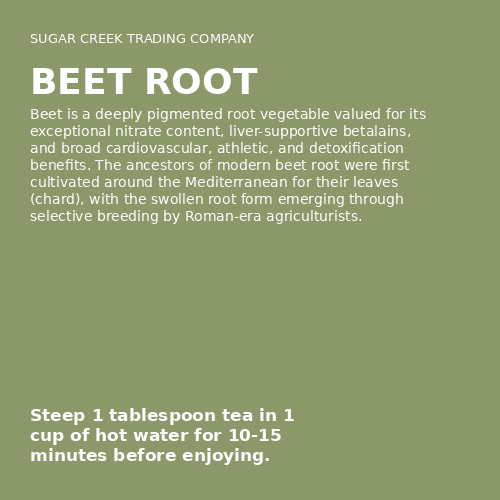
A deeply pigmented root vegetable valued for its exceptional nitrate content, liver-supportive betalains, and broad cardiovascular, athletic, and detoxification benefits.
BOTANICAL IDENTIFICATION
Scientific Name: Beta vulgaris L. subsp. vulgaris
Common Names: Beet Root, Red Beet, Garden Beet, Table Beet, Blood Turnip
Family: Amaranthaceae (formerly Chenopodiaceae)
Beet root is a biennial herbaceous plant cultivated as an annual for its swollen, fleshy taproot. The root is typically deep crimson to dark purple-red, though golden, white, and candy-striped cultivars also exist. The plant produces a rosette of broad, ovate leaves with prominent red-purple veining, and in its second year sends up a tall flowering spike bearing small, inconspicuous green flowers. The root flesh is dense, sweet, and earthy in flavor, with its intense color derived from betalain pigments.
Native to the Mediterranean coastline and Western Asia, beet root has been cultivated for over 4,000 years and is now grown commercially worldwide in temperate climates. It thrives in loose, well-drained soils with consistent moisture and is highly adaptable, tolerating a range of soil pH levels and moderate salinity.
CULTURAL AND HISTORICAL USE
The ancestors of modern beet root were first cultivated around the Mediterranean for their leaves (chard), with the swollen root form emerging through selective breeding by Roman-era agriculturists. Hippocrates recommended beet leaves as wound dressings, while Roman writers including Apicius documented the root in culinary recipes. By the Middle Ages, beet root was established as both a food crop and a medicinal plant across Europe, used by folk practitioners to address conditions of the blood and liver.
In traditional European folk medicine, beet root was considered a blood-building tonic, prescribed for anemia, pallor, and general weakness. Its deep red juice was seen as a signature of its affinity for the blood — a doctrine-of-signatures association that modern science has partially vindicated through the discovery of its effects on nitric oxide production and hemoglobin support. In Eastern European and Russian traditions, beet root is central to the cuisine and folk medicine alike, appearing in borscht and kvass, the latter being a fermented beet beverage used for digestive health and vitality.
In Ayurvedic medicine, beet root is considered a blood purifier and liver tonic, used to balance Pitta and support healthy digestion. Traditional Chinese Medicine does not use beet root extensively in its classical pharmacopoeia, but modern TCM practitioners have adopted it as a food therapy for blood stasis and liver Qi stagnation. The modern scientific era has brought beet root into the spotlight primarily for its remarkable nitrate content and its effects on cardiovascular performance and athletic endurance.
KEY BIOACTIVE COMPOUNDS & BENEFITS
| Compound/Class | Location in Plant | Human Benefit | Role in Plant |
|---|---|---|---|
| Inorganic nitrates | Root flesh, concentrated in outer layers | Converted to nitric oxide in the body; lowers blood pressure, enhances exercise performance, improves vascular endothelial function | Nitrogen uptake and storage from soil; metabolic reserve |
| Betalains (betacyanins and betaxanthins) | Root flesh (betanin is the primary red pigment) | Potent antioxidant and anti-inflammatory activity; phase II liver enzyme induction; protects against oxidative damage to lipids and DNA | Pigmentation; UV protection; possible antimicrobial defense |
| Betaine (trimethylglycine) | Root flesh | Supports liver function and healthy homocysteine metabolism; acts as an osmolyte protecting cells from dehydration stress | Osmotic regulation in saline or drought conditions |
| Dietary fiber (pectin, cellulose) | Root flesh | Supports healthy digestion, feeds beneficial gut microbiota, promotes regular bowel function | Structural support for root tissue |
| Minerals (potassium, manganese, iron, folate) | Throughout root | Supports electrolyte balance, red blood cell formation, and methylation pathways critical for cardiovascular and neurological health | Essential cofactors for plant enzymatic processes |
Beet root's therapeutic profile is anchored by the interplay between its nitrate content, betalain pigments, and betaine. Together, these compounds create a food-medicine that simultaneously supports vascular function, antioxidant defense, liver detoxification, and cellular resilience — a combination that explains why beet root has become one of the most studied functional foods of the 21st century.
HOW IT WORKS IN THE BODY
Beet root exerts its effects through several well-characterized physiological pathways, with the nitrate-nitric oxide pathway being the most extensively researched.
Nitric Oxide Production and Cardiovascular Support:
Dietary nitrates from beet root are absorbed in the upper gastrointestinal tract and concentrated in the salivary glands, where oral bacteria on the tongue reduce them to nitrite. This nitrite is then further converted to nitric oxide (NO) in the stomach and bloodstream. Nitric oxide is a critical signaling molecule that relaxes vascular smooth muscle, dilates blood vessels, and reduces blood pressure. Multiple clinical trials have demonstrated that beet root juice consumption can reduce systolic blood pressure by 4 to 10 mmHg within hours, with sustained benefits over weeks of regular use.
Athletic Performance and Oxygen Efficiency:
The nitric oxide produced from beet root nitrates improves the efficiency of mitochondrial oxygen utilization during exercise. Studies in athletes and recreational exercisers have shown that beet root supplementation can reduce the oxygen cost of submaximal exercise by 5-7%, extend time to exhaustion, and improve power output. These effects are particularly pronounced at high altitude and in endurance activities.
Liver Support and Detoxification:
Betaine (trimethylglycine) functions as a methyl donor in the liver, supporting the conversion of homocysteine to methionine — a critical step in the methylation cycle. Elevated homocysteine is a recognized risk factor for cardiovascular disease and cognitive decline. Betalain pigments also induce phase II detoxification enzymes, including glutathione S-transferase and quinone reductase, helping the liver neutralize and eliminate toxins more efficiently.
Antioxidant and Anti-Inflammatory Protection:
Betalains are among the most potent water-soluble antioxidants found in food, demonstrating higher free-radical scavenging capacity than many common polyphenols in laboratory assays. They inhibit COX-2 and lipoxygenase enzymes, reduce NF-kB activation, and protect LDL cholesterol from oxidation — mechanisms relevant to reducing chronic inflammation and cardiovascular risk.
DOSE GUIDELINES
| Preparation Type | Typical Dose | Purpose |
|---|---|---|
| Dried beet root powder | 3-6 grams (approximately 1-2 teaspoons) daily, mixed into water, juice, or smoothies | General cardiovascular support, liver health, and antioxidant protection |
| Beet root capsules | 500-1,000 mg, 2-3 times daily | Convenient daily supplementation for blood pressure and energy support |
| Decoction (simmered tea) | 1-2 teaspoons dried beet root in 8 oz water, simmered 10-15 minutes; 1-2 cups daily | Gentle daily tonic for digestion, liver support, and nutrient intake |
| Pre-exercise dose (powder or juice) | 5-8 grams powder (or 500 mL fresh juice) taken 2-3 hours before exercise | Athletic performance enhancement and oxygen efficiency |
Beet root is well-suited for long-term daily use as a food-level supplement. Cardiovascular benefits appear to increase with consistent daily intake over several weeks. For athletic performance, acute dosing 2 to 3 hours before exercise produces measurable effects, but chronic loading over 5 to 7 days yields more reliable improvements.
PREPARATION AND USES
Dried beet root powder dissolves readily in water, juice, or smoothies and has a mildly sweet, earthy flavor that blends well with other ingredients. It can be stirred into oatmeal, yogurt, or baked goods to add both nutrition and a striking deep-red color. For a simple tonic tea, simmer 1 to 2 teaspoons of dried beet root pieces in water for 10 to 15 minutes, strain, and drink warm or cool.
Beet root powder can also be encapsulated for those who prefer a tasteless delivery method, or blended into pre-workout formulations alongside other nitrate-rich or energy-supporting ingredients. When used topically, beet root decoctions have traditional applications as mild skin-soothing washes. The powder stores well in a cool, dry, dark environment, but note that betalain pigments degrade with prolonged light and heat exposure, so proper storage is important to maintain potency and color.
OPTIMAL CONTEXT FOR USE
Beet root is especially well-suited for individuals experiencing:
Elevated blood pressure or a desire to support cardiovascular health through dietary means
Athletic training goals requiring improved endurance, oxygen efficiency, and recovery
Sluggish liver function, elevated homocysteine levels, or a need for enhanced detoxification capacity
Chronic fatigue or low energy, particularly when linked to poor circulation or nutrient deficiency
Anemia or low iron status, where beet root's iron and folate content can complement other interventions
Beet root pairs effectively with hawthorn berry for cardiovascular support, with milk thistle and dandelion root for comprehensive liver care, and with adaptogenic herbs like rhodiola and cordyceps for synergistic athletic performance benefits.
SUSTAINABILITY AND ETHICAL HARVESTING
Beet root is a commercially cultivated crop with no conservation concerns. It is grown on every inhabited continent and is one of the most resource-efficient root vegetables, requiring moderate water inputs and tolerating a range of soil conditions including moderate salinity. Organic beet root cultivation avoids synthetic fertilizers and pesticides, supporting soil health and reducing runoff into waterways.
From a sustainability perspective, beet root is notable for its minimal waste profile — the roots, leaves, and stems are all edible, and the residual pulp from juice extraction can be composted or used as animal feed. Choosing organically grown beet root supports farming practices that build rather than deplete soil fertility, and ensures the product is free from residual herbicides and synthetic nitrogen compounds that could confound the nitrate content of the final product.
SAFETY AND CAUTIONS
Beet root is an extremely safe food-level supplement with a long history of daily culinary use worldwide. However, a few considerations apply.
Beeturia: Consumption of beet root causes red or pink discoloration of urine and stools in approximately 10-14% of the population. This is harmless and results from the excretion of betalain pigments, but it can be alarming if unexpected. It is not a sign of bleeding.
Oxalate content: Beet root contains moderate levels of oxalic acid. Individuals with a history of calcium oxalate kidney stones should consume beet root in moderation and ensure adequate hydration and calcium intake to bind dietary oxalates in the gut.
Blood pressure medications: Because beet root can lower blood pressure through nitric oxide-mediated vasodilation, individuals taking antihypertensive medications should monitor their blood pressure when adding beet root to their regimen and consult their healthcare provider to avoid excessive hypotension.
Nitrate-sensitive conditions: Individuals on medications that interact with nitrates (such as PDE-5 inhibitors like sildenafil, or organic nitrate drugs for angina) should avoid high-dose beet root supplementation without medical guidance, as additive vasodilation could cause dangerously low blood pressure.
REFERENCES
Clifford, T., et al. "The potential benefits of red beetroot supplementation in health and disease." Nutrients, 7(4): 2801-2822 (2015).
Siervo, M., et al. "Inorganic nitrate and beetroot juice supplementation reduces blood pressure in adults: a systematic review and meta-analysis." Journal of Nutrition, 143(6): 818-826 (2013).
Jones, A.M. "Dietary nitrate supplementation and exercise performance." Sports Medicine, 44(Suppl 1): S35-S45 (2014).
Krajka-Kuzniak, V., et al. "Beetroot juice protects against N-nitrosodiethylamine-induced liver injury in rats." Food and Chemical Toxicology, 50(6): 2027-2033 (2012).
Georgiev, V.G., et al. "Antioxidant activity and phenolic content of betalain extracts from intact plants and hairy root cultures of the red beetroot Beta vulgaris cv. Detroit Dark Red." Plant Foods for Human Nutrition, 65(2): 105-111 (2010).
FINAL NOTE
Beet root is that rare botanical that delivers profound physiological benefits through simple, food-based mechanisms the body already understands. Its nitrate-to-nitric-oxide pathway opens blood vessels and fuels athletic performance, its betalain pigments defend cells with some of nature's most potent water-soluble antioxidants, and its betaine quietly supports the liver's essential methylation and detoxification work. Whether taken as a daily powder, a pre-workout tonic, or a warming decoction, beet root exemplifies the principle that the most powerful medicines are often the most familiar foods, hiding remarkable complexity beneath their humble, earth-stained exterior.
Share