Sugar Creek Trading Company
Benzoin Gum
Benzoin Gum
Couldn't load pickup availability
STYRAX BENZOIN
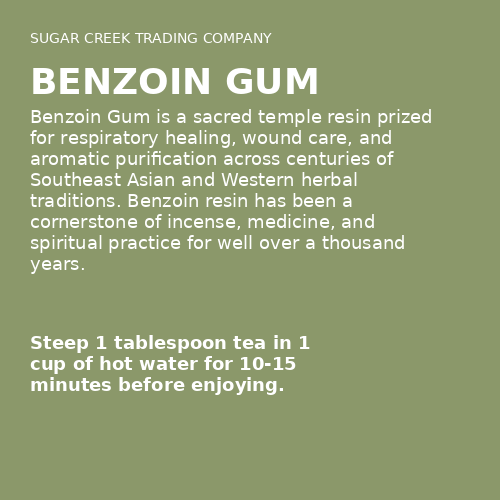
A sacred temple resin prized for respiratory healing, wound care, and aromatic purification across centuries of Southeast Asian and Western herbal traditions.
BOTANICAL IDENTIFICATION
Scientific Name: Styrax benzoin Dryand. (Siam benzoin: Styrax tonkinensis (Pierre) Craib ex Hartwich)
Common Names: Benzoin Gum, Gum Benjamin, Benzoin Resin, Loban, Kemenyan, Styrax Benzoin, Luban Jawi
Family: Styracaceae
Benzoin is harvested as a balsamic resin from medium-sized tropical trees that reach 10 to 20 meters in height. The trees have simple, alternate, ovate leaves with pale undersides and produce small, fragrant white flowers in drooping clusters. When the bark is incised, the tree exudes a thick, aromatic gum that hardens into amber-to-reddish-brown tears or lumps with a rich, warm, vanilla-like fragrance.
Native to the tropical forests of Sumatra, Java, and mainland Southeast Asia (Thailand, Laos, Vietnam), benzoin trees thrive in humid lowland and mid-elevation forests with well-drained soils. Sumatra benzoin (S. benzoin) and Siam benzoin (S. tonkinensis) are the two primary commercial varieties, each with a distinct aromatic profile.
CULTURAL AND HISTORICAL USE
Benzoin resin has been a cornerstone of incense, medicine, and spiritual practice for well over a thousand years. In Southeast Asia, it was burned in temples and homes as an offering to spirits and deities, and was one of the most important trade goods of the Malay Archipelago. Arab traders carried it along maritime spice routes to the Middle East, where it became known as "luban jawi" (Javanese frankincense) and was incorporated into Islamic fumigation practices, perfumery, and traditional medicine. In Ayurvedic and Unani systems, benzoin was used to treat respiratory congestion, skin wounds, and urinary complaints.
European herbalists adopted benzoin enthusiastically after it arrived via Venetian and Portuguese trade networks in the late medieval period. It became a key ingredient in Friar's Balsam (Compound Tincture of Benzoin), an antiseptic and respiratory preparation that remained an official pharmacopoeial remedy well into the 20th century and is still used today. Paracelsus and other Renaissance physicians valued it for preserving fats and oils, treating bronchial ailments, and dressing wounds. In Western perfumery, benzoin serves as a fixative and a warm, sweet base note.
Across cultures, benzoin has carried spiritual significance as a purifying agent. It was burned to cleanse sacred spaces in Buddhist temples, Catholic churches (as part of incense blends), and shamanic rituals throughout Indonesia. The resin's dual identity as both medicine and sacred substance reflects its deep integration into the cultural fabric of nearly every society that encountered it.
KEY BIOACTIVE COMPOUNDS & BENEFITS
| Compound/Class | Location in Plant | Human Benefit | Role in Plant |
|---|---|---|---|
| Benzoic Acid & Esters (coniferyl benzoate) | Resin exudate | Potent antimicrobial and antiseptic; protects wounds from infection | Chemical defense against microbial invasion at wound sites |
| Cinnamic Acid & Esters (coniferyl cinnamate) | Resin exudate | Anti-inflammatory; supports respiratory tract soothing | Deterrent against herbivores and pathogens |
| Vanillin | Resin exudate | Mild calming and mood-lifting aromatic; antioxidant properties | Aromatic volatile that may attract pollinators and deter pests |
| Triterpenoids (siaresinolic acid) | Resin exudate | Anti-inflammatory and expectorant activity | Structural component of resin matrix; wound sealing |
| Styrene & Benzaldehyde | Resin exudate (volatile fraction) | Aromatic compounds contributing to respiratory-clearing inhalation therapy | Volatile defense and wound-sealing compounds |
Benzoin's therapeutic profile is defined by its exceptionally high content of benzoic and cinnamic acid esters, which together account for its strong antiseptic and expectorant properties. The presence of vanillin gives it a distinctively warm, comforting aroma that also contributes mild antioxidant and anxiolytic effects. These compounds work in concert to make benzoin one of the most effective natural resins for respiratory support, wound care, and aromatic therapy.
HOW IT WORKS IN THE BODY
Benzoin acts primarily through its volatile aromatic compounds and its antimicrobial acid constituents, delivering benefits through both inhalation and topical application.
Respiratory Support and Expectoration:
When inhaled as a steam or burned as incense, benzoin's volatile aromatic acids help loosen and thin mucus in the bronchial passages. Benzoic acid and cinnamic acid esters stimulate the mucociliary clearance mechanism, promoting productive coughing and easing congestion. The warming, soothing vapors also help reduce irritation of inflamed mucous membranes in the throat and upper airways.
Antimicrobial and Wound-Healing Action:
Applied topically, benzoin's benzoic acid content creates an inhospitable environment for bacteria and fungi on the skin surface. The resin forms a protective, slightly adhesive film over minor cuts, cracks, and abrasions, sealing out pathogens while keeping the wound moist enough to promote healing. This mechanism is the basis for its long-standing use in Compound Tincture of Benzoin (Friar's Balsam) as a skin protectant and adhesive enhancer for bandages.
Circulatory Warming and Skin Care:
Benzoin has a gentle rubefacient quality when applied in diluted form, mildly stimulating local blood flow to the skin. This warming action helps deliver nutrients to damaged tissue and has made it a traditional remedy for chapped, cracked, or irritated skin, particularly in cold weather. In aromatherapy, the warm, sweet scent is considered grounding and emotionally comforting, helping to ease tension and nervous anxiety.
DOSE GUIDELINES
| Preparation Type | Typical Dose | Purpose |
|---|---|---|
| Steam Inhalation | 1-2 teaspoons of crushed resin in a bowl of hot water; inhale vapors for 10-15 minutes | Respiratory congestion, bronchitis, sore throat |
| Tincture (Friar's Balsam / Compound Tincture of Benzoin) | 5-20 drops in hot water for inhalation; or applied topically to skin | Antiseptic wound care, skin protection, respiratory steam |
| Topical Resin Application | Small amount of powdered resin mixed into a salve or carrier oil | Chapped skin, minor cuts, cracked heels |
| Incense / Fumigation | Small pieces burned on charcoal as needed | Aromatic therapy, space cleansing, stress relief |
Benzoin is best used as needed rather than as a daily internal supplement. For respiratory conditions, steam inhalation sessions can be repeated 2-3 times per day during acute illness. Topical use can be continued as long as needed. Benzoin is not typically taken internally in modern herbalism.
PREPARATION AND USES
Benzoin gum is most commonly used in its raw resin form, either as whole tears or coarsely powdered. For steam inhalation, crush the resin and add it to a bowl of near-boiling water, then drape a towel over your head and breathe the fragrant steam deeply for 10 to 15 minutes. This is one of the oldest and most effective home remedies for chest colds, bronchitis, and laryngitis. Alternatively, dissolve benzoin in alcohol (typically 70-90% ethanol) to create a tincture, which can be added to hot water for inhalation or applied directly to the skin as an antiseptic protectant.
For topical wound care and skin protection, benzoin tincture can be painted onto intact skin around a wound to help adhesive bandages stick better, or applied directly to minor cracks and abrasions. Powdered benzoin is also an excellent addition to homemade salves, balms, and body butters, where it acts as both a natural preservative (due to its antioxidant and antimicrobial properties) and a warm, sweet fragrance. As incense, benzoin burns with a rich, balsamic, slightly vanilla-toned smoke that is deeply calming and has been used in meditation and spiritual practice for centuries.
OPTIMAL CONTEXT FOR USE
Benzoin gum is especially well-suited for individuals experiencing:
Upper and lower respiratory congestion, including bronchitis, chest colds, sinusitis, and laryngitis
Dry, cracked, or chapped skin, particularly during cold-weather months
Minor cuts, abrasions, or skin irritation needing a protective antiseptic barrier
Need for a natural preservative or antioxidant in homemade skin care formulations
Stress, nervous tension, or desire for a grounding and comforting aromatic atmosphere
Benzoin pairs well with other respiratory herbs such as eucalyptus, thyme, and elecampane for inhalation blends, and complements frankincense, myrrh, and lavender in incense and aromatherapy formulations.
SUSTAINABILITY AND ETHICAL HARVESTING
Benzoin is harvested by tapping living trees, a non-destructive process similar to rubber or maple syrup collection. The bark is incised and the resin is collected over several weeks as it exudes and hardens. A single tree can be tapped productively for many years, making benzoin a sustainable forest product when managed responsibly. In Sumatra and Laos, benzoin harvesting has historically provided vital income for smallholder farming communities living near tropical forests.
However, deforestation and land conversion for palm oil and other monocultures threaten benzoin-producing forests in some regions. Supporting suppliers who source from community-managed agroforestry systems helps ensure that benzoin harvesting continues to provide economic incentives for forest conservation rather than clearing. Wild and semi-cultivated benzoin trees remain abundant in their native range when forest habitats are maintained.
SAFETY AND CAUTIONS
Benzoin is generally regarded as safe for external and inhalation use when used as directed.
Contact dermatitis is the most common adverse reaction. Some individuals may develop skin sensitivity or allergic reactions to benzoin, particularly with repeated topical use. Patch test before applying to large areas of skin.
Benzoin is not recommended for internal consumption in most modern herbal practice. Its primary applications are topical and inhalation-based.
Individuals with asthma or reactive airway conditions should use steam inhalation cautiously, as strong aromatic vapors can occasionally trigger bronchospasm in sensitive individuals.
Pregnant and nursing women should consult a qualified healthcare provider before using benzoin medicinally, as safety data for these populations is limited.
REFERENCES
British Herbal Pharmacopoeia (1983). Monograph: Benzoin.
Fernandez, X., et al. "Chemical composition of the essential oil and the headspace solid-phase microextraction of the oleoresin from Styrax benzoin Dryand." Journal of Essential Oil Research, 17(6), 2005.
World Health Organization. WHO Monographs on Selected Medicinal Plants, Vol. 4. Geneva: WHO, 2009.
FINAL NOTE
Benzoin gum is one of those timeless remedies that has served humanity across continents and centuries, from the temple incense of Southeast Asia to the apothecary shelves of Renaissance Europe. Its warm, sweet, balsamic character makes it as comforting to the spirit as it is effective on the body. Whether you reach for it to clear a stubborn chest cold, protect a cracked heel, or simply fill a room with one of nature's most beautiful aromas, benzoin delivers with quiet, reliable potency.
Share