Sugar Creek Trading Company
Black Currant Leaf
Black Currant Leaf
Couldn't load pickup availability
RIBES NIGRUM
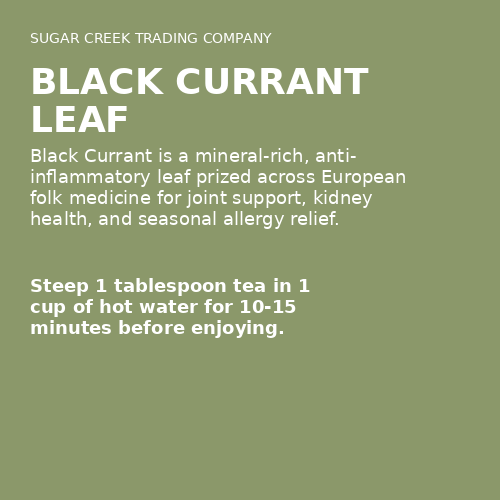
A mineral-rich, anti-inflammatory leaf prized across European folk medicine for joint support, kidney health, and seasonal allergy relief.
BOTANICAL IDENTIFICATION
Scientific Name: Ribes nigrum L.
Common Names: Black Currant Leaf, Blackcurrant, Cassis, Quinsy Berry, Squinancy Berry
Family: Grossulariaceae (Gooseberry family)
Black currant is a medium-sized, deciduous shrub growing 1 to 2 meters tall, with erect, woody stems and palmately lobed leaves that are three to five lobed, coarsely toothed, and dotted on the underside with distinctive yellow oil glands that release the plant's characteristic pungent, musky aroma when crushed. In spring, the shrub produces inconspicuous, bell-shaped, greenish-pink flowers in drooping racemes, which develop by mid-summer into clusters of small, glossy, deep purple-black berries. The leaves are typically harvested in late spring to early summer, when the oil glands are most active and the foliage is at its peak vitality.
Native to central and northern Europe and northern Asia, black currant thrives in moist, fertile soils in temperate climates, favoring partial shade and woodland edges, riverbanks, and hedgerows. It has been extensively cultivated across Europe, Russia, and New Zealand for its berries, and to a lesser extent for its medicinal leaves. The plant is cold-hardy and adapts to a wide range of soil types, though it prefers slightly acidic to neutral conditions.
CULTURAL AND HISTORICAL USE
Black currant leaf has deep roots in European folk and monastic medicine, where it was regarded as one of the great "cleansing" herbs for the kidneys and joints. By the Middle Ages, herbalists across France, Germany, and Scandinavia were prescribing infusions of the leaves as a diuretic and anti-rheumatic remedy. The French tradition, where black currant leaf tisane is still widely consumed today, gave the plant its enduring reputation as a treatment for gout, arthritis, and what historical texts called "cold, damp constitutions" -- people prone to stiffness, fluid retention, and sluggish circulation. The French name cassis became synonymous with both the berry liqueur and the leaf tea, reflecting how deeply the plant was woven into daily life.
In the Germanic herbal tradition, black currant leaf was a staple spring tonic, used to "purify the blood" after winter and to flush excess uric acid through the kidneys. The Abbess Hildegard of Bingen referenced related Ribes species in her writings, and by the 16th and 17th centuries, herbals across northern Europe regularly included the leaf for urinary complaints, sore throats, and fevers. Russian folk medicine similarly valued black currant leaf tea as a remedy for colds and rheumatic pain, and the tradition of drying the leaves for winter tea remains alive in rural Russia today.
In modern European phytotherapy, black currant leaf achieved formal recognition with its inclusion in the European Medicines Agency's herbal monograph system and the French Pharmacopoeia. The German Commission E evaluated it positively as a supportive treatment for rheumatic conditions. Today, it remains one of the most commonly prescribed herbal diuretics in France and Germany, often recommended by physicians alongside conventional treatments for urinary tract health, mild hypertension, and inflammatory joint conditions.
KEY BIOACTIVE COMPOUNDS & BENEFITS
| Compound/Class | Location in Plant | Human Benefit | Role in Plant |
|---|---|---|---|
| Proanthocyanidins and flavonoids (quercetin, kaempferol, myricetin glycosides) | Leaves (abundant) | Anti-inflammatory, antioxidant, capillary-strengthening, antiallergic | UV protection and defense against pathogens |
| Phenolic acids (caffeic, gallic, chlorogenic acids) | Leaves | Antioxidant, mild antimicrobial, supports vascular health | Chemical defense and UV screening |
| Essential oil terpenes (sabinene, caryophyllene, terpinen-4-ol) | Leaf oil glands (underside) | Anti-inflammatory, mild diuretic, aromatic and soothing | Insect deterrence and antimicrobial defense |
| Minerals (potassium, calcium, magnesium, iron, manganese) | Leaves | Electrolyte support, alkalizing, bone and muscle health | Essential metabolic cofactors for plant growth |
| Vitamin C | Leaves, berries | Immune support, antioxidant, collagen synthesis | Antioxidant protection of photosynthetic tissue |
The therapeutic character of black currant leaf arises from the synergy between its rich flavonoid content, aromatic essential oil terpenes, and high mineral density. The flavonoids -- particularly quercetin and its glycosides -- provide the primary anti-inflammatory and antiallergic effects, while the terpene-rich essential oil glands contribute additional anti-inflammatory and mild diuretic activity. The leaf's exceptional potassium content supports its aquaretic (water-moving without electrolyte depletion) properties, making it one of the gentler and more balanced herbal diuretics available.
HOW IT WORKS IN THE BODY
Black currant leaf acts through several complementary mechanisms that converge on reducing inflammation, promoting healthy fluid elimination, and modulating immune overreactivity.
Anti-Inflammatory and Joint Support:
The flavonoids in black currant leaf, especially quercetin and its derivatives, inhibit key pro-inflammatory enzymes including cyclooxygenase (COX) and lipoxygenase (LOX), reducing the production of prostaglandins and leukotrienes that drive joint inflammation and pain. This dual COX/LOX inhibition gives black currant leaf a broader anti-inflammatory profile than agents targeting only one pathway. Additionally, the proanthocyanidins help stabilize collagen structures in connective tissue and reduce the degradation of cartilage matrix, supporting long-term joint integrity.
Kidney and Urinary System Support:
Black currant leaf promotes increased urine volume without depleting potassium -- a property known as aquaresis, distinct from the harsher diuresis of pharmaceutical diuretics. The terpenes and flavonoids work together to increase renal blood flow and glomerular filtration, while the high potassium content of the leaf itself replaces what might otherwise be lost. This gentle flushing action helps the body clear uric acid, urea, and other metabolic waste products, which is one reason it has been so consistently used for gout and urinary gravel throughout European history.
Antiallergic and Immune Modulation:
Quercetin and related flavonoids in the leaf stabilize mast cells, inhibiting the release of histamine and other inflammatory mediators involved in allergic responses. This mast-cell-stabilizing effect makes black currant leaf a valuable supportive remedy during allergy season. Some research also suggests that the leaf extract modulates adrenal cortex function, supporting the body's own cortisol production -- a mechanism that may partly explain its traditional reputation for reducing inflammatory swelling without the side effects of synthetic corticosteroids.
Cardiovascular and Circulatory Support:
The combined antioxidant effects of flavonoids, phenolic acids, and vitamin C help protect blood vessel walls from oxidative damage. Proanthocyanidins specifically strengthen capillary walls and reduce vascular permeability, which can help with conditions involving poor circulation, varicose veins, or easy bruising. The mild blood-pressure-lowering effect attributed to black currant leaf is likely related to both its diuretic action and its ability to promote nitric oxide-mediated vasodilation.
DOSE GUIDELINES
| Preparation Type | Typical Dose | Purpose |
|---|---|---|
| Infusion (leaf tea) | 2-4 teaspoons dried leaf steeped in 1 cup boiling water for 10-15 minutes; 2-4 cups daily | Diuretic support, joint health, seasonal allergy relief |
| Tincture (1:5, 40% alcohol) | 2-4 mL (40-80 drops), 3 times daily | Concentrated anti-inflammatory and diuretic support |
| Powdered leaf (capsules) | 500-1000 mg, 2-3 times daily | Convenient long-term joint and kidney support |
| Cold infusion (overnight steep) | 2-3 tablespoons dried leaf in 1 liter cold water, steeped 8-12 hours | Maximizes mineral extraction; gentle daily tonic |
Black currant leaf is well-suited for long-term, daily use as a gentle tonic. The European tradition favors courses of 4 to 6 weeks for joint and urinary conditions, with breaks of 1 to 2 weeks between courses. For seasonal allergies, beginning daily use 2 to 4 weeks before the expected onset of allergy season can help build a baseline of protection. Adequate water intake throughout the day enhances the diuretic and flushing benefits.
PREPARATION AND USES
The standard preparation is a simple hot infusion. Place two to four teaspoons of dried black currant leaf in a cup, pour boiling water over, cover, and steep for 10 to 15 minutes. The resulting tea has a pleasant, mildly herbaceous and slightly astringent flavor with a distinctive aromatic character from the leaf's essential oil glands -- far more palatable than many medicinal herb teas. It can be sweetened with honey if desired, or combined with mint or lemon balm for a refreshing blend. For maximum mineral extraction, a cold overnight infusion in a mason jar yields a mineral-rich tonic that can be strained and sipped throughout the following day.
Tincturing is effective for those who want a more concentrated, portable preparation. A 1:5 tincture in 40 percent alcohol captures both the water-soluble flavonoids and the fat-soluble terpenes from the leaf's oil glands. Black currant leaf also blends well in formulas with other anti-inflammatory and diuretic herbs such as nettle leaf, meadowsweet, birch leaf, and willow bark. For topical use, a strong infusion can be used as a compress for sore, inflamed joints or as a soothing wash for irritated skin.
OPTIMAL CONTEXT FOR USE
Black currant leaf is especially well-suited for individuals experiencing:
Joint stiffness, rheumatic pain, or inflammatory arthritis -- where its dual COX/LOX inhibition and uric acid clearance offer meaningful support alongside conventional care
Seasonal allergies, hay fever, or histamine sensitivity -- where its mast-cell-stabilizing flavonoids can reduce the intensity of allergic reactions
Fluid retention, mild edema, or urinary sluggishness -- where its gentle, potassium-sparing diuretic action helps restore healthy fluid balance without electrolyte disruption
Gout or elevated uric acid levels -- where its traditional kidney-flushing and uric-acid-clearing properties have centuries of clinical support
General need for a mineral-rich, daily herbal tonic that supports kidney, circulatory, and immune function with minimal risk of side effects
Black currant leaf combines exceptionally well with nettle leaf for allergies and mineral support, with meadowsweet for joint inflammation, with birch leaf for urinary flushing, and with hawthorn for cardiovascular and circulatory care.
SUSTAINABILITY AND ETHICAL HARVESTING
Black currant is a widely cultivated agricultural crop with no conservation concerns. It is grown commercially across Europe, Russia, New Zealand, and parts of North America primarily for its berries, with the leaves available as a secondary harvest that does not harm the plant. Leaf harvesting from cultivated bushes is fully sustainable, as the plants regenerate foliage readily each season. In the United States, restrictions on growing Ribes species that were imposed in the early 20th century due to white pine blister rust concerns have been lifted in most states, and cultivation is expanding.
Wild black currant grows along streams, woodland margins, and hedgerows across its native range in Europe and Asia. Sustainable wild harvesting involves taking only a portion of the leaves from each bush, leaving enough foliage for the plant to photosynthesize and produce fruit. Given the abundance of cultivated stock, there is no ecological pressure on wild populations from the herbal trade.
SAFETY AND CAUTIONS
Black currant leaf has an excellent safety profile and is considered safe for general use by the European Medicines Agency and the German Commission E. It is one of the gentler medicinal herbs in the European pharmacopoeia.
Individuals with severe kidney disease or kidney failure should consult a healthcare provider before using black currant leaf or any herbal diuretic, as increased fluid output may not be appropriate in advanced renal conditions.
Because of its mild diuretic effect, those taking prescription diuretics, blood pressure medications, or lithium should be aware of potential additive effects and consult their prescriber.
While there is no established contraindication for pregnancy, the leaf has not been extensively studied in pregnant or breastfeeding women. Traditional use suggests a high degree of safety, but professional guidance is advisable during pregnancy.
Rare allergic reactions are possible in individuals with known sensitivity to Ribes species. Discontinue use if skin rash, itching, or digestive upset occurs.
REFERENCES
Taheri, R., et al. "Black currant (Ribes nigrum) leaf: a comprehensive review of its phytochemical and pharmacological profile." Journal of Ethnopharmacology, 277: 114265, 2021.
European Medicines Agency (EMA). "Assessment report on Ribes nigrum L., folium." EMA/HMPC/159344/2013.
Declume, C. "Anti-inflammatory evaluation of a hydroalcoholic extract of black currant leaves (Ribes nigrum)." Journal of Ethnopharmacology, 27(1-2): 91-98, 1989.
Wichtl, M. (ed.). Herbal Drugs and Phytopharmaceuticals. 3rd ed. CRC Press, 2004. (Monograph on Ribis nigri folium.)
Garbacki, N., et al. "Inhibition of the pro-inflammatory response of human macrophages by Ribes nigrum leaf extract." Journal of Agricultural and Food Chemistry, 52(3): 606-612, 2004.
FINAL NOTE
Black currant leaf is one of Europe's quiet treasures -- an unassuming garden shrub whose leaves deliver a remarkably broad and gentle spectrum of anti-inflammatory, diuretic, and antiallergic support. Where many medicinal herbs demand careful dosing and watchful use, black currant leaf invites daily companionship, offering its benefits as a pleasant, mineral-rich tea that supports the kidneys, calms inflamed joints, and steadies the immune system's overreactions. It is the kind of remedy that rewards patience and consistency, working quietly beneath the surface to restore balance over weeks and months of faithful use.
Share