Sugar Creek Trading Company
Boneset Herb
Boneset Herb
Couldn't load pickup availability
EUPATORIUM PERFOLIATUM
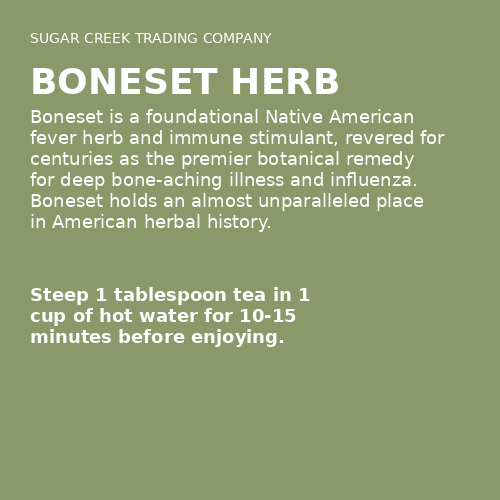
A foundational Native American fever herb and immune stimulant, revered for centuries as the premier botanical remedy for deep bone-aching illness and influenza.
BOTANICAL IDENTIFICATION
Scientific Name: Eupatorium perfoliatum L.
Common Names: Boneset, Thoroughwort, Feverwort, Sweating Plant, Ague Weed, Indian Sage, Crosswort, Vegetable Antimony
Family: Asteraceae (Daisy/Composite family)
Eupatorium perfoliatum is a robust, upright perennial herb growing 2 to 5 feet tall from a thick, horizontal rhizome. Its most distinctive feature is its opposite, lance-shaped leaves that are joined at the base, so the hairy stem appears to perforate through each pair of leaves, giving rise to the name "perfoliatum" and the common name "thoroughwort." The leaves are dark green, deeply wrinkled, coarsely serrated, and covered with fine downy hairs on the undersides. Flat-topped clusters (corymbs) of small, dull white fuzzy flowers appear from mid-summer through early autumn.
Boneset is native to eastern North America, ranging from Nova Scotia south to Florida and west to Texas, the Dakotas, and Manitoba. It thrives in low, wet ground, including marshes, stream banks, wet meadows, floodplain edges, and damp thickets. It prefers partial shade to full sun and rich, moist to saturated soils, making it a common sight along waterways and in bottomland areas throughout its range.
CULTURAL AND HISTORICAL USE
Boneset holds an almost unparalleled place in American herbal history. It was one of the most important and widely used medicinal plants among Native American peoples of eastern North America. The Menominee, Iroquois, Mohegan, Delaware, Creek, Cherokee, and many other nations used it extensively for fevers, colds, influenza, and the severe body aches that accompany them. The common name "Boneset" derives not from bone fracture healing but from its use in treating "break-bone fever" (dengue-like febrile illness) characterized by intense aching in the bones and joints. Some traditions also held that it could help "set" bones by reducing the deep pain associated with skeletal conditions.
European colonists rapidly adopted Boneset from Indigenous teachers, and by the 18th and 19th centuries it had become arguably the single most commonly used medicinal plant in American households. During the devastating influenza and malaria epidemics that swept the frontier, dried Boneset hung in nearly every cabin and farmhouse, ready to be brewed into a bitter tea at the first sign of fever. The Eclectic physicians, led by John King and Harvey Wickes Felter, considered it an indispensable remedy. King's American Dispensatory (1898) devotes extensive coverage to its use in intermittent and remittent fevers, influenza, and catarrhal conditions. It was also official in the United States Pharmacopeia from 1820 to 1916.
In the Physiomedicalist tradition, Boneset was classified as a relaxing diaphoretic, meaning it opens the pores and promotes sweating to break fevers while simultaneously supporting the body's vital force. Homeopathic medicine uses Eupatorium perfoliatum as a major remedy for influenza with severe bone pains. In modern Western herbalism, Boneset has experienced a renaissance of interest, particularly during flu seasons, as practitioners seek effective botanical alternatives for immune support and fever management.
KEY BIOACTIVE COMPOUNDS & BENEFITS
| Compound/Class | Location in Plant | Human Benefit | Role in Plant |
|---|---|---|---|
| Sesquiterpene lactones (eupafolin, eupatorin, eupatoriopyrin) | Leaves and flowering tops | Immunostimulant and anti-inflammatory activity; stimulate phagocytosis | Bitter chemical defense compounds that deter herbivory |
| Polysaccharides (heteroglycans) | Whole aerial herb | Potent immune stimulation; increase macrophage and granulocyte activity | Structural and energy storage compounds in cell walls |
| Flavonoids (quercetin, kaempferol, rutin, eupatorin) | Leaves and flowers | Antioxidant, anti-inflammatory, and antiviral activity | UV protection and pollinator signaling |
| Diterpenes (dendroidinic acid and related compounds) | Leaves and stems | Cytotoxic and anti-inflammatory properties; support fever resolution | Secondary metabolites involved in pathogen defense |
| Volatile oils and bitter principles | Whole aerial herb | Digestive stimulation, mild diaphoretic effect, and appetite restoration during illness | Aromatic defense against insects and microbial pathogens |
Boneset's therapeutic profile is driven by the interplay between its immunostimulant polysaccharides and its bitter sesquiterpene lactones. Research conducted at the University of Munster demonstrated that Boneset polysaccharides significantly increase phagocytic activity of macrophages and granulocytes, providing a scientifically validated basis for its centuries of use as an immune-activating fever herb. The flavonoid content adds antioxidant and antiviral layers, while the intensely bitter taste itself triggers a cascade of digestive and immune reflexes.
HOW IT WORKS IN THE BODY
Boneset acts through multiple, complementary pathways to support the body during acute febrile illness, combining direct immune stimulation with fever management and systemic support.
Immune Activation and Phagocytosis:
Boneset polysaccharides have been shown in in vitro studies to significantly enhance the activity of macrophages and granulocytes, the immune cells responsible for engulfing and destroying pathogens. This is not a nonspecific "boost" but a targeted upregulation of innate immune response. The sesquiterpene lactones further support immune function through anti-inflammatory modulation, helping to manage the cytokine cascade that drives the worst symptoms of influenza and febrile illness.
Diaphoresis and Fever Management:
As a relaxing diaphoretic, Boneset promotes perspiration by relaxing peripheral blood vessels and opening sweat glands. In traditional practice, this is understood as supporting the body's natural fever process rather than suppressing it. A hot infusion of Boneset encourages the body to "sweat out" a fever efficiently, bringing temperature down through the physiological cooling mechanism of evaporative sweating. This approach aligns with the body's innate defense strategy, where fever mobilizes immune function and sweating signals resolution.
Musculoskeletal Pain Relief:
The deep, aching bone and muscle pain that accompanies influenza and severe fevers is Boneset's signature indication. Its anti-inflammatory sesquiterpene lactones and flavonoids help reduce the prostaglandin-mediated inflammation and cytokine activity responsible for this pain. Traditional accounts consistently describe dramatic relief from the "break-bone" aching that characterizes severe flu when Boneset tea is administered in the early stages of illness.
Digestive and Hepatic Support:
Boneset is powerfully bitter, and its bitter constituents stimulate digestive secretions, improve appetite during illness, and support liver function during the metabolic stress of fever. The bitter reflex it triggers also activates vagal pathways that have downstream effects on immune regulation and systemic inflammation.
DOSE GUIDELINES
| Preparation Type | Typical Dose | Purpose |
|---|---|---|
| Hot infusion (dried herb) | 1-2 teaspoons steeped in 8 oz just-boiled water for 10-15 minutes, 3-4 times daily during acute illness | Primary method for fever management and immune stimulation (diaphoretic effect requires hot tea) |
| Cold infusion (dried herb) | 1-2 teaspoons steeped in cold water for several hours, sipped in small doses | Bitter tonic and mild laxative effect; emetic in large doses (traditional use) |
| Tincture (1:5, 60% ethanol) | 2-4 mL, 3 times daily during acute illness | Convenient immune support when tea preparation is impractical |
| Capsules (powdered herb) | 1-3 g, 3 times daily | Alternative delivery when the intense bitterness of tea is not tolerated |
Boneset is primarily an acute-use herb, taken at the onset of and during febrile illness, influenza, or severe colds. It is not typically used as a daily tonic. For maximum diaphoretic effect, the tea should be drunk hot and the patient should be warmly covered to encourage sweating. The taste is intensely bitter, which is considered a feature, not a flaw, as the bitter reflex contributes to its therapeutic action. Small, frequent doses are preferred over large single doses. In large cold doses, Boneset can act as an emetic, a property used intentionally in some traditional protocols but to be avoided in general use.
PREPARATION AND USES
The traditional and most effective preparation of Boneset is a hot infusion of the dried aerial herb (leaves and flowering tops). Place one to two teaspoons of dried Boneset in a cup, pour just-boiled water over it, cover, and steep for 10 to 15 minutes. Strain and drink as hot as can be comfortably tolerated, then retire to bed under warm covers to encourage sweating. This diaphoretic protocol is the classic application and has been repeated successfully for centuries. The tea is extremely bitter, and while honey can be added, many herbalists advise against masking the bitterness entirely, as the bitter taste triggers beneficial reflexes.
Boneset tincture is a practical alternative that can be kept on hand for sudden onset of flu or fever. It is best taken in warm water to preserve some diaphoretic effect. For combination formulas, Boneset pairs well with Elderflower (Sambucus nigra) and Yarrow (Achillea millefolium) in a classic fever-management trio, and with Echinacea for enhanced immune stimulation. Boneset is not commonly used in culinary preparations due to its extreme bitterness, though small amounts have historically been added to bitter tonics and digestive bitters blends.
OPTIMAL CONTEXT FOR USE
Boneset herb is especially well-suited for individuals experiencing:
Acute influenza or severe colds with deep, aching bone and muscle pain, the hallmark "break-bone fever" pattern
Febrile illness where productive sweating and natural fever resolution are desired
Early-stage upper respiratory infections with chills, body aches, and general malaise
Seasonal immune preparedness, kept on hand as a first-response herb during flu season
Recovery from prolonged illness where appetite loss, digestive sluggishness, and lingering fatigue are present
Boneset works most effectively when taken at the earliest onset of symptoms and continued through the acute phase. It combines excellently with Elderberry for antiviral support, Yarrow for enhanced diaphoresis, and Peppermint for added comfort and respiratory opening during febrile illness.
SUSTAINABILITY AND ETHICAL HARVESTING
Eupatorium perfoliatum is an abundant native plant across much of eastern North America and is not considered threatened or at risk in any part of its range. It grows prolifically in wetland edges, floodplains, and damp meadows, often forming large colonies that regenerate vigorously from established rhizome networks. Wild harvesting of aerial parts has minimal impact on established populations when done responsibly, as the root system remains intact and resprouts readily.
Boneset is increasingly cultivated in native plant nurseries and medicinal herb gardens, where it serves double duty as a pollinator-attracting landscape plant and a medicinal crop. Its affinity for moist soils makes it suitable for rain gardens and wetland restoration projects. Sugar Creek Trading Company sources Boneset herb from responsible suppliers who prioritize sustainable wild harvest practices and cultivated sources.
SAFETY AND CAUTIONS
Boneset has a long history of safe use when taken in appropriate doses during acute illness. It is recognized by the German Commission E and has been used safely for centuries in American herbal practice. The following cautions apply:
Large doses of cold Boneset tea can cause nausea and vomiting. This was used intentionally in some traditional "purging" protocols but should be avoided in general use. Start with small doses and increase as tolerated.
Boneset contains low levels of pyrrolizidine alkaloids (PAs) of the unsaturated type. Short-term use during acute illness (days to 1-2 weeks) is considered safe. Prolonged daily use is not recommended. Individuals with liver disease should consult a healthcare provider.
Individuals with known allergies to plants in the Asteraceae (Daisy) family should use caution, as cross-reactivity is possible.
Pregnant and nursing individuals should avoid Boneset due to insufficient safety data and its traditional use as an emetic in high doses.
Boneset should not be confused with other Eupatorium species, some of which contain higher levels of hepatotoxic pyrrolizidine alkaloids. Proper botanical identification or purchase from a reputable supplier is essential.
REFERENCES
Felter, H.W. & Lloyd, J.U. King's American Dispensatory, 18th Ed. Ohio Valley Company, 1898.
Wagner, H., Proksch, A., Riess-Maurer, I., et al. "Immunostimulating Polysaccharides of Higher Plants." Arzneimittelforschung, 1985; 35(7): 1069-1075.
Moerman, D.E. Native American Ethnobotany. Timber Press, 1998.
Hoffmann, D. Medical Herbalism: The Science and Practice of Herbal Medicine. Healing Arts Press, 2003.
FINAL NOTE
Boneset is one of the great heritage herbs of North American medicine, a plant whose reputation was built not in laboratories but in countless cabins, farmhouses, and Indigenous healing traditions during some of history's most devastating epidemics. Its specific affinity for the deep, aching misery of influenza and febrile illness remains unmatched in the Western herbal pharmacopoeia. For anyone who keeps a home herbal medicine chest, Boneset is an essential inclusion, ready to serve at the first sign of the bone-deep ache that signals serious illness is taking hold.
Share