Sugar Creek Trading Company
Cleavers Herb
Cleavers Herb
Couldn't load pickup availability
GALIUM APARINE
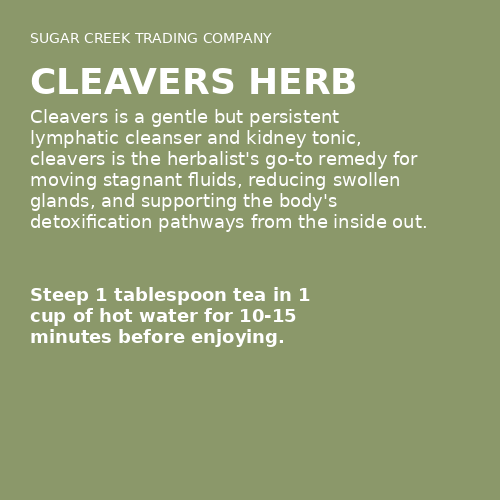
A gentle but persistent lymphatic cleanser and kidney tonic, cleavers is the herbalist's go-to remedy for moving stagnant fluids, reducing swollen glands, and supporting the body's detoxification pathways from the inside out.
BOTANICAL IDENTIFICATION
Scientific Name: Galium aparine L.
Common Names: Cleavers, Goosegrass, Stickyweed, Catchweed Bedstraw, Clivers, Grip Grass, Robin-Run-the-Hedge, Sweethearts, Barweed
Family: Rubiaceae (Madder/Coffee family)
Cleavers is a sprawling, annual herbaceous plant with square, weak stems that can extend 1 to 2 meters in length, climbing over and through surrounding vegetation with the aid of tiny, hooked hairs (trichomes) that cover the stems, leaves, and fruit. The narrow, lance-shaped leaves are arranged in whorls of 6 to 8 around each node, and they too bear backward-pointing hooks that give the plant its characteristic "sticky" or "clinging" quality. Small, white, four-petaled flowers appear in loose cymes from the leaf axils, followed by pairs of round, bristly fruits approximately 4 mm in diameter that readily attach to clothing and animal fur.
Cleavers is native to Europe, North Africa, and temperate Asia but has naturalized extensively across North America, South America, and Australasia, where it is often considered a common weed. It thrives in moist, nitrogen-rich soils along hedgerows, field margins, streambanks, gardens, and disturbed ground, preferring partial shade to full sun. The entire above-ground herb is harvested for medicinal use, ideally in spring when the plant is young and most vital.
CULTURAL AND HISTORICAL USE
Cleavers has been a cornerstone of European folk medicine for well over a thousand years. The Greek physician Dioscorides (1st century CE) documented its use as a remedy for fatigue and as a blood-cleansing herb. Throughout medieval and Renaissance Europe, cleavers was widely employed as a spring tonic to "cleanse the blood" after the heavy, stagnant diet of winter, a tradition that persisted well into the 20th century in rural Britain and Ireland. Nicholas Culpeper (1653) wrote that cleavers "is a good remedy in the spring, eaten (being first chopped small, and boiled well) in water-gruel, to cleanse the blood, and strengthen the liver, thereby to keep the body in health."
In British and Irish folk tradition, cleavers juice was applied to skin conditions including eczema, psoriasis, and boils, and the dried herb was used in poultices for swollen lymph glands and tumors. The plant's relationship with the lymphatic system is one of the most consistent themes across centuries of herbal writing. Gerard (1597), Parkinson (1640), and virtually every major European herbal text through to the modern era describe cleavers as a remedy that moves sluggish lymph and resolves glandular swellings.
Native American peoples also recognized cleavers' medicinal value. Several nations used preparations of the herb for kidney and urinary complaints, skin diseases, and as a cooling wash for fever. In Eclectic medicine (19th-century American botanical practice), cleavers was a principal remedy for lymphatic congestion, urinary gravel, and scrofula (tuberculous lymphadenitis). The Eclectics particularly valued the fresh plant juice, considering it far superior to dried preparations. This preference for fresh cleavers continues among many contemporary herbalists.
KEY BIOACTIVE COMPOUNDS & BENEFITS
| Compound/Class | Location in Plant | Human Benefit | Role in Plant |
|---|---|---|---|
| Iridoid glycosides (asperuloside, monotropein) | Leaves and stems | Anti-inflammatory; mild analgesic; liver-protective; supports detoxification | Herbivore deterrent (bitter taste); antimicrobial defense |
| Chlorogenic acid and other phenolic acids | Leaves | Antioxidant; anti-inflammatory; supports healthy blood sugar and lipid metabolism | UV protection; antimicrobial defense |
| Flavonoids (luteolin, quercetin derivatives) | Leaves and stems | Anti-inflammatory; diuretic; antispasmodic; capillary-strengthening | UV screening; pollinator signaling |
| Coumarins | Whole herb | Lymphatic stimulation; anti-edema; mild antispasmodic | Antifungal defense; growth regulation |
| Citric acid and other organic acids | Whole herb | Mild diuretic; alkalizing effect on urine; supports kidney stone prevention | Metabolic intermediates; mineral transport |
Cleavers' therapeutic identity is defined by the interplay between its iridoid glycosides and coumarins, which drive lymphatic and hepatic stimulation, and its flavonoid and organic acid fraction, which provide diuretic and anti-inflammatory support. Unlike harsh diuretics that simply force water excretion, cleavers works through gentle, tonic mechanisms that support the body's own fluid-processing systems, particularly the lymphatic vessels and kidneys. This is what makes it a true "alterative" in traditional herbal terminology: an herb that gradually restores normal function to the body's eliminative channels.
HOW IT WORKS IN THE BODY
Cleavers works through coordinated support of the lymphatic, urinary, and integumentary (skin) systems, gently promoting the movement and elimination of metabolic waste and excess fluid.
Lymphatic Stimulation and Decongestant:
Cleavers is one of the most important lymphatic herbs in the Western herbal tradition. Its coumarins and iridoid glycosides appear to enhance lymphatic vessel contractility and flow, helping to move interstitial fluid and immune cells through the lymphatic network more efficiently. This mechanism underlies cleavers' historical use for swollen lymph nodes, tonsillitis, adenoid enlargement, and the general lymphatic congestion that manifests as puffiness, fluid retention, and recurrent infections. By improving lymphatic drainage, cleavers indirectly supports immune surveillance and the clearance of cellular debris and pathogens.
Kidney and Urinary Support:
Cleavers acts as a gentle, aquaretic diuretic, meaning it increases urine volume without excessively depleting electrolytes. Its organic acid content, particularly citric acid, helps maintain an alkaline urine pH that discourages the formation of calcium oxalate kidney stones and urinary gravel. The flavonoid fraction contributes anti-inflammatory and antispasmodic effects on the urinary tract, making cleavers useful for cystitis, urethritis, and other irritative urinary conditions. The Eclectics specifically noted cleavers' ability to "dissolve and remove" urinary sediment and gravel.
Skin Clearing and Alterative Action:
Cleavers' support of lymphatic drainage and kidney elimination creates a downstream benefit for the skin. In traditional herbal theory, chronic skin conditions like eczema, psoriasis, and acne are often attributed to sluggish eliminative function, with the skin acting as a backup excretory organ when the primary channels (liver, kidneys, lymph) are overwhelmed. By enhancing fluid movement and waste clearance through these primary channels, cleavers reduces the toxic burden on the skin. Its anti-inflammatory flavonoids provide additional direct support for skin healing.
Mild Anti-Inflammatory and Antioxidant Protection:
The combination of chlorogenic acid, luteolin, quercetin, and asperuloside provides a gentle but broad anti-inflammatory effect. These compounds modulate NF-kB signaling, inhibit COX and LOX enzymes, and scavenge free radicals. This background anti-inflammatory and antioxidant action supports all of cleavers' other mechanisms and contributes to its traditional reputation as a systemic "blood cleanser."
DOSE GUIDELINES
| Preparation Type | Typical Dose | Purpose |
|---|---|---|
| Dried herb infusion (tea) | 2-4 teaspoons dried herb per cup, steeped 10-15 minutes; drink 3 cups daily | Lymphatic support; kidney tonic; skin clearing; spring detoxification |
| Fresh plant juice | 15-30 mL (1-2 tablespoons) 2-3 times daily | Considered the most potent preparation; lymphatic and urinary support |
| Tincture (1:5, 40% ethanol) | 3-5 mL, 3 times daily | Convenient daily lymphatic and alterative support |
| Cold infusion (overnight steep) | 4-6 teaspoons dried herb per quart of cold water, steeped 8-12 hours | Maximizes mineral and mucilage extraction; gentle kidney support |
Cleavers is traditionally used as a course of treatment over several weeks to months rather than as an acute single-dose remedy. Spring courses of 4 to 8 weeks are a time-honored tradition. The herb is mild enough for daily long-term use, and many herbalists recommend it as a foundational tonic during any period of lymphatic sluggishness or skin challenges. Adequate water intake alongside cleavers supports its diuretic and cleansing actions.
PREPARATION AND USES
For a standard infusion, place 2 to 4 teaspoons of dried cleavers herb in a cup, pour freshly boiled water over it, cover, and steep for 10 to 15 minutes. Strain and drink. The flavor is mild, slightly grassy, and pleasantly neutral, making it easy to drink on its own or blend with other herbs. Cleavers combines well with calendula and red clover for skin-supportive blends, with dandelion leaf for enhanced kidney support, or with echinacea and elderberry during acute lymphatic congestion.
A cold infusion (overnight steep in cold water) is another excellent preparation method that extracts minerals and delicate compounds that may be degraded by boiling. Simply place 4 to 6 teaspoons of dried herb in a quart jar, fill with cold water, cap, and refrigerate overnight. Strain in the morning and drink throughout the day. For topical use, a strong infusion of cleavers can be used as a wash or compress for inflamed skin, minor wounds, and sunburn. Cleavers infusion also makes an effective hair rinse for scalp irritation and dandruff.
OPTIMAL CONTEXT FOR USE
Cleavers herb is especially well-suited for individuals experiencing:
Swollen lymph nodes, tonsillitis, adenoid issues, or general lymphatic congestion and puffiness
Chronic skin conditions such as eczema, psoriasis, acne, or boils, particularly when associated with sluggish elimination
Urinary tract irritation, cystitis, urinary gravel, or a tendency toward kidney stone formation
Seasonal detoxification and spring cleansing, particularly after a winter of heavy, sedentary living
Fluid retention and edema, especially in the limbs or face, where gentle lymphatic drainage support is desired
Cleavers works especially well in combination with other lymphatic and alterative herbs including calendula, red clover, burdock root, and violet leaf. For urinary support, pair with corn silk, marshmallow root, or uva ursi.
SUSTAINABILITY AND ETHICAL HARVESTING
Cleavers is one of the most abundantly available medicinal plants in the temperate world. It grows prolifically in disturbed ground, gardens, hedgerows, and woodland margins across Europe, North America, and much of Asia, and it is universally regarded as a common weed rather than a plant at any risk of overharvesting. Its prolific seed production (via the adhesive, animal-dispersed burrs) and vigorous annual growth habit ensure that populations regenerate robustly each year regardless of harvesting pressure.
Commercial cleavers herb is typically sourced from cultivated or managed wildcraft operations in Eastern Europe and the United States. Because the plant thrives on nitrogen-rich soils and disturbed ground, it can be grown productively on marginal agricultural land or harvested sustainably from hedgerows and field edges without impacting wild plant populations. There are no conservation concerns whatsoever for this species, and it requires no special protection or management.
SAFETY AND CAUTIONS
Cleavers is considered one of the safest herbs in the Western herbal materia medica, with a long history of use including consumption as a food (young shoots were eaten as a pot herb throughout Europe). The following minor cautions apply:
Diuretic effect: Because cleavers increases urine output, individuals should maintain adequate hydration during use. Those with severe kidney disease should consult a healthcare provider before using cleavers or any diuretic herb.
Contact dermatitis: The tiny hooked hairs on fresh cleavers can cause mild skin irritation in some individuals during harvesting. This is a mechanical irritation, not an allergic reaction, and does not affect the dried herb or tea preparations.
Drug interactions: Cleavers' diuretic properties could theoretically interact with prescription diuretics or lithium (by affecting lithium clearance). Individuals on these medications should consult their healthcare provider.
Pregnancy: Cleavers has been used traditionally during pregnancy as a gentle kidney tonic, and it is generally considered safe. However, as with all herbs, pregnant women should consult their midwife or healthcare provider before use, particularly in the first trimester.
REFERENCES
Hoffman, D. (2003). Medical Herbalism: The Science and Practice of Herbal Medicine. Healing Arts Press. [Cleavers monograph, pp. 536-537.]
Felter, H.W. and Lloyd, J.U. (1898). King's American Dispensatory. [Galium aparine monograph.]
Chevallier, A. (2016). Encyclopedia of Herbal Medicine. 3rd ed. DK Publishing. [Galium aparine entry.]
FINAL NOTE
Cleavers is the quintessential "quiet worker" of the herbal world. It does not produce dramatic, immediate effects, nor does it contain any single blockbuster compound. Instead, it patiently and persistently supports the body's own fluid-moving and waste-clearing systems, gently opening the channels that allow the lymph, kidneys, and skin to do their jobs more efficiently. It is the herb you turn to when the body feels stagnant, puffy, and congested, and its effects accumulate steadily over weeks of consistent use into a noticeable sense of lightness, clarity, and renewed vitality.
Share