Sugar Creek Trading Company
Club Moss
Club Moss
Couldn't load pickup availability
LYCOPODIUM CLAVATUM
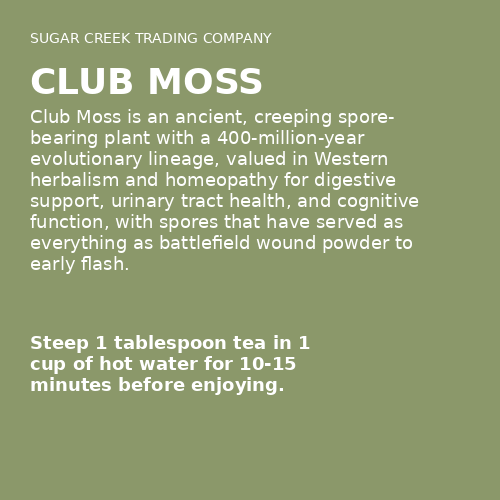
An ancient, creeping spore-bearing plant with a 400-million-year evolutionary lineage, valued in Western herbalism and homeopathy for digestive support, urinary tract health, and cognitive function, with spores that have served as everything as battlefield wound powder to early flash photography fuel.
BOTANICAL IDENTIFICATION
Scientific Name: Lycopodium clavatum L.
Common Names: Club Moss, Common Club Moss, Stag's Horn Clubmoss, Running Clubmoss, Wolf's Claw, Lycopodium, Ground Pine, Vegetable Sulfur (spores)
Family: Lycopodiaceae (Clubmoss family)
Club moss is a low-growing, creeping, evergreen perennial that spreads across forest floors via long, horizontal stems (stolons) that can extend several meters, sending up erect, branching aerial shoots 5 to 25 centimeters tall. The stems are densely covered in small, spirally arranged, needle-like leaves (microphylls) that give the plant its characteristic soft, furry appearance, often likened to a miniature conifer or the antler of a stag. The plant reproduces via spores rather than seeds, producing distinctive upright, club-shaped strobili (spore cones) at the tips of forked aerial branches, from which clouds of extremely fine, bright yellow spores are released in late summer and autumn.
Club moss is found throughout the temperate and boreal regions of the Northern Hemisphere, growing in acidic soils in coniferous and mixed forests, heathlands, moorlands, and alpine meadows. It favors cool, moist, partially shaded habitats with humus-rich, well-drained acidic substrates. The species also occurs in parts of the Southern Hemisphere, including montane areas of tropical America, Africa, and Australasia. Despite its common name, club moss is not a true moss; it belongs to the lycophytes, an ancient lineage of vascular plants that dominated the earth's flora during the Carboniferous period over 300 million years ago.
CULTURAL AND HISTORICAL USE
Club moss has a diverse and fascinating history of use spanning folk medicine, homeopathy, pharmacy, and even pyrotechnics. Indigenous peoples of northern Europe used club moss herb as a poultice for wounds and skin conditions and brewed the aerial parts into teas for kidney and bladder complaints. In Scandinavian and Germanic folk medicine, club moss was considered a powerful protective plant, associated with the Norse god Thor, and was hung in homes to ward off evil spirits and lightning. The whole herb was used as a diuretic, a digestive remedy, and a treatment for rheumatic pain in traditional European herbalism.
The fine, bright yellow spores of Lycopodium clavatum, known as "lycopodium powder" or "vegetable sulfur," have had an extraordinary range of practical applications. Due to their extreme hydrophobic (water-repelling) nature and uniform microscopic size, lycopodium spores were used for centuries as a dusting powder for surgical wounds, diaper rash, and chafed skin, as a coating for pharmaceutical pills to prevent them from sticking together, and as the flash powder in early photography and stage lighting because they ignite with a brilliant, rapid flash when dispersed in air. This last application is the origin of the dramatic flash effects in 19th-century theatrical performances.
In homeopathic medicine, Lycopodium is one of the most frequently prescribed constitutional remedies, used for digestive complaints with bloating and gas, liver dysfunction, urinary difficulties, low self-confidence, and right-sided symptoms. The homeopathic proving and clinical use of Lycopodium was established by Samuel Hahnemann himself in the early 19th century, and it remains a cornerstone of the homeopathic materia medica. In modern Western herbalism, the aerial parts of club moss are used primarily for urinary tract support, kidney health, and as a mild digestive and hepatic tonic, though its use is less common than in earlier centuries.
KEY BIOACTIVE COMPOUNDS & BENEFITS
| Compound/Class | Location in Plant | Human Benefit | Role in Plant |
|---|---|---|---|
| Lycopodine and related alkaloids (huperzine-group) | Aerial parts (stems and leaves) | Acetylcholinesterase inhibition; cognitive support; potential neuroprotective effects | Chemical defense against herbivores and pathogens |
| Huperzine A (in related Lycopodium species) | Aerial parts (primarily in Huperzia serrata, but trace amounts in some L. clavatum populations) | Potent acetylcholinesterase inhibitor; memory enhancement; investigated for Alzheimer's disease | Herbivore deterrent alkaloid |
| Flavonoids (apigenin, chrysoeriol derivatives) | Aerial parts | Anti-inflammatory; antioxidant; mild diuretic support | UV protection; antioxidant defense |
| Triterpenes and sterols | Aerial parts and spores | Anti-inflammatory; hepatoprotective; support cellular membrane integrity | Structural components; chemical defense |
| Sporopollenin (spore wall polymer) | Spores | Extreme hydrophobicity makes spores useful as dusting powder; potential drug delivery vehicle in modern pharmaceutical research | Protects spore viability; UV resistance; prevents desiccation |
The alkaloid fraction is the most pharmacologically significant component of club moss. The Lycopodium alkaloids are a unique class of nitrogen-containing compounds found only in the Lycopodiaceae family, and several of them inhibit acetylcholinesterase, the enzyme that breaks down the neurotransmitter acetylcholine. This mechanism is the basis for ongoing research into Lycopodium species as potential sources of cognitive-enhancing and neuroprotective compounds. The flavonoid and triterpene content supports the herb's traditional use as a mild anti-inflammatory and diuretic, while the remarkable spores represent one of nature's most chemically inert and physically uniform biological structures.
HOW IT WORKS IN THE BODY
Club moss acts through several complementary mechanisms, primarily involving cholinergic modulation, gentle diuretic support, and mild anti-inflammatory activity.
Cognitive and Nervous System Support:
The Lycopodium alkaloids, particularly lycopodine and its structural relatives, inhibit acetylcholinesterase (AChE), slowing the breakdown of acetylcholine in synaptic clefts. Acetylcholine is the primary neurotransmitter involved in memory formation, learning, attention, and neuromuscular coordination. By preserving acetylcholine levels, these alkaloids may support cognitive function, particularly in situations of age-related decline. This mechanism is shared with the pharmaceutical Alzheimer's drug donepezil and the related natural compound huperzine A, which is derived from a closely related clubmoss species (Huperzia serrata).
Urinary and Kidney Support:
Club moss has long been used as a mild diuretic and kidney tonic in European folk medicine. The flavonoid and triterpene compounds support healthy urine flow and may help reduce irritation in the urinary tract. Traditional use suggests benefit for individuals with gravel (small kidney stones), urinary retention, and chronic low-grade urinary tract discomfort. The mechanism likely involves mild enhancement of renal blood flow and gentle promotion of urine volume without the aggressive electrolyte depletion associated with pharmaceutical diuretics.
Digestive and Hepatic Support:
Traditional use of club moss for digestive complaints, particularly bloating, flatulence, and liver sluggishness, is supported by the herb's mild cholagogue (bile-stimulating) and carminative properties. The alkaloid and flavonoid fractions appear to support healthy bile flow from the liver and gallbladder, improving fat digestion and reducing the sensation of abdominal fullness after meals. This is consistent with the herb's prominent role in homeopathic practice, where the Lycopodium constitution is characterized by marked digestive sensitivity with bloating and distension.
DOSE GUIDELINES
| Preparation Type | Typical Dose | Purpose |
|---|---|---|
| Dried herb tea (infusion) | 1-2 teaspoons of dried aerial parts per cup, steeped 10-15 minutes | Urinary support; gentle digestive tonic; kidney health |
| Tincture (1:5, 45-60% ethanol) | 1-2 mL, 2-3 times daily | Concentrated urinary, digestive, and cognitive support |
| Spore powder (topical) | Dusted lightly on affected skin area | Skin irritation; moisture absorption; wound dressing powder |
Club moss is best used in moderate doses for defined periods rather than as a high-dose or indefinite daily supplement. Because it contains alkaloids, it should be used with awareness and ideally under the guidance of a qualified herbalist, particularly for internal use beyond simple tea preparations. The spore powder is considered very safe for external topical use.
PREPARATION AND USES
For a simple club moss tea, place 1 to 2 teaspoons of the dried aerial herb in a mug or teapot, pour boiling water over it, cover, and steep for 10 to 15 minutes. Strain and drink up to two cups daily. The tea has a mild, slightly bitter, earthy flavor that can be softened with a small amount of honey or combined with other gentle urinary herbs such as corn silk, horsetail, or marshmallow root. For a tincture, follow the dosing guidance of the specific product or the advice of a qualified herbalist; typical doses range from 1 to 2 mL taken two to three times daily in a small amount of water.
The bright yellow lycopodium spore powder can be used as a topical dusting powder for irritated, chafed, or moisture-prone skin areas. It is exceptionally fine, highly absorbent of moisture on the skin surface while simultaneously being water-repellent, making it an unusual and effective natural body powder. Historically it was used on infant skin, surgical wounds, and in herbal first-aid kits. Club moss herb can also be prepared as a poultice by moistening the dried herb and applying it wrapped in cloth to areas of soreness or swelling.
OPTIMAL CONTEXT FOR USE
Club moss is especially well-suited for individuals experiencing:
Urinary tract discomfort, sluggish urine flow, or a desire for gentle kidney tonic support alongside adequate hydration
Digestive bloating, flatulence, and abdominal fullness, particularly after meals containing fats
Age-related cognitive concerns, where gentle cholinergic support may complement a broader brain-health strategy
Skin irritation, chafing, or excessive moisture in skin folds, where the spore powder provides a natural, gentle drying agent
Interest in homeopathic Lycopodium as a constitutional remedy, guided by a qualified homeopathic practitioner
Club moss pairs well with ginkgo leaf for cognitive support, with dandelion root for liver and digestive enhancement, with corn silk and marshmallow root for urinary tract comfort, and with gotu kola for integrated nervous system nourishment.
SUSTAINABILITY AND ETHICAL HARVESTING
Club moss is a slow-growing plant that spreads gradually along the forest floor, and its populations can be significantly impacted by overharvesting. Unlike fast-growing annuals that regenerate within a single season, club moss colonies may take many years to recover from destructive collection practices. In several European countries, Lycopodium clavatum is now a protected or conservation-concern species due to habitat loss from deforestation, land-use changes, and historical overcollection for both herbal and industrial (spore powder) purposes.
Ethical sourcing of club moss requires careful attention to harvest methods and origin. Responsible wildcrafters harvest only small portions of established, healthy colonies, leaving the majority of the plant network intact to regenerate. Ideally, club moss should be sourced from regions where it is abundant and its harvest is sustainably managed. Consumers can support conservation by purchasing from suppliers who verify their sourcing practices and by using club moss in moderate quantities. Cultivation of Lycopodium clavatum is extremely difficult due to its dependence on specific soil fungi for germination and establishment, which makes wild populations the primary source and elevates the importance of sustainable wildcrafting.
SAFETY AND CAUTIONS
Club moss should be used with informed awareness due to its alkaloid content. General safety considerations include:
Alkaloid content: The Lycopodium alkaloids are pharmacologically active and can cause gastrointestinal upset, nausea, or dizziness if consumed in excessive quantities. Adhere to recommended doses and do not exceed suggested amounts. This is not a casual, drink-as-much-as-you-like herbal tea.
Pregnancy and nursing: Club moss should be avoided during pregnancy and breastfeeding due to insufficient safety data and the presence of bioactive alkaloids.
Cholinergic drug interactions: Because Lycopodium alkaloids inhibit acetylcholinesterase, club moss may interact with cholinergic medications, anticholinergic drugs, and Alzheimer's medications (donepezil, rivastigmine, galantamine). Consult a healthcare provider before combining.
Spore inhalation: While lycopodium spore powder is safe on the skin, avoid inhaling large quantities of the fine powder, as it can irritate the respiratory tract. The extreme flammability of dispersed spore powder in air should also be noted; keep away from open flames.
REFERENCES
Ma, X., et al. (2007). "The Lycopodium alkaloids." Natural Product Reports, 24(4), 735-752.
Orhan, I., et al. (2003). "Acetylcholinesterase inhibitory activity of some Turkish medicinal plants." Journal of Ethnopharmacology, 88(2-3), 189-195.
Rollinger, J.M., et al. (2004). "Acetylcholinesterase inhibitory activity of scopolin and scopoletin discovered by virtual screening of natural products." Journal of Medicinal Chemistry, 47(25), 6159-6166. [Includes comparative data for Lycopodium alkaloids.]
FINAL NOTE
Club moss is a living relic of an unimaginably ancient plant lineage, carrying in its creeping stems and golden spore dust the biochemical legacy of forests that predated the dinosaurs by a hundred million years. It asks for respectful, moderate use in return for its gentle gifts to the kidneys, the digestion, and the aging mind. In an age of aggressive pharmaceutical interventions, there is something both humbling and reassuring about a remedy whose evolutionary pedigree is measured in geological epochs, quietly doing its work on the forest floor as it has since long before our species existed.
Share