Sugar Creek Trading Company
Cramp Bark
Cramp Bark
Couldn't load pickup availability
VIBURNUM OPULUS
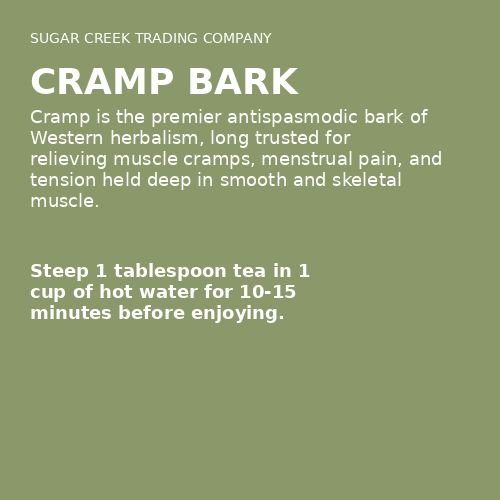
The premier antispasmodic bark of Western herbalism, long trusted for relieving muscle cramps, menstrual pain, and tension held deep in smooth and skeletal muscle.
BOTANICAL IDENTIFICATION
Scientific Name: Viburnum opulus L.
Common Names: Cramp Bark, Guelder Rose, European Cranberry Bush, Snowball Tree, Water Elder, High Cranberry
Family: Adoxaceae (Moschatel family; formerly Caprifoliaceae)
Cramp Bark is a large, spreading deciduous shrub that grows 8 to 15 feet tall with arching branches and distinctive three-lobed, maple-like leaves. In late spring, it produces showy flat-topped clusters of white flowers, with larger sterile flowers ringing the outside and smaller fertile flowers in the center. Bright red, translucent berries follow in autumn, hanging in drooping clusters that persist into winter.
Native to Europe, northern Asia, and parts of North Africa, Viburnum opulus has been widely naturalized in North America. It grows along stream banks, woodland edges, hedgerows, and moist thickets, preferring rich, well-drained to moderately moist soils in full sun to partial shade. The medicinally used bark is harvested from the branches and trunk.
CULTURAL AND HISTORICAL USE
Cramp Bark has been a cornerstone of Western herbal medicine for centuries, valued almost exclusively for one thing: its remarkable ability to relax cramped, spasming muscles. The common name says it all. In European folk medicine, the bark was decocted and given to women suffering from painful menstruation, uterine cramps, and threatened miscarriage. It was also used for muscle spasms in the back and limbs, colic, and urinary cramping. The plant appears in European herbals dating back to the 14th century, and by the 1800s it was an official entry in both the British Pharmacopoeia and the United States Pharmacopoeia.
Native American peoples independently discovered the antispasmodic properties of the closely related Viburnum species native to North America. The Meskwaki used cramp bark for cramps and body pains, while the Ojibwe and Iroquois employed various Viburnum species for similar purposes. The Eclectic physicians of 19th-century America championed Cramp Bark as one of the most reliable uterine antispasmodics available, prescribing it for dysmenorrhea, after-pains following childbirth, and false labor contractions.
In Eastern European folk tradition, particularly in Ukraine and Russia, the Guelder Rose (kalyna) holds immense cultural significance beyond medicine. It is a national symbol of Ukraine, appearing in folk songs, embroidery, and wedding ceremonies. The berries are used in traditional foods and beverages, while the bark maintains its role as a household remedy for pain and cramping.
KEY BIOACTIVE COMPOUNDS & BENEFITS
| Compound/Class | Location in Plant | Human Benefit | Role in Plant |
|---|---|---|---|
| Viopudial (iridoid glycoside) | Bark | Primary antispasmodic compound; relaxes smooth and skeletal muscle tissue | Bitter defense compound deterring herbivores |
| Scopoletin (coumarin) | Bark | Smooth muscle relaxant; mild anti-inflammatory and vasodilatory effects | Antifungal and allelopathic defense |
| Hydroquinones (arbutin) | Bark | Mild urinary antiseptic; supports urinary tract health | Antimicrobial defense |
| Tannins (catechins, proanthocyanidins) | Bark | Astringent action; help reduce excessive bleeding and tone tissues | Structural defense and wound sealing |
| Valerianic acid (trace) | Bark | Mild sedative and nervine effect; contributes to overall relaxation | Chemical defense |
The antispasmodic power of Cramp Bark stems primarily from the combined action of viopudial and scopoletin, which work on both smooth muscle (uterus, intestines, blood vessels, urinary tract) and skeletal muscle (back, legs, shoulders). The tannins add an astringent, toning quality that helps address excessive menstrual bleeding, while the trace valerianic acid contributes a calming nervine dimension.
HOW IT WORKS IN THE BODY
Cramp Bark is a targeted muscular relaxant that works through several interconnected mechanisms.
Smooth Muscle Relaxation (Uterine, GI, Urinary):
The iridoid glycosides and coumarins in Cramp Bark directly inhibit the contraction of smooth muscle tissue. In the uterus, this means reduced intensity and frequency of painful menstrual cramps. In the gastrointestinal tract, it helps relieve intestinal spasm, colic, and the cramping associated with irritable bowel patterns. In the urinary system, it eases spasm of the bladder and ureters, which can help with painful urination and the passage of kidney stones.
Skeletal Muscle Relaxation:
Beyond smooth muscle, Cramp Bark also helps relax voluntary skeletal muscles, making it useful for tension-related back pain, leg cramps, neck stiffness, and muscle spasms following overexertion. This broader antispasmodic action distinguishes it from herbs that target only one type of muscle tissue.
Vascular and Nervous System Support:
Scopoletin has mild vasodilatory properties, helping to improve blood flow to cramped tissues and reduce the ischemic component of muscle pain. The trace amounts of valerianic acid and the overall relaxant profile of the bark help calm the nervous system, reducing the stress-tension-pain cycle that often worsens muscle cramping.
DOSE GUIDELINES
| Preparation Type | Typical Dose | Purpose |
|---|---|---|
| Decoction | 1-2 teaspoons dried bark per 8 oz water, simmer 10-15 minutes; drink up to 3 times daily | Menstrual cramps, muscle spasm, colic |
| Tincture (1:5, 50% alcohol) | 3-5 mL (60-100 drops), up to 4 times daily | Acute cramps and spasms; faster onset than tea |
| Capsules (powdered bark) | 500-1,000 mg, 2-3 times daily | Maintenance for recurrent cramping conditions |
For menstrual cramps, begin taking Cramp Bark 1-2 days before the expected onset of menstruation and continue through the first 2-3 days of the period. For acute muscle spasms, the tincture form offers the fastest relief and can be taken every 2-3 hours as needed. Cramp Bark is safe for extended use during symptomatic periods but is typically taken as needed rather than as a continuous daily tonic.
PREPARATION AND USES
Because the active compounds reside in dense, woody bark, a decoction (simmering) is the preferred method for tea preparation. Place 1 to 2 teaspoons of dried bark pieces in a small saucepan with 8 to 10 ounces of water, bring to a gentle boil, then reduce heat and simmer covered for 10 to 15 minutes. Strain and drink warm. The resulting tea has a distinctly bitter, slightly astringent, woody flavor. Honey, cinnamon, or ginger can be added to improve palatability and provide complementary warming and anti-inflammatory effects.
Tincture is the most popular preparation among herbalists because the alcohol effectively extracts the key antispasmodic compounds and the liquid form allows for rapid absorption. Cramp Bark combines exceptionally well with Black Haw bark (Viburnum prunifolium) for enhanced uterine antispasmodic action, with Valerian root for combined muscle relaxation and sedation, or with Ginger root for warming circulation to cramped tissues. A sitz bath or warm compress made from a strong decoction can also provide topical relief for pelvic and lower back cramps.
OPTIMAL CONTEXT FOR USE
Cramp Bark is especially well-suited for individuals experiencing:
Painful menstrual cramps (dysmenorrhea) that interfere with daily activities and are not adequately managed by other approaches
Muscle spasms in the back, neck, legs, or other areas, whether from overexertion, stress, or chronic tension patterns
Intestinal cramping, colic, or spasmodic digestive complaints
Urinary tract spasm, bladder irritability, or cramping associated with kidney stone passage
Tension and pain that worsens with stress, suggesting a nervous system component to the cramping pattern
Cramp Bark works best when combined with warmth (hot water bottles, warm baths), gentle stretching or movement, stress management, and adequate magnesium intake. For menstrual support, it pairs well with dietary anti-inflammatory strategies and other uterine tonics.
SUSTAINABILITY AND ETHICAL HARVESTING
Viburnum opulus is widely cultivated as an ornamental shrub throughout Europe and North America, and wild populations are abundant across its native range. It is not considered threatened or at risk from commercial harvesting. The bark is typically harvested from cultivated shrubs or managed hedgerows, and sustainable practices involve taking bark from pruned branches rather than stripping the main trunk, which can damage or kill the plant.
Responsible suppliers harvest bark from mature shrubs during the autumn when active compound concentrations are highest, and they ensure that harvesting does not compromise the plant's long-term health or reproductive capacity. The widespread cultivation of Guelder Rose as a garden ornamental provides an additional, sustainable source of bark material.
SAFETY AND CAUTIONS
Cramp Bark has an excellent safety profile and a long history of use, including during pregnancy under professional guidance. However, some precautions apply.
The berries of Viburnum opulus are mildly toxic when consumed raw in large quantities and should not be confused with the medicinal bark. This product contains only the bark.
Due to the presence of coumarins (scopoletin), individuals taking blood-thinning medications (warfarin, heparin, aspirin) should consult a healthcare provider before use, as there is a theoretical risk of enhanced anticoagulant effects.
While Cramp Bark has been used traditionally during pregnancy to prevent miscarriage and ease false labor, it should only be used during pregnancy under the direct supervision of a qualified healthcare provider or experienced midwife.
Individuals with aspirin sensitivity should use caution, as the plant contains salicin-like compounds that may trigger reactions in sensitive individuals.
REFERENCES
Hoffmann, David. Medical Herbalism: The Science and Practice of Herbal Medicine. Healing Arts Press, 2003.
Mills, S. & Bone, K. Principles and Practice of Phytotherapy: Modern Herbal Medicine. 2nd ed. Churchill Livingstone, 2013.
Felter, H.W. & Lloyd, J.U. King's American Dispensatory. 18th ed. Ohio Valley Co., 1898.
FINAL NOTE
Few herbs are as straightforwardly named or as reliably effective as Cramp Bark. Where other antispasmodics may be subtle or slow-acting, Viburnum opulus delivers direct, noticeable muscle relaxation that generations of herbalists, Eclectic physicians, and everyday users have depended upon. Whether the cramp is in the uterus, the gut, or the lower back, this is the bark that was named for the job -- and it continues to live up to that name.
Share