Sugar Creek Trading Company
Elder Flower
Elder Flower
Couldn't load pickup availability
SAMBUCUS NIGRA
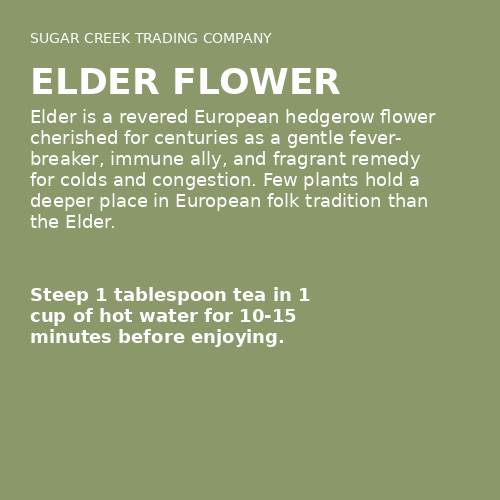
A revered European hedgerow flower cherished for centuries as a gentle fever-breaker, immune ally, and fragrant remedy for colds and congestion.
BOTANICAL IDENTIFICATION
Scientific Name: Sambucus nigra L.
Common Names: Elder Flower, Elderflower, European Elder, Black Elder, Pipe Tree, Bore Tree, Bour Tree, Ellhorn, Lady Elder
Family: Adoxaceae (Moschatel family; formerly Caprifoliaceae)
Sambucus nigra is a deciduous large shrub or small tree growing 3 to 10 meters tall, with arching branches containing soft, white pith. The leaves are opposite and pinnately compound, bearing five to seven sharply serrate, dark green leaflets with a somewhat unpleasant smell when bruised. From late May through July, the plant produces large, flat-topped corymbs (up to 20 cm across) of tiny, creamy-white, star-shaped flowers with a sweet, muscat-like fragrance, followed by drooping clusters of small, glossy, purple-black berries in autumn.
Native to Europe, western Asia, and North Africa, Elder thrives in nitrogen-rich, moist soils along hedgerows, woodland margins, waste ground, and riverbanks. It is widely naturalized in North America and cultivated worldwide for both its flowers and berries.
CULTURAL AND HISTORICAL USE
Few plants hold a deeper place in European folk tradition than the Elder. In Germanic and Scandinavian folklore, the Elder was believed to be inhabited by a protective spirit known as the Elder Mother (Hyldemoer in Danish, Holda or Frau Holle in German), and it was considered profoundly disrespectful to cut the tree without first asking her permission. Farmers planted Elder near homes and barns as a ward against evil spirits and lightning. Hippocrates referred to the Elder as his "medicine chest" for the breadth of its applications, and the first-century Roman naturalist Pliny the Elder documented its use for fevers and catarrh.
In the Western herbal tradition, Elder flowers have been a cornerstone cold and flu remedy for centuries. The great English herbalists John Gerard (1597), Nicholas Culpeper (1653), and John Parkinson all praised Elderflower for its ability to promote sweating and break fevers. In folk practice, Elderflower tea was the standard household remedy administered at the first sign of a cold, often blended with Yarrow and Peppermint in the classic "cold and flu tea" of European herbalism. The 17th-century text The Anatomie of the Elder by Martin Blochwich devoted an entire book to the plant's medicinal virtues.
Beyond medicine, Elder flowers have a rich culinary history. Elderflower cordial, made by steeping the fresh blossoms in sugar syrup with lemon, remains a beloved summer drink across Britain and Scandinavia. The flowers are also used to make elderflower champagne, fritters, and the French liqueur St-Germain. In traditional European homesteading, virtually every part of the Elder tree found use, earning it the nickname "the country people's medicine chest."
KEY BIOACTIVE COMPOUNDS & BENEFITS
| Compound/Class | Location in Plant | Human Benefit | Role in Plant |
|---|---|---|---|
| Flavonoids (rutin, isoquercitrin, hyperoside, kaempferol glycosides) | Flowers (petals and pollen) | Anti-inflammatory, antioxidant, capillary-strengthening, diaphoretic support | UV protection and pollinator attraction pigments |
| Phenolic acids (chlorogenic acid, caffeic acid) | Flowers and leaves | Antioxidant, antiviral, metabolic support | Defense against microbial infection and UV stress |
| Triterpenes (ursolic acid, oleanolic acid) | Flower surface waxes | Anti-inflammatory, mild diuretic, skin-soothing activity | Protective waxy coating on plant surfaces |
| Volatile oils (linalool, cis- and trans-rose oxide, nerol, geraniol) | Fresh flowers | Mild relaxant, aromatic properties, sensory appeal in preparations | Pollinator attraction through fragrance signaling |
| Mucilage and pectin | Flowers | Soothing to mucous membranes of the respiratory and digestive tracts | Water retention and structural support in floral tissues |
The combined phytochemical profile of Elder flowers creates a gentle yet effective remedy whose action centers on promoting healthy circulation to the periphery, supporting the body's natural fever response, and soothing inflamed mucous membranes. The rich flavonoid content, particularly rutin and isoquercitrin, provides the foundation for its anti-inflammatory and antioxidant effects, while the volatile oils and mucilage contribute to its pleasant taste and demulcent qualities.
HOW IT WORKS IN THE BODY
Elder flower works through several complementary mechanisms, primarily supporting the body's upper respiratory defenses and natural thermoregulatory processes.
Diaphoretic and Fever Management:
Elder flower is classified as a relaxing diaphoretic, meaning it gently opens peripheral circulation and promotes perspiration without overstimulating the body. When consumed as a hot infusion, the flavonoids and volatile compounds dilate peripheral blood vessels, increase blood flow to the skin, and support the body's natural mechanism for resolving fevers. This action is enhanced when the tea is drunk hot and the person rests under warm covers, a classic technique in Western herbalism.
Anti-inflammatory and Immune Support:
The flavonoid glycosides, particularly rutin and isoquercitrin, inhibit pro-inflammatory cytokines and modulate NF-kB signaling pathways. Chlorogenic acid provides additional antiviral activity, and in vitro studies have shown Elder flower extracts can reduce the replication of certain influenza strains. This positions Elder flower as both an immune-supportive and inflammation-modulating herb during upper respiratory infections.
Respiratory and Sinus Relief:
Elder flower has a traditional affinity for the upper respiratory tract. Its anti-catarrhal properties help reduce excessive mucus production and ease sinus congestion. The German Commission E approved Elder flower specifically for the treatment of colds, and it is an ingredient in the well-known Sinupret formula, a clinically studied European phytomedicine for sinusitis.
Mild Diuretic and Detoxification Support:
Elder flower has gentle diuretic properties, historically employed to support kidney function and reduce fluid retention. The triterpenes and flavonoids contribute to increased renal blood flow and mild aquaretic effects without depleting electrolytes aggressively.
DOSE GUIDELINES
| Preparation Type | Typical Dose | Purpose |
|---|---|---|
| Hot infusion (dried flowers) | 3-5 g steeped in 250 mL hot water for 10-15 minutes, 3 times daily | Cold and flu support, fever management, sinus relief |
| Tincture (1:5, 45% ethanol) | 2-4 mL, 3 times daily | Convenient immune and respiratory support |
| Cold infusion | 3-5 g steeped in cold water for 2-4 hours | Gentle diuretic and skin-supporting tonic |
| Topical (strong infusion or compress) | 10-15 g per 500 mL water, applied as compress | Skin irritation, eye wash (strained), sunburn relief |
For acute cold and flu symptoms, Elder flower is best used at the first onset and consumed frequently as a hot infusion throughout the day. The classic cold and flu combination of Elder flower, Yarrow, and Peppermint (equal parts) is a time-tested formula in European herbalism. For seasonal allergy support or as a gentle daily tonic, a milder infusion taken once or twice daily is appropriate.
PREPARATION AND USES
The most traditional and effective preparation is a hot infusion. Steep 3 to 5 grams of dried Elder flowers in just-boiled water, covered, for 10 to 15 minutes. The cover is important, as it prevents the loss of volatile aromatic compounds. Strain and drink hot, ideally while resting under a warm blanket, to maximize the diaphoretic effect. The tea has a delicate, slightly sweet, floral flavor that most people find very pleasant. Honey and lemon make excellent additions, particularly during illness.
Elder flowers also lend themselves beautifully to culinary use. Traditional elderflower cordial is made by steeping fresh (or rehydrated dried) blossoms in a sugar syrup with citrus zest and citric acid, producing a fragrant concentrate for diluting with water or sparkling water. The flowers can be dipped in a light batter and fried as elderflower fritters, a traditional springtime delicacy. For topical use, a strong infusion makes an excellent skin wash for minor irritations, and cooled elderflower tea has been used as a gentle eye compress for tired or inflamed eyes. Elderflower is also widely used in cosmetic preparations, particularly toners and face mists, for its skin-soothing and complexion-brightening properties.
OPTIMAL CONTEXT FOR USE
Elder flower is especially well-suited for individuals experiencing:
Early-stage colds, flu, or upper respiratory infections, particularly when taken at the very first sign of symptoms
Fever that needs gentle support to resolve naturally, especially in children and those who prefer mild, well-tolerated remedies
Sinus congestion, excessive mucus, or hay fever and seasonal allergies affecting the upper respiratory tract
Mild fluid retention or a desire for gentle, non-aggressive diuretic support
Skin irritation, minor inflammation, or a need for a soothing topical wash or compress
Elder flower combines particularly well with Yarrow and Peppermint for acute cold and flu support, with Nettle leaf for seasonal allergy relief, and with Linden flower for calming, diaphoretic support during feverish restlessness.
SUSTAINABILITY AND ETHICAL HARVESTING
Sambucus nigra is an abundant, fast-growing species that is in no danger of overharvesting. It colonizes hedgerows, waste ground, and forest edges readily and is considered a common wayside plant across its native range in Europe and western Asia. Elder is also widely cultivated for commercial elderflower and elderberry production, with significant agricultural plantings in Austria, Denmark, and the United Kingdom. Wild harvesting of Elder flowers is sustainable and widespread, as the tree produces flowers prolifically and light harvesting does not harm the plant.
Ethical harvesting practices include taking flowers from multiple trees rather than stripping a single plant, avoiding sprayed or roadside specimens, and leaving enough blossoms for berry production and wildlife. Sugar Creek Trading Company sources Elder flowers from responsible growers and collectors who follow sustainable harvesting guidelines.
SAFETY AND CAUTIONS
Elder flowers are generally regarded as very safe and are approved for use by the German Commission E and the European Medicines Agency (EMA). They have a long history of use in all age groups, including children.
Individuals with known allergies to plants in the Adoxaceae family should avoid Elder flower. Allergic reactions are rare but possible.
Elder flowers may have mild diuretic effects; those taking prescription diuretics or lithium should consult a healthcare provider to avoid compounding effects.
Raw, unripe elderberries and other plant parts (leaves, bark, stems, roots) contain cyanogenic glycosides and should not be consumed raw. Dried Elder flowers used for tea do not pose this concern.
Pregnant and nursing individuals can generally use Elder flower tea safely in moderate amounts, but should consult a healthcare provider for ongoing or therapeutic use.
REFERENCES
European Medicines Agency (EMA). "Assessment Report on Sambucus nigra L., flos." EMA/HMPC/611512/2016.
Blumenthal, M., Goldberg, A., & Brinckmann, J. Herbal Medicine: Expanded Commission E Monographs. American Botanical Council, 2000.
Beaux, D., Fleurentin, J., & Mortier, F. "Effect of Extracts of Orthosiphon stamineus Benth, Hieracium pilosella L., Sambucus nigra L. and Arctostaphylos uva-ursi (L.) Spreng. in Rats." Phytotherapy Research, 1999; 13(3): 222-225.
Hoffmann, D. Medical Herbalism: The Science and Practice of Herbal Medicine. Healing Arts Press, 2003.
FINAL NOTE
Elder flower is one of the most gentle and universally trusted remedies in the Western herbal tradition, a plant that has stood by families for centuries as the first line of comfort at the onset of winter illness. Its ability to gently encourage the body's own healing processes, from promoting a healthy fever response to soothing congested sinuses, reflects the Elder tree's deep roots in the everyday herbal wisdom of Europe. Whether sipped as a healing tea during a cold or enjoyed as a fragrant cordial on a summer afternoon, Elder flower offers a bridge between herbal medicine and culinary pleasure that few plants can match.
Share