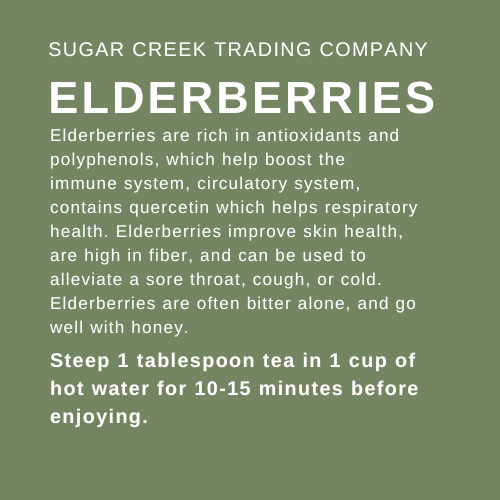
Sugar Creek Trading Company
Elderberry
Elderberry
Couldn't load pickup availability
SAMBUCUS NIGRA
(Elderberry, Elder Flower, Black Elder, European Elder)
Family: Adoxaceae (formerly Caprifoliaceae)
Part Used: Flowers, berries (occasionally leaves and bark in external use)
Energetics: Cooling, drying, dispersing
Taste: Sweet, slightly tart (berries); floral, mildly bitter (flowers)
BOTANICAL DESCRIPTION
Sambucus nigra L. is a deciduous shrub or small tree, typically 3–8 meters (10–25 ft) tall, with a spreading, many-stemmed habit and grayish bark that becomes furrowed with age. The leaves are opposite, pinnate, and composed of 5–9 serrated leaflets with a characteristic pungent aroma when crushed.
In late spring to early summer, large, flat-topped umbels (corymbs) of tiny creamy-white, five-petaled flowers appear, followed by dense clusters of glossy purplish-black berries in late summer to early autumn.
Roots: Fibrous and shallow, preferring moist, nutrient-rich soil.
Habitat: Found along hedgerows, forest margins, and stream banks throughout Europe, North Africa, and western Asia; now naturalized across North America and cultivated worldwide.
CULTIVATION AND ECOLOGY
-
Growth habit: Fast-growing, long-lived deciduous shrub; forms dense thickets.
-
Soil: Moist, fertile, well-drained loam; tolerates poor soils.
-
Water: Requires consistent moisture, though mature plants tolerate brief droughts.
-
Sun exposure: Full sun to partial shade.
-
Propagation: By softwood cuttings, hardwood cuttings, or seed stratification.
Ecological importance:
-
Flowers provide abundant nectar for pollinators.
-
Berries are a vital late-summer food for birds and wildlife.
-
Acts as a hedgerow stabilizer, preventing soil erosion.
TRADITIONAL AND ETHNOBOTANICAL USE
Elder has been revered for millennia across European, Celtic, and Germanic traditions as a sacred tree of protection, healing, and renewal. Folklore held that the “Elder Mother” (Hylde Moer) inhabited the tree; cutting it without offering respect was believed to bring misfortune.
Historical Use:
-
Hippocrates (4th century BCE) described elder as his “medicine chest,” referring to its broad range of actions.
-
Medieval European herbalists used flower infusions for fever, influenza, and eruptive illnesses, and berry syrups for respiratory infections and winter immunity.
-
Native American tribes employed native Sambucus canadensis similarly — as a fever remedy, expectorant, and blood purifier.
In modern Western herbalism, elder remains one of the most trusted immune-supportive and antiviral herbs, often used at the first sign of cold or flu to shorten duration and severity. Flowers continue to be used to open pores, reduce fever, and support detoxification through gentle diaphoresis.
PHYTOCHEMISTRY AND ACTIVE CONSTITUENTS
| Compound Class | Representative Compounds | Actions / Benefits | Notes |
|---|---|---|---|
| Anthocyanins (berries) | Cyanidin-3-glucoside, cyanidin-3-sambubioside | Antiviral, antioxidant, vascular-protective | Responsible for dark color and high ORAC value |
| Flavonoids (flowers) | Quercetin, kaempferol, rutin | Anti-inflammatory, antipyretic, immune-modulating | Enhance vitamin C absorption |
| Phenolic acids | Caffeic acid, chlorogenic acid, ferulic acid | Antioxidant, antimicrobial | Found in both berries and flowers |
| Vitamins & minerals | Vitamin C, A, potassium, calcium | Immune and cardiovascular support | Especially high in ripe berries |
| Triterpenes (bark, leaves) | Oleanolic acid, ursolic acid | Antimicrobial, anti-inflammatory (external use only) | Can be toxic internally |
| Lectins & polysaccharides | Sambucine, β-glucans | Immune modulation | May contribute to antiviral activity |
ACTIONS AND INDICATIONS
Primary Actions:
-
Immune stimulant and antiviral
-
Diaphoretic (induces gentle perspiration during fever)
-
Antioxidant and free radical scavenger
-
Anti-inflammatory (especially respiratory and vascular)
-
Mild expectorant and decongestant
-
Diuretic and detoxifying
Indicated For:
-
Colds, influenza, and viral infections
-
Sinusitis, bronchitis, dry or irritated coughs
-
Fever management (especially with flower tea)
-
Early stages of infection or immune compromise
-
Allergic rhinitis and seasonal allergies
-
Vascular inflammation, oxidative stress, or metabolic syndrome (berry extracts)
PREPARATIONS AND DOSAGE
| Form | Preparation | Suggested Dose | Notes |
|---|---|---|---|
| Berry syrup | Simmer fresh or dried berries with water and honey | 1–2 tsp every 2–3 hrs (acute), 1 tbsp daily (preventive) | Classic immune tonic |
| Tincture (1:5, 40% alcohol) | Fresh or dried berries or flowers | 2–4 mL, 2–3× daily | May be used in acute or long-term prevention |
| Infusion (flowers) | 1 tbsp flowers per cup hot water; steep 10–15 min | 1 cup, 2–3× daily | Promotes sweating, opens pores, reduces fever |
| Capsules (berry powder) | Standardized extract | 500–1000 mg, 1–2× daily | For year-round antioxidant support |
| Topical applications | Infused oil, salve, or lotion (flowers) | Apply externally | For inflammation, rashes, burns, or wounds |
Formulation Notes:
Elderberry combines beautifully with Echinacea, Andrographis, or Astragalus for immune defense; and with Yarrow or Peppermint for fever support.
For allergies and hay fever, pair with Nettle leaf and Eyebright.
SAFETY, CONTRAINDICATIONS, AND TOXICITY
-
Ripe, cooked berries and flowers are safe and widely consumed.
-
Unripe or raw berries, seeds, and leaves contain cyanogenic glycosides (sambunigrin), which can release small amounts of cyanide; these are destroyed by cooking or fermentation.
-
Do not consume bark or root internally.
-
Rare allergic responses may occur in sensitive individuals.
-
Safe for short- and long-term use, including in children (as syrup).
Pregnancy and Lactation:
Generally considered safe in moderation as food; use medicinal doses with care due to limited data.
Toxicity:
Low. Raw fruit ingestion in quantity may cause transient nausea or diarrhea.
HARVEST AND PROCESSING
-
Flowers: Harvest on dry mornings just after opening. Dry in thin layers in shade to preserve volatile compounds.
-
Berries: Harvest when fully ripe (dark purple-black). Cook immediately or dehydrate at low temperature (<120°F / 49°C).
-
Storage: Keep dried material in airtight containers, away from heat and light; shelf life 12–18 months.
SUSTAINABILITY AND CONSERVATION
Elder is abundant and sustainable, easily propagated, and beneficial to local ecosystems. It supports biodiversity, stabilizes soil, and provides wildlife forage.
Encouraged for regenerative hedgerow planting, pollinator habitats, and home gardens.
Avoid overharvesting from wild populations where native species (Sambucus canadensis) provide vital bird food; prefer cultivated or organically grown sources.
SUMMARY
Sambucus nigra unites the floral and the fruitful — the flower’s cooling, diaphoretic energy with the berry’s deep, immune-nourishing power. Together they embody a complete cycle of defense and renewal: dispelling heat, restoring balance, and building resilience.
From ancient European rites to modern clinical use, Elder has earned its place as a guardian herb of the respiratory and immune systems — a botanical ally for every home apothecary and community medicine garden.
Share