Sugar Creek Trading Company
Elecampane Root
Elecampane Root
Couldn't load pickup availability
INULA HELENIUM
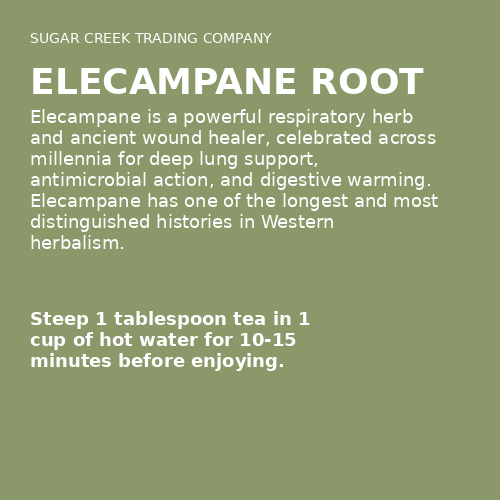
A powerful respiratory herb and ancient wound healer, celebrated across millennia for deep lung support, antimicrobial action, and digestive warming.
BOTANICAL IDENTIFICATION
Scientific Name: Inula helenium L.
Common Names: Elecampane, Horse-heal, Scabwort, Elf Dock, Wild Sunflower, Velvet Dock, Aunee (French), Alant (German)
Family: Asteraceae (Daisy/Composite family)
Inula helenium is a robust, stately perennial growing 1 to 2 meters tall with thick, erect, branching stems covered in soft, downy hairs. The basal leaves are enormous, up to 80 cm long and 30 cm wide, broadly ovate with a velvety underside, while the upper stem leaves are smaller and clasping. From mid to late summer, the plant produces bright yellow, sunflower-like composite flower heads 6 to 8 cm across with slender, radiating ray florets. The root, the primary medicinal part, is a large, thick, fleshy, branching rhizome with an aromatic, camphor-like smell and a warm, bitter, slightly pungent taste.
Native to central and southern Europe and temperate western Asia, Elecampane has been naturalized across the British Isles, eastern North America, and parts of East Asia. It favors damp meadows, riverbanks, roadsides, and hedgerows, thriving in rich, heavy, moist soils in partial shade to full sun.
CULTURAL AND HISTORICAL USE
Elecampane has one of the longest and most distinguished histories in Western herbalism. The plant's species name, helenium, is traditionally linked to Helen of Troy, with legend holding that the herb sprang from her tears (or that she was carrying it when she was abducted by Paris). The ancient Greeks and Romans used Elecampane extensively. Hippocrates prescribed it for respiratory conditions, Dioscorides included it in De Materia Medica as a remedy for coughs and digestive complaints, and Pliny the Elder recommended it for a wide range of ailments. The Romans also candied the root as a digestive confection and flavoring, a practice that persisted in European apothecaries well into the 19th century.
In medieval European herbal medicine, Elecampane was one of the most important lung herbs. It was a key ingredient in cough syrups and respiratory formulas across the monasteries and apothecary shops of England, France, and Germany. The Anglo-Saxon Lacnunga and the Leech Books of Bald both include Elecampane in their remedies. Nicholas Culpeper praised it as a remedy that "warms a cold and windy stomach" and recommended it for "old coughs and shortness of breath." In Welsh folk tradition, Elecampane was known as "marchalan" and was considered essential for treating consumptive lung conditions.
Traditional Chinese Medicine uses the closely related Inula species (particularly I. japonica and I. britannica) under the name Xuan Fu Hua, though I. helenium itself (Tu Mu Xiang) has also been used in Chinese practice for digestive stagnation and abdominal pain. In Ayurvedic tradition, Elecampane root (Pushkaramoola) is classified as a pungent, bitter, warming herb used to treat asthma, bronchitis, and respiratory congestion, and it appears in classical texts including the Charaka Samhita.
KEY BIOACTIVE COMPOUNDS & BENEFITS
| Compound/Class | Location in Plant | Human Benefit | Role in Plant |
|---|---|---|---|
| Sesquiterpene lactones (alantolactone, isoalantolactone, dihydroalantolactone) | Root and rhizome (essential oil fraction) | Potent antimicrobial, antifungal, antiparasitic, expectorant, and anti-inflammatory activity | Chemical defense against herbivores, fungi, and microbial pathogens |
| Inulin (up to 44% of dry root weight) | Root parenchyma | Prebiotic fiber supporting beneficial gut bacteria, mild demulcent action | Primary carbohydrate storage polymer (fructan), replaces starch in Asteraceae roots |
| Essential oil (1-4%; rich in alantol, azulene precursors) | Root and rhizome | Antimicrobial, expectorant, antispasmodic, warming aromatic action | Volatile defense compounds and communication signals |
| Triterpenes (dammaradienyl acetate, friedelin) | Root bark and cortex | Anti-inflammatory, hepatoprotective support | Structural defense and wound-sealing compounds |
| Phytosterols (stigmasterol, beta-sitosterol) | Root | Cholesterol modulation, mild anti-inflammatory effects | Cell membrane structural components |
Elecampane's therapeutic profile is dominated by two remarkable constituents: the sesquiterpene lactones (alantolactone and its derivatives) and the polysaccharide inulin. The sesquiterpene lactones are responsible for the root's powerful antimicrobial and expectorant properties, while inulin, making up nearly half the dry root weight, provides prebiotic and demulcent support. This combination of antimicrobial strength and soothing demulcency makes Elecampane uniquely effective for deep respiratory and digestive conditions.
HOW IT WORKS IN THE BODY
Elecampane root acts through several potent and well-characterized mechanisms, with a primary affinity for the respiratory and digestive systems.
Respiratory Support and Expectorant Action:
Elecampane is one of the most specific herbs for deep, chronic respiratory conditions. The sesquiterpene lactones and essential oil components stimulate bronchial mucous membranes, promoting the production and expectoration of phlegm from the deep lungs. This is not a simple mucolytic action but a true expectorant and antitussive effect, loosening thick, stuck mucus while simultaneously calming irritated bronchial tissue. The herb has a particular affinity for wet, productive coughs with copious or stubborn phlegm, though it also soothes dry, irritated coughs through its inulin-derived demulcent action.
Antimicrobial and Antiparasitic Activity:
Alantolactone and isoalantolactone have demonstrated significant antimicrobial activity in laboratory studies. They show effectiveness against Mycobacterium tuberculosis (the tuberculosis bacterium), Staphylococcus aureus, and multiple fungal species including Candida. This antimicrobial potency explains Elecampane's historical reputation as a remedy for tuberculosis and other deep lung infections. The sesquiterpene lactones also exhibit antiparasitic (anthelmintic) activity, which is reflected in the traditional name "Scabwort" and its historical use against intestinal worms.
Digestive Warming and Prebiotic Support:
The warming, bitter, and aromatic qualities of Elecampane stimulate digestive secretions, improve appetite, and ease bloating and gas. The high inulin content acts as a prebiotic fiber, selectively feeding beneficial Bifidobacterium and Lactobacillus species in the colon, supporting microbiome diversity and healthy bowel function. In TCM terms, Elecampane moves Qi stagnation in the middle burner and resolves dampness.
Anti-inflammatory Pathways:
The sesquiterpene lactones inhibit NF-kB activation and reduce the expression of pro-inflammatory enzymes (COX-2, iNOS), providing systemic anti-inflammatory support. This is particularly relevant in chronic respiratory inflammation where persistent cough and bronchial irritation are driven by ongoing inflammatory processes.
DOSE GUIDELINES
| Preparation Type | Typical Dose | Purpose |
|---|---|---|
| Decoction (dried root) | 3-5 g simmered in 350 mL water for 15-20 minutes, 3 times daily | Deep respiratory support, chronic cough, bronchial congestion |
| Tincture (1:5, 45% ethanol) | 2-4 mL, 3 times daily | Convenient respiratory and digestive tonic |
| Powdered root | 1-3 g daily in capsules or stirred into warm water or honey | Digestive warming, prebiotic support, general use |
| Syrup (decoction reduced with honey) | 5-10 mL, 3-4 times daily | Cough and sore throat relief (traditional preparation) |
Elecampane is best used over a course of several weeks for chronic respiratory conditions, though it can also be employed acutely for coughs and bronchial congestion. The decoction is the most traditional and therapeutically potent preparation, as simmering effectively extracts both the essential oil compounds and the water-soluble inulin. The root has a distinctive warm, camphoraceous, slightly bitter flavor that blends well with honey, licorice, or thyme in cough formulas.
PREPARATION AND USES
The classic preparation is a decoction: place 3 to 5 grams of dried, cut Elecampane root in cold water, bring to a simmer, and cook gently for 15 to 20 minutes. Strain and drink warm, sweetened with honey if desired. The decoction has a distinctive warm, earthy, camphoraceous taste that many find pleasantly medicinal. For cough support, a traditional Elecampane syrup can be made by reducing the decoction by half and adding an equal volume of raw honey, creating a soothing, shelf-stable preparation ideal for chronic coughs.
Tincture is another popular form, particularly for practitioners who want precise dosing. The root tinctures well in 45% ethanol. Elecampane root can also be powdered and encapsulated for those who prefer not to taste the strong flavor. In historical practice, the root was candied in sugar as a confection and digestive aid, a preparation once common in European apothecary shops. Elecampane pairs exceptionally well with other respiratory herbs such as Mullein, Thyme, Horehound, and Licorice in cough and bronchial support blends.
OPTIMAL CONTEXT FOR USE
Elecampane root is especially well-suited for individuals experiencing:
Chronic or lingering coughs with thick, stuck, or copious mucus, particularly bronchitis, post-infectious cough, or persistent respiratory congestion
Deep lung conditions requiring both antimicrobial support and expectorant action, such as recurrent respiratory infections
Digestive sluggishness, bloating, poor appetite, or gut dysbiosis where prebiotic and bitter tonic support is needed
Compromised respiratory function from smoking, environmental exposures, or chronic inflammation of the airways
Situations calling for a warming, stimulating herb to move stagnant mucus and revive sluggish digestion during cold, damp seasons
Elecampane combines exceptionally well with Mullein leaf for soothing deep lung support, with Thyme for antimicrobial bronchial action, with Licorice root for its demulcent and harmonizing effects, and with Marshmallow root when additional mucosal soothing is needed.
SUSTAINABILITY AND ETHICAL HARVESTING
Inula helenium is widely cultivated in herb gardens and small farms across Europe and North America, and it is not considered at risk in the wild. The plant is vigorous, self-seeding, and easy to grow in temperate climates, making it a reliable cultivated crop. Most commercial Elecampane root comes from cultivated sources in Europe (particularly Eastern Europe and the Balkans) and parts of Asia. Wild populations exist throughout its native range in central and southern Europe, where they are locally common along rivers, damp meadows, and roadsides.
Roots are typically harvested from two- to three-year-old plants in autumn, when the inulin content is at its peak. Sustainable harvesting practice involves replanting root divisions to ensure continued regeneration. Sugar Creek Trading Company sources Elecampane root from suppliers committed to responsible cultivation and harvesting practices.
SAFETY AND CAUTIONS
Elecampane is generally well-tolerated at recommended doses and has a long history of safe use. However, its potent sesquiterpene lactones warrant some awareness.
Individuals with allergies to plants in the Asteraceae (Compositae) family (ragweed, chamomile, echinacea, etc.) should use caution, as cross-reactivity is possible. Sesquiterpene lactones can be contact sensitizers in susceptible individuals.
Large doses may cause nausea, vomiting, or digestive upset due to the strong bitter and aromatic compounds. Start with lower doses and increase gradually.
Pregnant and nursing individuals should avoid Elecampane due to its uterine-stimulating potential and the potency of its sesquiterpene lactone content. Consult a qualified healthcare provider before use.
Those taking sedative or blood-sugar-lowering medications should consult a healthcare provider, as Elecampane may have additive effects in these areas.
REFERENCES
O'Shea, S., Lucey, B., & Cotter, L. "In vitro Activity of Inula helenium Against Clinical Staphylococcus aureus Strains Including MRSA." British Journal of Biomedical Science, 2009; 66(4): 186-189.
Seca, A.M.L., Grigore, A., Pinto, D.C.G.A., & Silva, A.M.S. "The Genus Inula and Their Metabolites: From Ethnopharmacological to Medicinal Uses." Journal of Ethnopharmacology, 2014; 154(2): 286-310.
Hoffmann, D. Medical Herbalism: The Science and Practice of Herbal Medicine. Healing Arts Press, 2003.
Grieve, M. A Modern Herbal. Dover Publications, 1971 (originally published 1931).
FINAL NOTE
Elecampane root is one of the most powerful respiratory herbs in the Western tradition, a plant that reaches deep into the lungs to move what is stuck, clear what is infected, and warm what has grown cold and stagnant. Its remarkable combination of potent antimicrobial sesquiterpene lactones and gut-nourishing prebiotic inulin makes it a dual-action remedy for the two great organ systems most in need of support during winter illness. For herbalists dealing with stubborn, chronic, deep-seated coughs and bronchial congestion, Elecampane remains an indispensable botanical ally with few true equals.
Share