Sugar Creek Trading Company
Eleuthero Root
Eleuthero Root
Couldn't load pickup availability
ELEUTHEROCOCCUS SENTICOSUS
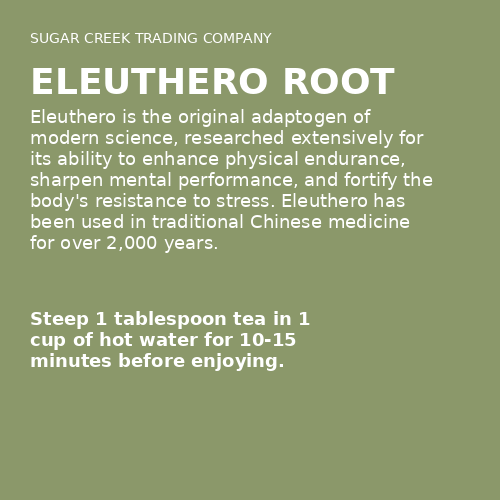
The original adaptogen of modern science, researched extensively for its ability to enhance physical endurance, sharpen mental performance, and fortify the body's resistance to stress.
BOTANICAL IDENTIFICATION
Scientific Name: Eleutherococcus senticosus (Rupr. & Maxim.) Maxim.
Common Names: Eleuthero, Siberian Ginseng, Ci Wu Jia (Chinese), Devil's Bush, Devil's Shrub, Touch-Me-Not, Taiga Root, Acanthopanax senticosus (former name)
Family: Araliaceae (Ginseng family)
Eleutherococcus senticosus is a thorny, deciduous shrub growing 2 to 3 meters tall (occasionally up to 6 meters) with multiple erect stems densely covered in fine, downward-pointing bristles. The leaves are palmately compound with five (occasionally three) elliptical, finely serrate leaflets radiating from a long petiole, resembling a smaller version of true Ginseng foliage. Small, yellowish-green to violet umbel flower clusters appear in mid-summer, followed by clusters of round, black drupes in autumn. The root and rhizome are the primary medicinal parts: woody, cylindrical, and extensively branched with a distinctive sweet, slightly pungent, aromatic taste.
Native to the dense, mixed forests of northeastern Asia, including Siberia, northern China (Heilongjiang, Jilin, Liaoning provinces), Korea, and Japan, Eleuthero thrives in the understory of the taiga and boreal-temperate transition forests at elevations up to 2,000 meters. It prefers well-drained, humus-rich soils in partial shade and is remarkably cold-hardy, tolerating temperatures as low as -40 degrees Celsius.
CULTURAL AND HISTORICAL USE
Eleuthero has been used in traditional Chinese medicine for over 2,000 years. It is recorded in the Shennong Ben Cao Jing (Divine Farmer's Classic of Materia Medica, circa 200 CE) under the name Wu Jia Pi, where it was classified as a superior-grade herb that "tonifies the Qi, strengthens the sinews and bones, and treats deficiency and fatigue." In TCM theory, Eleuthero is considered warm in nature, entering the Spleen, Kidney, and Heart meridians. It was traditionally prescribed to strengthen the Wei Qi (defensive energy), invigorate the elderly, and support recovery from prolonged illness. In Chinese folk medicine, it was said that "I would rather take a handful of Wu Jia than a cartload of gold and jade."
Eleuthero's modern prominence, however, stems from Soviet-era research. In the 1950s and 1960s, Soviet pharmacologist Dr. Israel Brekhman and his team at the Institute of Biologically Active Substances in Vladivostok conducted extensive research on Eleuthero as part of the USSR's adaptogen program. Brekhman was searching for a more affordable and sustainable alternative to Panax ginseng for enhancing the performance of Soviet athletes, cosmonauts, military personnel, and factory workers. His research team coined the term "adaptogen" and established Eleuthero as its prototype, defining an adaptogen as a substance that increases resistance to a broad spectrum of harmful factors (stressors) through nonspecific mechanisms. Over 1,000 studies were conducted in the Soviet Union alone, making Eleuthero one of the most researched herbs of the 20th century.
Following the Soviet research, Eleuthero was adopted into official pharmacopoeias in Russia, China, Japan, and several European nations. It became widely used by athletes, shift workers, students, and anyone facing periods of high physical or mental demand. In the West, it was marketed as "Siberian Ginseng" until regulations in several countries restricted the use of the word "ginseng" to true Panax species, leading to the adoption of the name "Eleuthero."
KEY BIOACTIVE COMPOUNDS & BENEFITS
| Compound/Class | Location in Plant | Human Benefit | Role in Plant |
|---|---|---|---|
| Eleutherosides B (syringin) and E (syringaresinol di-glucoside) | Root bark and cortex | Primary adaptogenic compounds: stress resistance, immune modulation, enhanced work capacity | Phenylpropanoid and lignan glycosides involved in structural defense and stress response |
| Eleutherosides A, C, D (various triterpene and sterol glycosides) | Root and rhizome | Anti-fatigue, anti-inflammatory, cholesterol-modulating effects | Secondary metabolites providing defense against microbial attack and environmental stress |
| Polysaccharides (heteroglycans) | Root parenchyma | Immunostimulating activity, enhanced macrophage and NK cell function | Energy storage and cell wall components |
| Phenolic compounds (chlorogenic acid, caffeic acid, isofraxidin) | Root and stem bark | Antioxidant protection, hepatoprotective, anti-inflammatory support | UV screening and pathogen defense |
| Coumarins (isofraxidin, eleutheroside B1) | Stem and root bark | Vascular support, mild sedative properties, anti-inflammatory | Phytoalexin defense compounds produced in response to injury |
Eleuthero's adaptogenic activity is attributed primarily to the eleutherosides, a chemically diverse group of glycosides that do not belong to a single compound class but share the ability to modulate the hypothalamic-pituitary-adrenal (HPA) axis and improve the body's stress response efficiency. Eleutherosides B and E are considered the most pharmacologically important and are used as marker compounds for quality standardization. Together with the immunostimulatory polysaccharides and antioxidant phenolics, they create a broad-spectrum adaptogenic profile distinct from that of true Ginseng.
HOW IT WORKS IN THE BODY
Eleuthero operates as a true adaptogen, modulating the body's stress response systems to enhance resilience, work capacity, and recovery across multiple physiological pathways.
HPA Axis and Stress Response Modulation:
Eleuthero's primary mechanism of action involves regulating the hypothalamic-pituitary-adrenal (HPA) axis, the central command system for the body's stress response. The eleutherosides, particularly B and E, help normalize cortisol and stress hormone output, preventing both the excessive spikes of acute stress and the flattened, depleted cortisol curves of chronic stress and burnout. Rather than stimulating or suppressing the stress response, Eleuthero helps the body mount an appropriate, proportional response to stressors and then recover efficiently. This is the hallmark of true adaptogenic action.
Physical Performance and Anti-Fatigue Effects:
Extensive research, beginning with the Soviet studies and continuing through modern clinical trials, has demonstrated that Eleuthero can improve physical work capacity, extend time to exhaustion during exercise, enhance oxygen utilization (VO2 max), and accelerate recovery after physical exertion. These effects are attributed to improved mitochondrial efficiency, enhanced glycogen sparing, and reduced accumulation of stress-related metabolic waste products such as lactic acid and ammonia.
Cognitive Function and Mental Performance:
Eleuthero has shown consistent effects on mental performance, including improved concentration, attention, and cognitive processing speed under stressful conditions. Studies on shift workers, students during exam periods, and individuals in high-demand occupations have shown improvements in accuracy, alertness, and subjective well-being. The mechanism involves modulation of neurotransmitter activity, enhanced cerebral blood flow, and protection of neural tissue from oxidative and stress-related damage.
Immune Modulation:
The polysaccharide fraction of Eleuthero stimulates innate immune function, enhancing natural killer (NK) cell activity, macrophage phagocytosis, and the production of immunoglobulins. Clinical studies have shown reduced frequency and duration of upper respiratory infections in individuals taking Eleuthero during cold and flu season. Importantly, Eleuthero modulates rather than simply stimulates immunity, making it suitable for long-term use.
DOSE GUIDELINES
| Preparation Type | Typical Dose | Purpose |
|---|---|---|
| Decoction (dried root) | 6-15 g simmered in water for 20-30 minutes, 1-2 times daily | Traditional adaptogenic tonic for energy, endurance, and immune support |
| Powdered root | 2-4 g daily in capsules or mixed into beverages | General adaptogenic maintenance and stress resilience |
| Tincture (1:5, 40-50% ethanol) | 2-5 mL, 2-3 times daily | Convenient daily adaptogenic support |
| Standardized extract (0.8% eleutherosides) | 300-400 mg, 1-3 times daily | Standardized dosing for performance and immune support |
Eleuthero is traditionally used in cycles: 6 to 8 weeks of daily use followed by a 1- to 2-week rest period, then resumed. This cycling pattern was established during the Soviet research era and is still widely recommended by herbalists. It is typically taken in the morning and early afternoon, as taking it late in the day may interfere with sleep in some individuals due to its mildly stimulating and energizing effects. Eleuthero is considered most effective when used consistently over weeks to months rather than as a single-dose intervention.
PREPARATION AND USES
The dried root is traditionally prepared as a decoction by simmering 6 to 15 grams in water for 20 to 30 minutes. The resulting tea has a mildly sweet, slightly woody, and faintly pungent flavor that is generally well-received. In Russian folk practice, Eleuthero root was also macerated in vodka or wine as a tonic extract. Modern preparations include powdered root in capsules, liquid tinctures, and standardized extracts.
Powdered Eleuthero root can be stirred into smoothies, warm beverages, or blended into adaptogenic drink mixes alongside mushrooms like Reishi or Cordyceps and other adaptogens like Rhodiola or Ashwagandha. For athletes and those in physically demanding work, Eleuthero is often incorporated into pre-workout or daily performance formulas. The root can also be combined with Astragalus and Codonopsis for a synergistic immune-and-energy tonic in the TCM tradition.
OPTIMAL CONTEXT FOR USE
Eleuthero root is especially well-suited for individuals experiencing:
Chronic stress, overwork, or burnout with diminished energy, resilience, and recovery capacity
Physically demanding lifestyles including athletic training, manual labor, or endurance activities where improved stamina and reduced fatigue are goals
Cognitive demands such as prolonged study, shift work, high-pressure deadlines, or situations requiring sustained mental focus under stress
Frequent illness or susceptibility to colds and respiratory infections, particularly during high-stress periods when immunity is compromised
Recovery from prolonged illness, surgery, or debilitating conditions where the body needs support rebuilding vitality and adaptive capacity
Eleuthero works well in combination with Rhodiola rosea for enhanced mental-physical performance, with Ashwagandha for deeper nervous system restoration, with Astragalus for immune reinforcement, and with Schisandra berry for liver support and comprehensive adaptogenic coverage.
SUSTAINABILITY AND ETHICAL HARVESTING
Eleutherococcus senticosus is abundant across its native range in the vast boreal and mixed forests of Siberia, northern China, Korea, and Japan. It is not currently listed as threatened or endangered, and its extensive natural range in the relatively undisturbed taiga forests of eastern Russia and Manchuria provides a large wild resource base. The plant is also cultivated commercially in China, Russia, and to a lesser extent in North America and Europe.
However, increased global demand has led to concerns about overharvesting in certain accessible areas, particularly in China's northeastern provinces. Sustainable harvesting practices involve taking only a portion of the root system from mature plants, allowing regeneration, and rotating harvest areas. Root harvest should be conducted on plants at least four to five years old. Sugar Creek Trading Company prioritizes Eleuthero root sourced from suppliers who demonstrate responsible wild-harvesting or cultivation practices.
SAFETY AND CAUTIONS
Eleuthero has an excellent safety profile and is well-tolerated by the vast majority of users. It is classified as GRAS (Generally Recognized as Safe) in the United States and is approved by the German Commission E and the WHO for use as a prophylactic and restorative tonic.
Individuals with uncontrolled hypertension should use Eleuthero with caution and under practitioner guidance, as it may raise blood pressure in some cases, though this effect is inconsistent in the literature.
May interact with anticoagulant/antiplatelet medications, cardiac glycosides (digoxin), sedatives, and hypoglycemic drugs. Consult a healthcare provider if taking these medications.
Pregnant and nursing individuals should consult a qualified healthcare provider before use. While traditional use during pregnancy exists in some cultures, Western safety reviews generally advise caution.
Eleuthero may cause mild insomnia or overstimulation if taken late in the day or at high doses. If this occurs, reduce the dose or limit use to morning and early afternoon.
Not recommended during acute febrile illness. As with most adaptogens, it is best used during non-acute periods for building resilience rather than during active infection with high fever.
REFERENCES
Panossian, A. & Wikman, G. "Evidence-Based Efficacy of Adaptogens in Fatigue, and Molecular Mechanisms Related to Their Stress-Protective Activity." Current Clinical Pharmacology, 2009; 4(3): 198-219.
Huang, L., Zhao, H., Huang, B., et al. "Acanthopanax senticosus: Review of Botany, Chemistry and Pharmacology." Die Pharmazie, 2011; 66(2): 83-97.
Cicero, A.F.G., Derosa, G., Brillante, R., et al. "Effects of Siberian Ginseng (Eleutherococcus senticosus Maxim.) on Elderly Quality of Life: A Randomized Clinical Trial." Archives of Gerontology and Geriatrics, 2004; 38(Suppl 1): 69-73.
World Health Organization. WHO Monographs on Selected Medicinal Plants, Volume 2. Geneva, 2002.
FINAL NOTE
Eleuthero root is the herb that launched the modern science of adaptogens, and decades of research have only reinforced its reputation as one of the most reliable and well-rounded stress-resilience botanicals available. It does not deliver the sharp, immediate stimulation of caffeine or the dramatic shift of pharmaceutical stimulants. Instead, it works quietly and cumulatively, building the body's capacity to handle more, recover faster, and maintain equilibrium under pressure. For anyone navigating sustained physical demands, mental stress, or the simple wear of modern life, Eleuthero offers a time-tested foundation of adaptogenic support with a safety profile that permits confident, long-term use.
Share