Sugar Creek Trading Company
Epazote Herb
Epazote Herb
Couldn't load pickup availability
DYSPHANIA AMBROSIOIDES
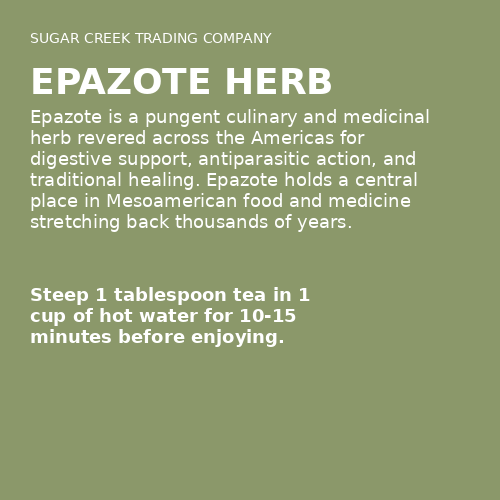
A pungent culinary and medicinal herb revered across the Americas for digestive support, antiparasitic action, and traditional healing.
BOTANICAL IDENTIFICATION
Scientific Name: Dysphania ambrosioides (L.) Mosyakin & Clemants
Common Names: Epazote, Mexican tea, wormseed, Jesuit's tea, paico, apazote, hierba hedionda
Family: Amaranthaceae (formerly Chenopodiaceae)
Epazote is an aromatic annual or short-lived perennial herb that typically grows 40 to 120 cm tall, with erect, branching stems that are often reddish-purple at the base. The leaves are lance-shaped to oblong, 4 to 12 cm long, with irregularly toothed margins and prominent oil glands that release the plant's distinctive strong, camphor-like aroma. Small, greenish flowers appear in dense clusters along leafy terminal spikes, producing tiny round seeds.
Native to Central America, Mexico, and South America, epazote has naturalized across warm and temperate regions worldwide, thriving in disturbed soils, roadsides, and cultivated gardens. It prefers full sun and well-drained soil, tolerating drought and poor soil conditions with ease.
CULTURAL AND HISTORICAL USE
Epazote holds a central place in Mesoamerican food and medicine stretching back thousands of years. The Aztecs and Maya used the herb both as a cooking spice and as a remedy for intestinal parasites, flatulence, and stomach complaints. Its Nahuatl name, "epazotl," translates roughly to "skunk sweat," a vivid reference to its pungent, polarizing aroma. In traditional Mexican cuisine, epazote is considered nearly indispensable in dishes featuring black beans, as it is believed to reduce the gas-producing effects of legumes while adding a distinctive earthy, slightly citrus-like flavor.
Throughout Central and South America, indigenous and folk medicine traditions have long employed epazote as a vermifuge (anti-worm agent), particularly for roundworms and hookworms. In Brazil, where it is known as "mastruz" or "erva-de-santa-maria," the herb is used in poultices for respiratory ailments and wound healing. In the Caribbean and parts of Africa where it was introduced, epazote teas are given for digestive cramping, menstrual irregularity, and fever.
In Western herbal medicine, epazote gained attention in the early 20th century when its essential oil, known as chenopodium oil or "oil of wormseed," was widely used as an anthelmintic before the advent of synthetic pharmaceuticals. The Eclectics documented its use for intestinal parasites and as a digestive carminative. Today, epazote remains a staple herb in Latin American kitchens and continues to be valued by herbalists for its gastrointestinal benefits.
KEY BIOACTIVE COMPOUNDS & BENEFITS
| Compound/Class | Location in Plant | Human Benefit | Role in Plant |
|---|---|---|---|
| Ascaridole (monoterpene peroxide) | Essential oil, leaves | Potent antiparasitic and anthelmintic activity against intestinal worms | Chemical defense against herbivores and pathogens |
| p-Cymene | Essential oil, leaves | Anti-inflammatory, analgesic, and antioxidant properties | Volatile deterrent against insect herbivory |
| Alpha-terpinene | Essential oil, leaves | Antimicrobial and antifungal activity; supports immune defense | Aromatic defense compound |
| Flavonoids (kaempferol, quercetin derivatives) | Leaves, stems | Antioxidant protection, anti-inflammatory support | UV protection and pollinator signaling |
| Saponins and tannins | Leaves, seeds | Digestive support, carminative effects, mild antimicrobial action | Deterrent against herbivores and microbial invasion |
Together, these compounds create a potent phytochemical profile centered on gastrointestinal health. The monoterpene peroxide ascaridole is the signature compound responsible for epazote's historical fame as a parasite remedy, while the broader terpene and flavonoid content provides anti-inflammatory, antimicrobial, and antioxidant support that benefits the digestive tract and beyond.
HOW IT WORKS IN THE BODY
Epazote exerts its effects primarily through its volatile oil constituents and secondary metabolites, acting on the digestive system, immune defenses, and smooth muscle tissue.
Antiparasitic and Antimicrobial Action:
Ascaridole, the herb's most studied compound, works by disrupting the metabolic processes of intestinal parasites, particularly roundworms (Ascaris) and hookworms. It interferes with the parasites' ability to metabolize oxygen, effectively paralyzing and killing them. The broader essential oil also demonstrates activity against bacteria, fungi, and protozoa, contributing to a hostile environment for gut pathogens.
Digestive and Carminative Support:
Epazote's aromatic compounds stimulate the secretion of digestive enzymes and bile, promoting more efficient breakdown of food. Its carminative action helps relax smooth muscle in the gastrointestinal tract, reducing spasms and allowing trapped gas to pass. This is why it is traditionally paired with beans and other gas-producing legumes in Mexican cooking.
Anti-inflammatory and Antioxidant Effects:
Flavonoids and terpenes in epazote modulate inflammatory pathways by inhibiting the production of pro-inflammatory cytokines and scavenging free radicals. This protective action extends to the intestinal lining, helping to soothe irritation and support mucosal integrity.
DOSE GUIDELINES
| Preparation Type | Typical Dose | Purpose |
|---|---|---|
| Dried herb tea (infusion) | 1-2 teaspoons steeped in 8 oz hot water for 10-15 minutes, 1-2 times daily | Digestive support, gas relief, mild antiparasitic |
| Culinary use | 1-2 fresh or dried sprigs added to beans, soups, or stews during cooking | Flavor enhancement and digestive carminative |
| Tincture (1:5, 45% alcohol) | 15-30 drops in water, 1-2 times daily | Concentrated digestive and antiparasitic support |
| Powdered herb in capsules | 500-1,000 mg, 1-2 times daily with food | General digestive aid |
Epazote is best used in short courses rather than as a long-term daily tonic, especially when employing it for antiparasitic purposes. For culinary and mild digestive use, moderate regular consumption as a cooking herb is considered safe within traditional food amounts. Avoid high doses or prolonged concentrated use, as the essential oil can be irritating in excess.
PREPARATION AND USES
The most traditional preparation of epazote is simply adding a sprig or handful of the dried herb to a pot of simmering black beans, where it imparts its characteristic flavor while easing digestion. It is also used in quesadillas, tamales, mole verde, soups, and egg dishes throughout Mexican and Central American cuisine. For a simple digestive tea, steep 1 to 2 teaspoons of the dried leaf in hot water for 10 to 15 minutes, strain, and sip after meals.
For more concentrated therapeutic use, a tincture can be prepared by macerating the dried herb in 45% alcohol at a 1:5 ratio for 4 to 6 weeks. Epazote can also be ground into powder and encapsulated. Externally, poultices of the fresh or rehydrated leaves have been applied in Latin American folk medicine to insect bites, minor wounds, and fungal skin infections. The essential oil itself should not be used internally without professional guidance, as it is far more concentrated than the whole herb.
OPTIMAL CONTEXT FOR USE
This herb is especially well-suited for individuals experiencing:
Chronic bloating, gas, and digestive discomfort, particularly after consuming beans and legumes
Suspected intestinal parasites or a history of parasitic infection (used under practitioner guidance)
Sluggish digestion with feelings of heaviness after meals
A desire to incorporate traditional Latin American culinary herbs into their cooking with added health benefits
Mild gastrointestinal cramping or spasms
Epazote works well as part of a broader digestive wellness protocol and pairs naturally with other carminative herbs such as fennel, cumin, and Mexican oregano.
SUSTAINABILITY AND ETHICAL HARVESTING
Epazote is an abundant, fast-growing herb that thrives in a wide variety of conditions and is considered weedy or invasive in many parts of the world. It is easily cultivated from seed, self-sows prolifically, and requires minimal inputs such as water or fertilizer. There are no conservation concerns associated with this species, and it is not listed as threatened or endangered in any region.
Because of its ease of cultivation, most commercial epazote is farm-grown rather than wild-harvested, making it an inherently sustainable botanical. Ethical sourcing focuses primarily on fair labor practices in the farming communities that produce it, particularly in Mexico and Central America.
SAFETY AND CAUTIONS
Epazote is generally recognized as safe when consumed in normal culinary amounts. However, caution is warranted with concentrated preparations:
Essential oil toxicity: Pure epazote essential oil (chenopodium oil) contains high concentrations of ascaridole, which can be toxic to the liver, kidneys, and nervous system in large doses. Never ingest the essential oil directly. Use only the whole herb or properly diluted preparations.
Pregnancy and nursing: Epazote has been traditionally used as an emmenagogue (to promote menstruation) and should be avoided during pregnancy, as it may stimulate uterine contractions. Nursing mothers should also avoid concentrated preparations.
Children: Historically, epazote was given to children for worms, but concentrated doses can be dangerous for small children. Culinary amounts are generally considered safe; medicinal doses should be supervised by a qualified practitioner.
Drug interactions: May interact with anticoagulant medications due to its effects on blood flow. Consult a healthcare provider if taking prescription medications, especially blood thinners or liver-metabolized drugs.
REFERENCES
Gadano, A. B., et al. "In vitro genotoxic evaluation of the medicinal plant Chenopodium ambrosioides L." Journal of Ethnopharmacology, vol. 81, no. 1, 2002, pp. 11-16.
Kiuchi, F., et al. "Nematocidal activity of turmeric: synergistic action of curcuminoids." Chemical and Pharmaceutical Bulletin, vol. 41, no. 9, 1993, pp. 1640-1643. [Cross-reference for anthelmintic comparison]
Monzote, L., et al. "Essential oil from Chenopodium ambrosioides and main components: Activity against Leishmania, their mitochondria and other microorganisms." Experimental Parasitology, vol. 121, no. 2, 2009, pp. 302-307.
Duke, J. A. Handbook of Medicinal Herbs, 2nd ed., CRC Press, 2002.
FINAL NOTE
Epazote is one of those rare herbs that earns its place equally in the kitchen and the apothecary. Its bold, unmistakable aroma signals the potent volatile chemistry within -- compounds that have protected human digestive systems from parasites and discomfort for millennia across the Americas. Whether simmered into a pot of black beans or brewed as a post-meal digestive tea, epazote offers a direct connection to one of the oldest and most practical herbal traditions in the Western Hemisphere.
Share