Sugar Creek Trading Company
Fo Ti Pieces (ho-shou-wu)
Fo Ti Pieces (ho-shou-wu)
Couldn't load pickup availability
FALLOPIA MULTIFLORA
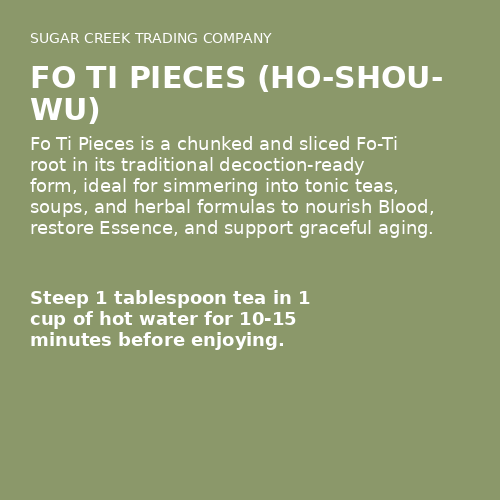
Chunked and sliced Fo-Ti root in its traditional decoction-ready form, ideal for simmering into tonic teas, soups, and herbal formulas to nourish Blood, restore Essence, and support graceful aging.
BOTANICAL IDENTIFICATION
Scientific Name: Fallopia multiflora (Thunb.) Haraldson (syn. Polygonum multiflorum Thunb.)
Common Names: Fo-Ti Pieces, He Shou Wu Slices, Ho Shou Wu Pieces, Flowery Knotweed Root, Chinese Knotweed, Multiflower Knotweed
Family: Polygonaceae (Buckwheat family)
Fallopia multiflora is a vigorous, twining herbaceous perennial vine climbing 2 to 4 meters or more, with reddish-brown woody stems and alternate, heart-shaped leaves. It produces dense panicles of small, white to greenish-white flowers in late summer and autumn. The medicinal root is a large, woody, irregularly knotted tuber with a reddish-brown exterior and pinkish to reddish interior. Fo-Ti Pieces are the root cut into thick slices, chunks, or irregular pieces, preserving the root's characteristic cross-section that reveals concentric growth rings and a distinctive reddish-brown coloration. This cut form is the traditional presentation for decoction-based preparations in TCM.
Native to central and southern China, Fo-Ti grows wild in hillside forests, valley shrublands, and rocky slopes at 200 to 3,000 meters elevation. It is extensively cultivated in Guizhou, Sichuan, Hubei, and Guangxi provinces. The root is typically harvested from plants at least three to four years old, with older roots considered more potent in traditional practice.
CULTURAL AND HISTORICAL USE
Fo-Ti Pieces represent the most traditional and historically authentic form of He Shou Wu as it has been prepared and dispensed in Chinese herbal pharmacies for over a thousand years. When a patient visited a TCM practitioner and received a prescription containing He Shou Wu, they would take that prescription to an herbal pharmacy where the pharmacist would weigh out thick slices or chunks of processed root, package them alongside the other formula ingredients, and send the patient home with instructions to simmer the herbs into a decoction. This slice-and-simmer method remains the gold standard of TCM herbal preparation today.
The legend of He Shou Wu dates to the Tang Dynasty (618-907 CE), when an elderly, weakened man named He Tianer reportedly consumed the root and experienced a remarkable restoration of vitality, darkening of gray hair, and renewed vigor. First formally recorded in the Ri Hua Zi Ben Cao and later extensively documented in Li Shizhen's Bencao Gangmu (1596), He Shou Wu earned classification as a superior tonic for the Liver and Kidney meridians. It was considered capable of nourishing Blood, replenishing Jing (vital Essence), strengthening sinews and bones, and combating the visible signs of aging.
The piece or slice form of Fo-Ti is particularly valued in TCM practice because it allows the herbalist and patient to visually assess the root's quality: good-quality processed He Shou Wu pieces should display a dark reddish-brown exterior, dense cross-sectional texture with visible vascular bundles, and a slight sheen from the traditional black bean processing. This visual inspection is an integral part of the quality assurance tradition in Chinese herbal medicine that has been practiced for centuries.
KEY BIOACTIVE COMPOUNDS & BENEFITS
| Compound/Class | Location in Plant | Human Benefit | Role in Plant |
|---|---|---|---|
| Stilbene glycosides (THSG / 2,3,5,4'-tetrahydroxystilbene-2-O-beta-D-glucoside) | Root tuber cortex and medulla | Potent antioxidant, neuroprotective, lipid-lowering, anti-aging cellular support | Phytoalexin defense against fungal pathogens and UV radiation |
| Anthraquinones (emodin, physcion, chrysophanol) | Root (reduced by processing) | Antimicrobial, anti-inflammatory; laxative in raw form | Antimicrobial and allelopathic defense compounds |
| Phospholipids (lecithin) | Root tuber | Cell membrane integrity, cholesterol metabolism, cognitive support | Structural component of plant cell membranes |
| Tannins (catechin, epicatechin, gallic acid) | Root bark and outer cortex | Antioxidant protection, vascular toning, astringent activity | Herbivore deterrence and wound-sealing compounds |
| Polysaccharides | Root parenchyma | Immune modulation, prebiotic activity, anti-fatigue effects | Energy storage and structural support |
Fo-Ti Pieces contain the identical compound profile as powdered Fo-Ti root, with THSG serving as the primary bioactive marker. The piece form offers a distinct advantage for decoction preparation: the larger particle size allows for a slow, thorough extraction during extended simmering, which is the traditional method designed to draw out the full spectrum of stilbenes, polysaccharides, and tannins while allowing volatile or unstable compounds to release gradually. The processing status (raw vs. processed) determines the compound balance: properly processed pieces have reduced anthraquinone content and concentrated tonic stilbenes, while raw pieces retain higher anthraquinone levels suited to detoxification and laxative applications.
HOW IT WORKS IN THE BODY
Fo-Ti Pieces, when prepared as a traditional decoction, deliver their bioactive compounds through the same pathways as other Fo-Ti preparations, with the extended simmering process optimizing extraction of both water-soluble and partially soluble constituents.
Antioxidant Defense and Cellular Longevity:
THSG extracted during decoction provides potent antioxidant protection by upregulating superoxide dismutase (SOD), reducing malondialdehyde (MDA) lipid peroxidation markers, and preserving glutathione (GSH) reserves. These actions protect cells from the cumulative oxidative damage that drives aging at the cellular level. Preclinical research has shown THSG supports telomere maintenance and reduces markers of cellular senescence, aligning with He Shou Wu's traditional classification as a Jing-preserving longevity tonic.
Blood Nourishment and Liver Support:
In TCM theory, He Shou Wu nourishes Liver Blood, which governs the health of hair, nails, eyes, sinews, and menstrual regularity. Modern research suggests this effect involves improved hematopoietic function, enhanced iron metabolism, and antioxidant protection of red blood cells. The lecithin component supports healthy cell membrane function throughout the body, while tannins and stilbenes protect hepatocytes from oxidative stress, supporting the liver's role as the body's primary organ of blood filtration and regeneration.
Lipid Metabolism and Cardiovascular Health:
THSG has demonstrated the ability to inhibit intestinal cholesterol absorption and modulate hepatic lipid metabolism in preclinical models, contributing to healthier lipid profiles. The lecithin content assists with cholesterol emulsification and transport. Combined with the root's antioxidant protection of vascular endothelium, these actions support cardiovascular health as part of the overall anti-aging profile that TCM attributes to He Shou Wu.
Neuroprotective and Cognitive Support:
THSG crosses the blood-brain barrier and has shown protective effects on neurons in preclinical models of neurodegeneration, including reduction of beta-amyloid aggregation, protection of dopaminergic neurons, and support of brain-derived neurotrophic factor (BDNF) expression. These findings provide a pharmacological basis for He Shou Wu's traditional use in maintaining mental clarity and memory with advancing age.
DOSE GUIDELINES
| Preparation Type | Typical Dose | Purpose |
|---|---|---|
| Decoction (processed pieces) | 9-15 g simmered in 2-3 cups water for 30-60 minutes | Traditional TCM tonic for Blood nourishment, Kidney Essence, and longevity |
| Formula decoction (as part of multi-herb blend) | 9-30 g combined with other herbs, simmered 30-60 minutes | Synergistic tonic formulas such as Shou Wu Wan or Qi Bao Mei Ran Dan |
| Tonic soup or broth | 10-20 g simmered in bone broth or soup stock for 1-2 hours | Food-as-medicine approach for sustained tonification |
| Raw pieces (short-term only, under guidance) | 6-12 g simmered 20-30 minutes | Detoxification, constipation relief (NOT for long-term tonic use) |
Fo-Ti Pieces are specifically designed for the decoction method, which is the most traditional and thorough extraction technique in TCM herbal pharmacy. The pieces should be simmered at a gentle boil (not a rapid rolling boil) for 30 to 60 minutes, allowing the dense root material to gradually release its full spectrum of compounds into the water. The decoction can be strained and consumed warm, typically divided into two or three doses throughout the day. For long-term tonic use, only properly processed (Zhi) pieces should be used, as processing reduces hepatotoxic anthraquinone levels. He Shou Wu is traditionally taken in cycles, with periodic breaks, and is frequently combined with complementary tonics such as Goji Berry, Dang Gui, Rehmannia, and Astragalus.
PREPARATION AND USES
The piece form of Fo-Ti is optimized for the traditional Chinese decoction method. Place 9 to 15 grams of pieces in a ceramic, glass, or stainless-steel pot (avoid aluminum or iron), cover with 2 to 3 cups of cold water, and bring to a boil. Reduce heat to a gentle simmer and cook for 30 to 60 minutes, until the liquid has reduced by approximately one-third. Strain the decoction and drink warm. The pieces can often be simmered a second time for a lighter but still beneficial second extraction. In multi-herb formulas, Fo-Ti pieces are typically added at the beginning of the decoction with other roots and barks that require extended simmering.
Fo-Ti Pieces are also well-suited for culinary medicine preparations. They can be simmered into chicken soup, bone broth, or congee for 1 to 2 hours, infusing the dish with their mildly bitter, slightly sweet, earthy flavor and their tonic properties. This food-medicine approach is deeply rooted in Chinese culinary tradition, particularly during autumn and winter months when Kidney and Liver tonification is emphasized. For those who prefer convenience, the pieces can also be ground at home using a spice grinder or high-powered blender and then encapsulated or stirred into beverages, though the traditional decoction method is considered the most effective extraction approach.
OPTIMAL CONTEXT FOR USE
Fo-Ti Pieces are especially well-suited for individuals who:
Prefer the traditional decoction method of herbal preparation, simmering whole root pieces into teas, soups, and medicinal broths
Are experiencing premature graying of hair, hair thinning, or hair loss associated with aging, stress, or constitutional weakness
Show signs of Blood deficiency or Kidney Essence depletion: pallor, fatigue, dizziness, dry skin, brittle nails, low back weakness, or diminished vitality
Seek a slow-acting, cumulative longevity tonic for cardiovascular health, cognitive maintenance, and graceful aging
Practice TCM-based herbalism and want a form suitable for multi-herb formula preparation in the traditional pharmacy style
Fo-Ti Pieces work best as part of a comprehensive longevity and wellness program that includes nourishing whole-foods diet, adequate sleep, stress management, and regular movement. They are traditionally combined with Goji Berry (Gou Qi Zi), Dang Gui (Angelica sinensis), Rehmannia (Shu Di Huang), Ligustrum (Nu Zhen Zi), and Astragalus (Huang Qi) for synergistic Blood and Essence nourishment.
SUSTAINABILITY AND ETHICAL HARVESTING
Fallopia multiflora is extensively cultivated in China to meet the substantial domestic and international demand for He Shou Wu. Major production provinces include Guizhou, Sichuan, Hubei, and Guangxi, where organized cultivation programs grow the root as a multi-year crop, with harvest typically occurring after three to four years of growth. Older roots are more highly prized in traditional grading systems, incentivizing patience over rapid turnover in quality-conscious operations.
Wild Fo-Ti populations have experienced decline in some traditional harvesting areas due to strong commercial demand, leading to provincial-level harvesting restrictions in parts of China. The Chinese Pharmacopoeia establishes identity and quality standards for commercial He Shou Wu, and Good Agricultural Practices (GAP) programs are increasingly adopted in major growing regions. Outside its native range, Fo-Ti can be aggressively invasive in warm, humid climates and has been declared a noxious weed in parts of the southeastern United States and Australia. Sugar Creek Trading Company sources Fo-Ti pieces with attention to quality, proper processing, and responsible supply chain practices.
SAFETY AND CAUTIONS
Fo-Ti requires informed use with careful attention to form (processed vs. raw), dosage, and duration. The following cautions are essential.
Hepatotoxicity is the primary safety concern with Fo-Ti. Both raw and processed forms contain anthraquinones (particularly emodin) that have been associated with liver injury in documented case reports, particularly with prolonged use, high doses, or in individuals with pre-existing liver conditions. Liver function monitoring is recommended during extended use. Discontinue immediately if signs of liver stress appear, including jaundice, dark urine, upper abdominal pain, or unexplained fatigue.
Only properly processed (Zhi) He Shou Wu pieces should be used for long-term tonic purposes. Processing with black bean liquid reduces anthraquinone content by 50-70% and is essential for safe extended use. Raw (Sheng) pieces have substantially higher anthraquinone levels and should only be used short-term under practitioner supervision.
Fo-Ti may interact with medications metabolized by liver enzymes (CYP450 substrates), anticoagulant and antiplatelet drugs, diabetes medications, and cholesterol-lowering medications. Consult a healthcare provider before combining with any prescription medications.
Pregnant and nursing individuals should avoid Fo-Ti due to anthraquinone content and insufficient safety data. Individuals with liver disease, hepatitis, or elevated liver enzymes should not use Fo-Ti.
REFERENCES
Lin, L., et al. "Polygonum multiflorum Thunb.: A Review of Phytochemistry, Pharmacology, and Safety." Phytomedicine, 2015; 22(12): 983-995.
Bounda, G.A., & Feng, Y.U. "Review of Clinical Studies of Polygonum multiflorum Thunb. and Its Isolated Bioactive Compounds." Pharmacognosy Research, 2015; 7(3): 225-236.
Chinese Pharmacopoeia Commission. Pharmacopoeia of the People's Republic of China, Volume I. China Medical Science Press, 2020.
Lei, X., et al. "Liver Damage Associated with Polygonum multiflorum Thunb.: A Systematic Review of Case Reports and Case Series." Evidence-Based Complementary and Alternative Medicine, 2015; 2015: 459749.
FINAL NOTE
Fo-Ti Pieces offer this legendary longevity root in its most authentic, time-honored form: thick slices ready for the slow simmer that has been the foundation of Chinese herbal pharmacy for centuries. There is something deeply meaningful about preparing He Shou Wu the way it has been prepared for over a thousand years, watching the water darken as the root releases its compounds, and drinking a decoction that connects you to one of the oldest and most respected tonic traditions in the world. For practitioners and individuals who value the decoction method, Fo-Ti Pieces provide an irreplaceable bridge between ancient wisdom and modern wellness.
Share