Sugar Creek Trading Company
Gentian Root
Gentian Root
Couldn't load pickup availability
GENTIANA LUTEA
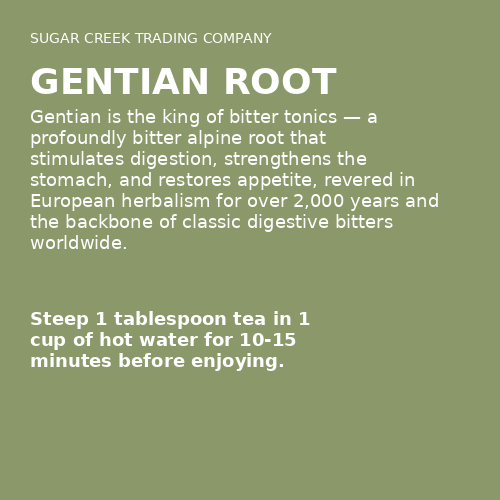
The king of bitter tonics — a profoundly bitter alpine root that stimulates digestion, strengthens the stomach, and restores appetite, revered in European herbalism for over 2,000 years and the backbone of classic digestive bitters worldwide.
BOTANICAL IDENTIFICATION
Scientific Name: Gentiana lutea L.
Common Names: Yellow gentian, great gentian, bitter root, bitterwort, felwort
Family: Gentianaceae (Gentian family)
Yellow gentian is a robust, long-lived perennial that grows 3 to 6 feet tall in alpine and subalpine meadows. It produces large, prominently veined, oval-to-elliptic basal leaves and a stout, hollow stem bearing whorls of bright golden-yellow flowers clustered in the leaf axils. The thick, branching taproot — the primary medicinal part — is yellowish-brown externally and deep yellow internally, developing slowly over 5 to 10 years before reaching harvestable size.
Native to the mountain meadows and pastures of central and southern Europe — the Alps, Pyrenees, Carpathians, and Apennines — gentian thrives at elevations of 3,000 to 7,500 feet in calcareous, well-drained soils with full sun. It is also cultivated in parts of France, Germany, and the Balkans specifically for root harvest.
CULTURAL AND HISTORICAL USE
Gentian root has been the cornerstone of European bitter tonic traditions for over two millennia. The plant is named for Gentius, king of ancient Illyria (modern Albania), who according to Pliny the Elder and Dioscorides was the first to recognize its medicinal value around 180 BCE. Dioscorides prescribed it for liver ailments, stomach weakness, and venomous bites, and it was a staple of Greek and Roman materia medica. By the medieval period, gentian was firmly established as the primary bitter tonic of European monastic herbalism.
Gentian root is the foundation of the global digestive bitters category. Angostura bitters, Underberg, Suze, Enzian schnapps, Aperol, and the traditional amaros of Italy and France all rely on gentian as their primary bittering agent. In the Alps, Enzian — gentian root distilled into a clear, intensely bitter spirit — has been a folk digestive remedy for centuries. The French aperitif Suze, created in 1889, is a gentian-based liqueur still popular throughout Europe. This deep integration into both medicine and drinking culture reflects a fundamental European understanding: bitterness before meals promotes digestion.
In traditional Western herbalism, gentian is classified as a "simple bitter" or "pure bitter" — it works primarily through its extreme bitterness rather than through aromatic or pungent qualities. Herbalists have used it for centuries to treat loss of appetite, sluggish digestion, bloating, heartburn (paradoxically, by stimulating proper acid production), nausea, and general debility. It was a standard inclusion in the materia medica of every major European pharmacopoeia from the 16th century onward and remains official in the German Commission E monographs, the European Pharmacopoeia, and the British Herbal Pharmacopoeia today.
KEY BIOACTIVE COMPOUNDS & BENEFITS
| Compound/Class | Location in Plant | Human Benefit | Role in Plant |
|---|---|---|---|
| Gentiopicroside (secoiridoid glycoside) | Root | Primary bitter compound; stimulates gastric secretion, bile flow, and appetite; hepatoprotective | Herbivore deterrent and antimicrobial defense |
| Amarogentin | Root | One of the most bitter substances known (detectable at 1:58,000,000 dilution); potent TAS2R bitter receptor agonist; chemopreventive | Extreme antifeedant defense compound |
| Swertiamarin and sweroside | Root | Anti-inflammatory; support liver function and bile production; mild analgesic | Iridoid-class chemical defense molecules |
| Xanthones (gentisin, isogentisin) | Root | Antioxidant, antimicrobial, and antidepressant activity; MAO inhibition | UV-absorbing pigments and antimicrobial defense |
| Gentianose and gentiobiose (oligosaccharides) | Root | Prebiotic activity; support beneficial intestinal flora | Energy storage carbohydrates |
Gentian's therapeutic identity is dominated by its extraordinary bitterness. Amarogentin is the most bitter naturally occurring compound ever identified — detectable by the human tongue at dilutions of nearly 1 part in 58 million. This extreme bitterness is not incidental to the medicine; it IS the medicine. Bitter taste receptors (TAS2Rs) on the tongue and throughout the digestive tract trigger a cascade of physiological responses that constitute the "bitter reflex" — the foundation of gentian's healing power.
HOW IT WORKS IN THE BODY
Gentian root works through the bitter reflex — a well-characterized physiological cascade initiated when bitter compounds contact TAS2R receptors on the tongue and in the gastrointestinal tract.
The Bitter Reflex and Digestive Stimulation:
When gentian's bitter compounds contact taste receptors, they trigger vagus nerve signaling that stimulates the entire upper digestive system: increased salivary flow, enhanced gastric acid and pepsin secretion, accelerated bile release from the gallbladder, and increased pancreatic enzyme output. This coordinated response prepares the digestive system to efficiently break down and absorb nutrients. The effect begins within minutes of tasting the bitterness and persists for 1-2 hours. Critically, the bitterness must be tasted for the full reflex to activate — capsules bypass some of this mechanism.
Appetite Restoration and Gastric Tone:
Gentian increases the production of gastrin, a hormone that stimulates appetite and gastric motility. This makes it invaluable for conditions involving appetite loss (anorexia from illness, medication side effects, or convalescence), chronic hypochlorhydria (low stomach acid), and general digestive atony. It effectively "retrains" a sluggish stomach to secrete properly and move food through the digestive tract at the correct pace.
Hepatobiliary Support:
Gentiopicroside and swertiamarin stimulate bile production (choleretic effect) and bile release (cholagogue effect), supporting fat digestion, cholesterol metabolism, and the liver's detoxification capacity. The xanthones gentisin and isogentisin provide additional hepatoprotective antioxidant activity, making gentian a comprehensive liver-and-gallbladder tonic.
Anti-Inflammatory and Immune Modulation:
Swertiamarin and gentiopicroside demonstrate anti-inflammatory activity by inhibiting pro-inflammatory cytokines and prostaglandin synthesis. Gentian also supports innate immune function — traditionally it was used during convalescence from fevers and infections to restore strength and appetite. The xanthones show mild antimicrobial activity against certain bacteria and fungi.
DOSE GUIDELINES
| Preparation Type | Typical Dose | Purpose |
|---|---|---|
| Decoction (simmered tea) | 1/2 - 1 teaspoon root per cup, simmer 10-15 minutes; drink 15-30 minutes before meals | Digestive stimulation, appetite restoration |
| Tincture (1:5, 45% alcohol) | 1-3 mL (20-60 drops) in a small amount of water, 15-30 minutes before meals | Convenient daily bitter tonic |
| Dried root powder (capsules) | 500 mg - 1.5 g before meals | Digestive support (less effective than tasted preparations) |
| Cold infusion (maceration) | 1 teaspoon root in 1 cup cold water, steep 8-12 hours; strain and sip before meals | Gentler preparation that extracts bitter compounds with minimal tannins |
Gentian is most effective when the bitterness is tasted directly — tinctures in water or decoctions are significantly more potent as digestive stimulants than capsules. Take 15-30 minutes before meals for optimal effect. Gentian is best used in short-to-medium courses (2-6 weeks) for acute digestive weakness, or as a pre-meal ritual during periods of poor appetite or digestive sluggishness.
PREPARATION AND USES
For a classic gentian bitter tea, simmer 1/2 to 1 teaspoon of cut root in one cup of water for 10-15 minutes. The resulting decoction will be intensely bitter — this is intentional and therapeutic. Sip slowly 15-30 minutes before meals. For those new to bitters, start with 1/2 teaspoon and work up. Gentian combines beautifully with orange peel, ginger, and cardamom to create a balanced digestive bitter blend that is more palatable while retaining full therapeutic strength.
For tincture making, macerate gentian root in 45% alcohol at a 1:5 ratio for 4-6 weeks, shaking regularly. The resulting tincture can be taken directly on the tongue (15-30 drops) or added to a splash of water before meals. Gentian is the key ingredient in homemade digestive bitters — combine with dandelion root, artichoke leaf, orange peel, and a touch of fennel seed for a classic European-style bitters formula. A cold-water maceration (overnight soak in cold water) produces a gentler, less tannic bitter tea that some find more agreeable while still delivering strong digestive stimulation.
OPTIMAL CONTEXT FOR USE
This herb is especially well-suited for individuals experiencing:
Loss of appetite — from illness, medication side effects, stress, aging, or convalescence — where a safe, reliable appetite stimulant is needed
Chronic indigestion, bloating, or heaviness after meals, particularly when associated with low stomach acid (hypochlorhydria) rather than excess acid
Sluggish bile flow or gallbladder complaints, including difficulty digesting fats and post-cholecystectomy digestive issues
General digestive weakness or "tired stomach" during or after illness, where the entire upper GI system needs to be re-activated
Herbalists formulating digestive bitters, aperitifs, or tonic blends — gentian is the indispensable backbone of the bitter formula tradition
Gentian combines excellently with ginger (warming carminative), peppermint (antispasmodic), dandelion root (liver support), and artichoke leaf (bile stimulation) in comprehensive digestive formulas.
SUSTAINABILITY AND ETHICAL HARVESTING
Wild yellow gentian has faced significant harvesting pressure in parts of Europe due to high demand from the bitters, spirits, and herbal medicine industries. The root requires 5-10 years to reach harvestable maturity, and overharvesting from wild alpine populations has led to legal protections in several European countries. Gentiana lutea is listed under Appendix A of the Bern Convention and is protected in France, Switzerland, and parts of Germany and Italy, where wild collection requires permits or is prohibited entirely.
Cultivation programs in France (Auvergne region), Germany, and the Balkans now produce a significant portion of commercial gentian root, reducing pressure on wild populations. When purchasing gentian, prioritizing cultivated or sustainably wildcrafted sources is important. We source our gentian root with attention to these conservation realities, supporting supply chains that protect wild alpine populations while meeting demand through responsible cultivation.
SAFETY AND CAUTIONS
Gentian root is generally well tolerated when used as directed and has a long safety record in European herbalism and pharmacopoeia standards.
Gentian is contraindicated in active peptic ulcers, gastric or duodenal ulcers, and gastroesophageal reflux disease (GERD) with erosive esophagitis. By stimulating gastric acid production, it can worsen conditions where excess acid is already damaging tissue.
Individuals with gallstones should use gentian with caution, as its cholagogue (bile-stimulating) effect could theoretically mobilize stones. Consult a healthcare provider before use.
Pregnant and breastfeeding women should avoid therapeutic doses of gentian root, as safety data in pregnancy is insufficient. Small amounts in commercial bitters are generally considered acceptable.
Very high doses may cause nausea, vomiting, or headache due to the intensity of the bitter reflex. Start with lower doses and increase gradually. Extremely rare cases of allergic reaction have been reported.
CRITICAL SAFETY NOTE: Wild gentian can be confused with the highly toxic white hellebore (Veratrum album), which grows in similar alpine habitats and has similar leaves when not in flower. Never wildcraft gentian unless you can positively identify it — purchase from reputable suppliers.
REFERENCES
Mirzaee, F., et al. "Medicinal, Biological, and Phytochemical Properties of Gentiana Species." Journal of Traditional and Complementary Medicine, 2017.
German Commission E Monograph: Gentianae radix (Gentian Root). Bundesanzeiger, 1990.
European Medicines Agency (EMA). "Assessment Report on Gentiana lutea L., radix." Committee on Herbal Medicinal Products (HMPC), 2018.
FINAL NOTE
Gentian root is the great teacher of an idea modern culture has largely forgotten: that bitterness is not something to avoid but something the body actively needs. In a world of sweetened, processed foods, the bitter reflex — that ancient cascade of digestive activation — goes unstimulated, and digestion suffers for it. Gentian corrects this with uncompromising directness. One sip of gentian tea and every digestive organ from mouth to liver wakes up and gets to work. It is the single most important herb in the Western bitter tonic tradition, and there is no adequate substitute for it.
Share