Sugar Creek Trading Company
Graviola Leaf
Graviola Leaf
Couldn't load pickup availability
ANNONA MURICATA
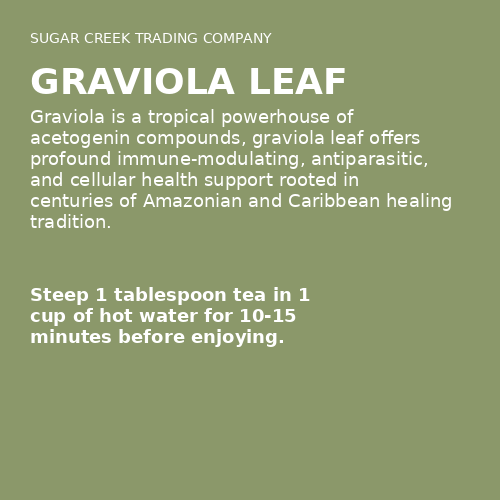
A tropical powerhouse of acetogenin compounds, graviola leaf offers profound immune-modulating, antiparasitic, and cellular health support rooted in centuries of Amazonian and Caribbean healing tradition.
BOTANICAL IDENTIFICATION
Scientific Name: Annona muricata L.
Common Names: Graviola, Graviola Leaf, Soursop Leaf, Guanabana, Brazilian Paw Paw, Corossol, Prickly Custard Apple
Family: Annonaceae
Annona muricata is a small, evergreen tropical tree reaching 5 to 10 meters in height, with broad, glossy, dark green leaves that are smooth and leathery with a distinctly pungent aroma when crushed. The tree produces large, heart-shaped, spiny green fruits weighing up to 5 kilograms, with soft, white, fibrous pulp that is both sweet and tart. The leaves are the primary part used in herbal medicine, containing the highest concentration of bioactive acetogenins outside the seeds.
Native to the tropical regions of Central and South America, as well as the Caribbean islands, graviola thrives in warm, humid lowland environments with well-drained soil. It is now cultivated throughout the tropics worldwide, including Southeast Asia, West Africa, the Pacific Islands, and parts of southern Florida. The tree fruits year-round in favorable conditions and has been a staple of tropical agroforestry for centuries.
CULTURAL AND HISTORICAL USE
Graviola has been a cornerstone of traditional medicine in nearly every tropical region where it grows. In the Amazon basin, indigenous peoples have used leaf decoctions for centuries to treat fever, parasitic infections, digestive complaints, and nervous tension. Brazilian and Peruvian curanderos (traditional healers) consider the leaf tea a primary remedy for liver conditions, malaria-type fevers, and internal parasites. The Amazonian tradition of using graviola leaf as a calmative sedative for restless children and anxious adults is well-documented in ethnobotanical literature.
In the Caribbean, graviola leaf tea is a deeply embedded household remedy. Jamaican, Trinidadian, and Haitian folk medicine traditions use it for hypertension, diabetes management, sleeplessness, and general immune support. Across West Africa, where the tree was introduced centuries ago, the leaves are used for wound healing, fever, and gastrointestinal parasites. In Southeast Asian traditional medicine, particularly in Malaysia and the Philippines, soursop leaf decoctions serve as a remedy for coughs, skin conditions, and rheumatic pain.
The modern surge of scientific interest in graviola began in the 1990s when researchers at Purdue University identified a family of compounds called annonaceous acetogenins in the leaves and seeds. These compounds showed remarkable selective activity against certain abnormal cell lines in laboratory studies, sparking worldwide interest and extensive ongoing research. Today, graviola leaf is one of the most widely researched tropical medicinal plants, with studies spanning antimicrobial, antiparasitic, antidiabetic, anti-inflammatory, and cellular health applications.
KEY BIOACTIVE COMPOUNDS & BENEFITS
| Compound/Class | Location in Plant | Human Benefit | Role in Plant |
|---|---|---|---|
| Annonaceous acetogenins (annonacin, bullatacin, muricatocin) | Leaves, seeds, bark | Selective modulation of abnormal cellular energy production (Complex I inhibition); antiparasitic; immune-supportive | Potent insecticidal and antimicrobial defense compounds |
| Alkaloids (reticuline, coreximine, muricine) | Leaves, bark, root | Mild sedative and anxiolytic effects; smooth muscle relaxation; hypotensive activity | Herbivore deterrents; antimicrobial defense |
| Flavonoids (quercetin, kaempferol, rutin) | Leaves | Antioxidant; anti-inflammatory; support vascular health; modulate immune response | UV protection; antioxidant defense in photosynthetic tissue |
| Tannins and phenolic acids | Leaves, bark | Astringent and tissue-toning; antimicrobial; support wound healing | Structural defense; pathogen resistance |
| Megastigmanes and terpenoids | Leaves | Anti-inflammatory; antidiabetic potential; hepatoprotective activity | Volatile signaling compounds; stress response molecules |
The acetogenins are the most pharmacologically distinctive compounds in graviola leaf. These long-chain fatty acid derivatives selectively inhibit mitochondrial Complex I (NADH-ubiquinone oxidoreductase) in cells with altered energy metabolism, while having significantly less effect on normal cells in laboratory studies. This selectivity, combined with the leaf's broad-spectrum antiparasitic and immune-modulating properties, creates a uniquely multifaceted therapeutic profile that has made graviola one of the most intensively studied tropical plants of the 21st century.
HOW IT WORKS IN THE BODY
Graviola leaf works through multiple independent but complementary pathways, affecting cellular energy metabolism, the nervous system, the immune system, and blood sugar regulation.
Cellular Health and Immune Modulation:
Acetogenins selectively inhibit Complex I of the mitochondrial electron transport chain in cells with abnormally high energy demands. This disruption of ATP production in such cells triggers apoptotic (programmed cell death) pathways. Simultaneously, the flavonoid and alkaloid content supports healthy immune surveillance by enhancing natural killer cell activity and moderating inflammatory cytokine production. These dual mechanisms support the body's own cellular quality control processes.
Antiparasitic and Antimicrobial Action:
Graviola leaf demonstrates broad-spectrum activity against protozoan parasites (including Leishmania and Plasmodium species), helminths, and pathogenic bacteria. The acetogenins and alkaloids disrupt parasitic cellular metabolism and membrane integrity. Traditional use against intestinal parasites and tropical fevers is well-supported by in vitro and animal studies showing potent antiparasitic effects.
Nervous System and Mood Support:
The isoquinoline alkaloids in graviola leaf, particularly reticuline, interact with serotonergic and dopaminergic pathways, producing mild sedative, anxiolytic, and muscle-relaxing effects. This explains the widespread traditional use of graviola tea for insomnia, anxiety, and nervous tension. The effect is calming without being strongly sedating at normal doses.
Blood Sugar and Metabolic Regulation:
Animal and preliminary human studies suggest graviola leaf compounds improve insulin sensitivity, reduce hepatic gluconeogenesis, and enhance pancreatic beta cell function. The flavonoids and phenolic acids provide antioxidant protection to pancreatic tissue, while specific terpenoids appear to modulate glucose transporters in peripheral tissues.
DOSE GUIDELINES
| Preparation Type | Typical Dose | Purpose |
|---|---|---|
| Leaf tea (infusion) | 1-2 teaspoons dried leaf per cup, steeped 10-15 minutes; 1-3 cups daily | General immune support, relaxation, digestive wellness |
| Capsules (powdered leaf) | 500-1,500 mg, 1-3 times daily | Convenient daily supplementation for immune and cellular support |
| Tincture (1:5, 45% alcohol) | 2-4 mL (40-80 drops), 2-3 times daily | Concentrated extract for therapeutic protocols |
| Decoction (simmered) | 1 tablespoon leaf per 2 cups water, simmered 15 minutes | Stronger preparation for antiparasitic and intensive immune protocols |
Graviola leaf is typically used in courses of 4-8 weeks followed by a 1-2 week rest period, particularly when used at higher therapeutic doses. For general wellness and immune support, lower daily doses can be used more continuously. Many practitioners recommend cycling graviola with other immune-supportive herbs to maintain the body's responsive diversity.
PREPARATION AND USES
The simplest and most traditional preparation is a leaf tea. Steep 1-2 teaspoons of dried graviola leaf in freshly boiled water for 10-15 minutes, strain, and drink. The flavor is mild, slightly grassy, and gently bitter with earthy undertones that most people find pleasant, especially with a touch of honey or lemon. For a stronger therapeutic decoction, simmer the leaves for 15 minutes rather than simply steeping, which extracts a broader range of the less water-soluble acetogenins.
Powdered graviola leaf encapsulates well for those who prefer not to prepare tea daily. Tincture preparations offer the most concentrated form and are favored in clinical herbal practice for targeted protocols. Some practitioners combine graviola leaf with cat's claw, pau d'arco, or chanca piedra in comprehensive Amazonian immune-support formulas. For sleep and relaxation, a cup of graviola tea 30-60 minutes before bed pairs well with passionflower or valerian. The leaf can also be incorporated into smoothies or blended with other dried herbs for custom tea blends.
OPTIMAL CONTEXT FOR USE
Graviola leaf is especially well-suited for individuals experiencing:
Compromised immune function or desire for enhanced cellular immune surveillance and support
Parasitic infections, tropical travel, or exposure to environments with high parasite burden
Anxiety, nervous tension, insomnia, or stress-related sleep disturbance seeking a gentle botanical calmative
Blood sugar dysregulation, prediabetes, or metabolic challenges requiring gentle glycemic support
Inflammatory conditions requiring broad-spectrum anti-inflammatory and antioxidant coverage
Graviola combines powerfully with cat's claw for immune modulation, with pau d'arco for antimicrobial support, with passionflower for sleep, and with cinnamon or fenugreek for blood sugar balance. It is a versatile foundational herb in tropical and integrative wellness protocols.
SUSTAINABILITY AND ETHICAL HARVESTING
Annona muricata is widely cultivated throughout the tropics and faces no conservation threats. As a fruit tree, the leaves can be sustainably harvested without harming the tree's fruit production, making it an excellent agroforestry crop that provides both food and medicine. Leaf harvesting actually encourages new growth and can be integrated into regular orchard management without reducing fruit yields when done responsibly.
Supporting fair-trade and ethically sourced graviola from small-scale tropical farmers directly benefits communities in South America, the Caribbean, and Southeast Asia. The growing global demand for graviola leaf has created meaningful income opportunities for smallholders in regions where the tree grows abundantly. Look for suppliers who maintain direct relationships with farming communities and ensure fair compensation.
SAFETY AND CAUTIONS
Graviola leaf is generally well-tolerated at recommended doses, but important cautions apply, particularly with extended high-dose use.
High-dose, long-term consumption of annonaceous acetogenins has been associated in some epidemiological studies with atypical Parkinsonism in Caribbean populations. This concern primarily relates to consuming large quantities of fruit pulp and seeds over many years, but prudent use of leaf preparations suggests cycling (4-8 weeks on, 1-2 weeks off) rather than indefinite continuous use at high doses.
Graviola may lower blood pressure. Those on antihypertensive medications should monitor blood pressure closely and consult their healthcare provider.
May enhance the effects of blood sugar-lowering medications. Diabetics on medication should monitor glucose levels carefully and consult their healthcare provider.
Pregnant and nursing women should avoid graviola leaf due to insufficient safety data and the potential for uterine stimulant effects documented in animal studies.
Those scheduled for surgery should discontinue use 2 weeks prior due to potential blood pressure and blood sugar-lowering effects.
REFERENCES
Moghadamtousi, S.Z., Fadaeinasab, M., Nikzad, S., et al. (2015). "Annona muricata (Annonaceae): a review of its traditional uses, isolated acetogenins and biological activities." International Journal of Molecular Sciences, 16(7), 15625-15658.
Coria-Tellez, A.V., Montalvo-Gonzalez, E., Yahia, E.M., & Obledo-Vazquez, E.N. (2018). "Annona muricata: a comprehensive review on its traditional medicinal uses, phytochemicals, pharmacological activities, mechanisms of action and toxicity." Arabian Journal of Chemistry, 11(5), 662-691.
Rieser, M.J., Gu, Z.M., Fang, X.P., et al. (1996). "Five novel mono-tetrahydrofuran ring acetogenins from the seeds of Annona muricata." Journal of Natural Products, 59(2), 100-108.
FINAL NOTE
Graviola leaf carries the concentrated intelligence of a tropical tree that has evolved one of the most pharmacologically unique defense arsenals in the plant kingdom. The acetogenins are unlike anything found in temperate medicinal plants, representing an entirely different chemical strategy for cellular protection. When indigenous Amazonian healers first brewed this leaf for fever, parasites, and restless spirits, they were accessing compounds that modern science is only beginning to characterize. Used thoughtfully and with appropriate cycling, graviola leaf offers a depth of immune and cellular support that bridges ancient tropical wisdom with the cutting edge of phytochemical research.
Share