Sugar Creek Trading Company
Gymnema Sylvestre Leaf
Gymnema Sylvestre Leaf
Couldn't load pickup availability
GYMNEMA SYLVESTRE
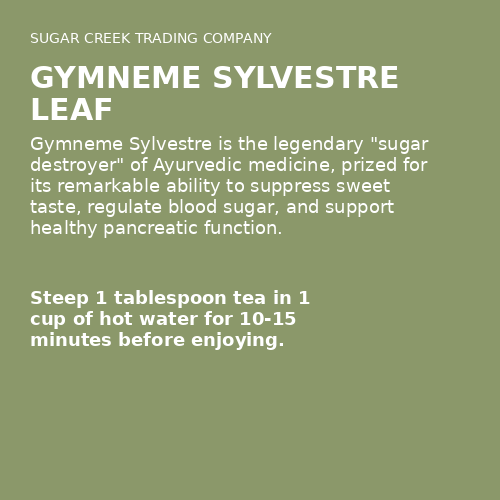
The legendary "sugar destroyer" of Ayurvedic medicine, prized for its remarkable ability to suppress sweet taste, regulate blood sugar, and support healthy pancreatic function.
BOTANICAL IDENTIFICATION
Scientific Name: Gymnema sylvestre (Retz.) R.Br. ex Sm.
Common Names: Gymnema, Gurmar, Meshashringi, Miracle Fruit (not to be confused with Synsepalum dulcificum), Australian Cowplant, Periploca of the Woods
Family: Apocynaceae (Dogbane family), formerly placed in Asclepiadaceae
Gymnema sylvestre is a slow-growing, woody, perennial climbing vine that can reach lengths of up to 10 meters as it twines through the forest canopy. The leaves are opposite, oval to elliptic, 3 to 6 centimeters long, with a slightly pubescent surface and entire margins. Small, yellow, bell-shaped flowers appear in axillary umbellate cymes, producing paired follicular fruits containing numerous flattened, winged seeds. The entire plant exudes a milky white latex when cut, characteristic of its family.
Native to the tropical and subtropical forests of India, Sri Lanka, Southeast Asia, and tropical Africa, gymnema thrives in warm, humid environments with well-drained soils, often found growing in deciduous and semi-evergreen forests at elevations up to 600 meters. It is increasingly cultivated in peninsular India, particularly in the states of Tamil Nadu, Karnataka, Kerala, and Andhra Pradesh.
CULTURAL AND HISTORICAL USE
Gymnema's Hindi name, "gurmar," translates directly to "sugar destroyer," a name earned through centuries of empirical observation by Ayurvedic practitioners. In the classical Ayurvedic texts, gymnema is classified as a madhunashini (honey destroyer) herb and is included in formulations for prameha, the Ayurvedic category encompassing urinary disorders and metabolic imbalances that closely parallels the modern understanding of diabetes and metabolic syndrome. The Sushruta Samhita and later texts prescribe gymnema leaf both internally as a powder or decoction and as part of complex polyherbal formulas designed to balance kapha dosha and support healthy glucose metabolism.
The most dramatic and immediately observable property of gymnema is its ability to temporarily abolish the perception of sweetness on the tongue. Chewing a fresh leaf or swishing a gymnema tea in the mouth renders sugar, honey, and artificial sweeteners tasteless for 30 minutes to two hours. This phenomenon has been known to Indian villagers and practitioners for centuries, and it was this striking sensory effect that first attracted Western scientific attention to the plant in the mid-19th century. British colonial botanists and pharmacologists documented the effect as early as 1847, though it would take another century for researchers to isolate the responsible compounds.
In traditional folk medicine across southern India and Sri Lanka, gymnema leaves were also chewed to treat snakebite, used as a mild laxative, applied topically for wound healing, and employed as a remedy for malaria and cough. In parts of tropical Africa where the plant grows wild, similar folk uses have been recorded. Today, gymnema has become one of the most commercially important Ayurvedic herbs globally, with a thriving market in dietary supplements aimed at blood sugar support, weight management, and sugar craving reduction.
KEY BIOACTIVE COMPOUNDS & BENEFITS
| Compound/Class | Location in Plant | Human Benefit | Role in Plant |
|---|---|---|---|
| Gymnemic acids (I-VII, plus derivatives) | Leaves (highest concentration) | Block sweet taste receptors on the tongue; inhibit intestinal glucose absorption; stimulate insulin secretion and pancreatic beta-cell regeneration | Antifeedant defense against herbivorous insects |
| Gymnemasaponins (IV and V) | Leaves | Anti-obesity and lipid-lowering activity; support healthy cholesterol profiles | Membrane-disrupting defense compounds |
| Gurmarin (polypeptide, 35 amino acids) | Leaves | Suppresses sweet taste perception in animal models; contributes to anti-sweet activity | Chemical defense signaling |
| Triterpenoid saponins (gymnemagenin, gymnestrogenin) | Leaves and stems | Anti-inflammatory and hepatoprotective activity | Structural defense and membrane protection |
| Flavonoids, phenolic acids, and tannins | Leaves | Antioxidant protection; support vascular health | UV protection and pathogen defense |
The gymnemic acids are the signature compounds that define this plant's therapeutic identity. Structurally, they are oleanane-type triterpenoid saponins whose molecular shape closely mimics glucose, allowing them to competitively bind to sweet taste receptors (T1R2/T1R3) on the tongue and to glucose absorption sites in the intestinal epithelium. This molecular mimicry creates a dual mechanism: reduced desire for sweet foods at the sensory level and reduced glucose uptake at the metabolic level. The leaf is the preferred part of the plant because it contains the highest concentration of these active gymnemic acids.
HOW IT WORKS IN THE BODY
Gymnema leaf exerts its effects through several complementary mechanisms that address blood sugar regulation from multiple angles, distinguishing it from single-mechanism interventions.
Sweet Taste Receptor Blockade:
Gymnemic acids bind to the T1R2/T1R3 sweet taste receptor complex on the lingual papillae, temporarily blocking the perception of sweetness. This effect is dose-dependent and typically lasts 30 to 90 minutes. By diminishing the hedonic reward of sweet foods, gymnema reduces sugar cravings at a neurological level, making it easier to modify dietary habits without relying solely on willpower.
Intestinal Glucose Absorption Inhibition:
In the small intestine, gymnemic acids compete with glucose for binding sites on the sodium-dependent glucose transporter (SGLT1) in the brush border membrane of enterocytes. This competition reduces the rate and total amount of glucose absorbed from a meal, blunting postprandial blood sugar spikes. The structural similarity between gymnemic acid and glucose molecules is the key to this competitive inhibition.
Pancreatic Beta-Cell Support and Insulin Secretion:
Research in both animal models and human studies suggests that gymnema supports the regeneration and functional restoration of pancreatic beta cells, the insulin-producing cells that are progressively damaged in type 2 diabetes. Gymnemic acids appear to stimulate insulin secretion from existing beta cells and may promote the differentiation of new insulin-producing cells from pancreatic progenitor cells, a mechanism of profound interest in metabolic research.
Lipid Metabolism and Weight Management:
Gymnemasaponins and related compounds have demonstrated the ability to inhibit lipid accumulation in adipocytes, reduce serum triglycerides and LDL cholesterol, and increase HDL cholesterol in multiple studies. These effects complement the glucose-lowering activity by addressing the broader metabolic syndrome picture that frequently accompanies blood sugar dysregulation.
DOSE GUIDELINES
| Preparation Type | Typical Dose | Purpose |
|---|---|---|
| Whole leaf (cut and dried) | 2-4 grams daily, divided into two doses before meals | Traditional Ayurvedic use for blood sugar support and craving reduction |
| Leaf tea / infusion | 1-2 teaspoons of dried leaf per cup of hot water, steeped 10-15 minutes; 1-3 cups daily | Gentle daily support; swish in mouth before meals to reduce sweet cravings |
| Tincture (1:5, 40-50% ethanol) | 2-4 mL, two to three times daily before meals | Convenient liquid extract for metabolic support |
| Capsules (standardized extract, 25-75% gymnemic acids) | 400-800 mg daily, divided into two doses | Standardized supplementation; clinical trial dosing |
Gymnema leaf is most effective when taken 10 to 15 minutes before meals, allowing the gymnemic acids to reach the intestinal lining before glucose from food arrives. For sugar craving reduction, swishing a gymnema tea or placing the powdered leaf directly on the tongue before eating is the most immediately effective approach. Consistent use over 8 to 12 weeks is recommended for meaningful effects on fasting blood glucose and HbA1c levels.
PREPARATION AND USES
This dried gymnema leaf is well-suited to multiple preparation methods. The most common and traditional approach is a simple hot infusion: steep 1 to 2 teaspoons of the dried leaf in a cup of just-boiled water for 10 to 15 minutes, then strain and drink before meals. The tea has a mildly bitter, astringent flavor that most people find tolerable, especially when combined with green tea or peppermint. For the full anti-sweet effect, swish the tea in the mouth for 30 to 60 seconds before swallowing. The dried leaf can also be ground into a finer powder at home using a spice grinder for use in capsules, smoothies, or mixed directly into warm water.
For tincture making, macerate the crushed leaf in 40 to 50 percent alcohol at a 1:5 ratio for 4 to 6 weeks, shaking daily. Gymnema combines well with other metabolic support herbs such as fenugreek seed, bitter melon, cinnamon bark, and turmeric. In Ayurvedic practice, it is frequently compounded with shilajit, neem, and turmeric in polyherbal formulas for prameha (metabolic disorders). Topically, a poultice of the leaves has traditional use for wounds and skin conditions, though internal use is far more common in modern practice.
OPTIMAL CONTEXT FOR USE
Gymnema sylvestre leaf is especially well-suited for individuals experiencing:
Sugar cravings and difficulty reducing sweet food intake, particularly those seeking a natural, non-stimulant approach to managing the desire for sweets
Elevated blood sugar levels, prediabetes, or type 2 diabetes, as an adjunct to dietary and lifestyle modifications under professional guidance
Metabolic syndrome characterized by the combination of high blood sugar, elevated triglycerides, abdominal weight gain, and insulin resistance
Weight management goals where reducing caloric intake from sugar and refined carbohydrates is a primary strategy
Digestive sluggishness and kapha-type imbalances in the Ayurvedic framework, where bitter and astringent herbs are indicated to stimulate metabolic fire (agni)
Gymnema pairs synergistically with cinnamon bark for postprandial glucose control, with bitter melon for comprehensive pancreatic support, with fenugreek for insulin sensitivity, and with chromium-rich foods or supplements for enhanced cellular glucose uptake.
SUSTAINABILITY AND ETHICAL HARVESTING
Gymnema sylvestre is both wild-harvested and cultivated across its native range in India and Southeast Asia. Wild populations have faced increasing pressure due to high commercial demand, and the plant's slow growth rate means overharvested populations recover slowly. The Indian government and several state forestry departments have recognized this issue and promoted cultivation programs, particularly in Tamil Nadu and Karnataka, where farmer cooperatives now grow gymnema as a cash crop alongside traditional agriculture.
Cultivated gymnema is generally preferred for both quality and sustainability reasons, as it can be grown using organic methods and harvested at optimal maturity for maximum gymnemic acid content. The plant is not currently listed by CITES, but it has been flagged by Indian conservation authorities as a species requiring monitoring and managed harvest protocols. Supporting suppliers who source from cultivated or sustainably managed wild harvest operations helps ensure the long-term availability of this important medicinal plant.
SAFETY AND CAUTIONS
Gymnema leaf has a long history of safe use in traditional medicine and is generally well-tolerated at recommended doses. However, the following precautions should be observed:
Gymnema can lower blood sugar levels; individuals taking insulin, sulfonylureas, or other hypoglycemic medications must use gymnema only under medical supervision to avoid potentially dangerous hypoglycemia. Blood sugar should be monitored more frequently when introducing gymnema.
Pregnant and nursing women should avoid gymnema, as safety data for these populations is insufficient and the herb's potent metabolic activity warrants caution.
Individuals scheduled for surgery should discontinue gymnema at least two weeks prior, as its blood sugar-lowering effects could interfere with glycemic control during and after surgical procedures.
Rare cases of mild gastrointestinal discomfort, including nausea and loose stools, have been reported at higher doses. Start with a lower dose and increase gradually.
Gymnema may interact with lipid-lowering medications by enhancing their effects; consult a healthcare provider if you are on statins or fibrates.
REFERENCES
Shanmugasundaram, E.R.B., Rajeswari, G., Baskaran, K., Rajesh Kumar, B.R., Shanmugasundaram, K.R., & Kizar Ahmath, B. (1990). "Use of Gymnema sylvestre leaf extract in the control of blood glucose in insulin-dependent diabetes mellitus." Journal of Ethnopharmacology, 30(3), 281-294.
Baskaran, K., Kizar Ahamath, B., Radha Shanmugasundaram, K., & Shanmugasundaram, E.R.B. (1990). "Antidiabetic effect of a leaf extract from Gymnema sylvestre in non-insulin-dependent diabetes mellitus patients." Journal of Ethnopharmacology, 30(3), 295-305.
Tiwari, P., Mishra, B.N., & Sangwan, N.S. (2014). "Phytochemical and pharmacological properties of Gymnema sylvestre: An important medicinal plant." BioMed Research International, 2014, 830285.
FINAL NOTE
Gymnema sylvestre stands virtually alone in the botanical world for its ability to directly alter sweet taste perception, a property that makes it both a compelling research subject and a remarkably practical tool for anyone struggling with sugar cravings. Its multi-layered approach to metabolic support, working simultaneously at the tongue, the intestinal wall, and the pancreas, reflects the kind of sophisticated, whole-system strategy that characterizes the most effective Ayurvedic medicines. In whole dried leaf form, it delivers the complete spectrum of gymnemic acids and supporting compounds exactly as traditional practitioners have employed it for over two thousand years.
Share