Sugar Creek Trading Company
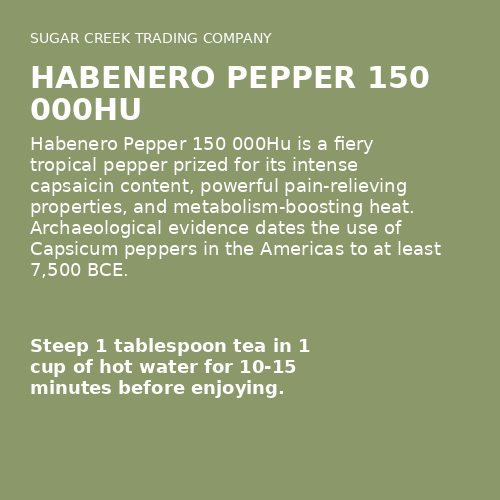
Habanero Pepper 150 000hu
Habanero Pepper 150 000hu
Couldn't load pickup availability
CAPSICUM CHINENSE
A fiery tropical pepper prized for its intense capsaicin content, powerful pain-relieving properties, and metabolism-boosting heat.
BOTANICAL IDENTIFICATION
Scientific Name: Capsicum chinense Jacq.
Common Names: Habanero Pepper, Habañero, Scotch Bonnet (related cultivar), Caribbean Red Pepper, Ají Chombo
Family: Solanaceae (Nightshade family)
Habanero is a compact, bushy perennial plant typically growing 2 to 4 feet tall. It produces small, lantern-shaped fruits ranging from green to bright orange, red, or chocolate brown at maturity. The leaves are broad, ovate, and slightly wrinkled, with small white flowers that precede fruit development.
Native to the Amazon basin and widely cultivated across the Yucatán Peninsula, Caribbean, and tropical regions worldwide, habanero thrives in warm, humid climates with well-drained soil and full sun. It is one of the hottest commonly cultivated peppers, typically measuring 100,000 to 350,000 Scoville Heat Units (SHU). This product is standardized to 150,000 HU.
CULTURAL AND HISTORICAL USE
Archaeological evidence dates the use of Capsicum peppers in the Americas to at least 7,500 BCE. The habanero itself has been cultivated in Mexico for thousands of years and was a cornerstone of Mayan cuisine and medicine. Mayan healers used hot peppers to treat respiratory infections, digestive ailments, and toothache. The name "habanero" derives from La Habana (Havana), reflecting the pepper's historical trade route through Cuba.
In traditional Caribbean and Central American folk medicine, habanero and related hot peppers were applied topically as poultices for joint pain, muscle soreness, and skin infections. The intense heat was also used as a sweat-inducing remedy during fevers and colds, a practice shared by many tropical healing traditions. In West African herbalism, closely related Capsicum species were used to stimulate appetite, aid digestion, and improve circulation.
In Western herbalism, cayenne and habanero peppers have long been considered among the most powerful circulatory stimulants available. Dr. John Christopher, a prominent 20th-century herbalist, famously championed cayenne pepper as a "crisis herb" for cardiovascular emergencies. Today, capsaicin—the primary active compound in habanero—is one of the most extensively studied plant compounds in modern pharmacology, with applications ranging from topical pain creams to metabolic research.
KEY BIOACTIVE COMPOUNDS & BENEFITS
| Compound/Class | Location in Plant | Human Benefit | Role in Plant |
|---|---|---|---|
| Capsaicin & Dihydrocapsaicin | Placental tissue & seeds of fruit | Pain relief (TRPV1 desensitization), metabolism boost, anti-inflammatory | Deterrent against mammalian herbivores; antifungal defense |
| Carotenoids (Capsanthin, Beta-carotene) | Fruit flesh & skin | Antioxidant protection, supports eye and skin health | Photoprotection, attracts seed-dispersing birds |
| Vitamin C (Ascorbic Acid) | Fruit flesh | Immune support, collagen synthesis, antioxidant | Antioxidant defense during fruit ripening |
| Flavonoids (Quercetin, Luteolin) | Fruit skin & leaves | Anti-inflammatory, cardiovascular support, antioxidant | UV protection and pathogen resistance |
| Vitamins A, E & K | Fruit flesh | Immune function, skin health, blood clotting support | Metabolic cofactors in plant tissue |
Together, these compounds make habanero a potent thermogenic, analgesic, and circulatory stimulant. The high capsaicin content drives the pepper's signature heat and its most studied therapeutic effects, while the rich carotenoid and vitamin profile adds substantial antioxidant value that supports whole-body health beyond pain and metabolism alone.
HOW IT WORKS IN THE BODY
Capsaicin exerts its effects primarily through the TRPV1 (vanilloid) receptor, a heat- and pain-sensing ion channel found throughout the nervous system, digestive tract, and cardiovascular tissues.
Pain and Inflammation:
Capsaicin initially activates TRPV1 receptors, causing the familiar burning sensation. With repeated exposure, these receptors become desensitized, depleting Substance P—a key neurotransmitter involved in transmitting pain signals. This mechanism is the basis for topical capsaicin creams used in neuropathic pain, arthritis, and post-surgical discomfort. Internally, capsaicin also downregulates NF-kB and COX-2 inflammatory pathways.
Metabolism and Thermogenesis:
Capsaicin stimulates thermogenesis by activating brown adipose tissue and increasing sympathetic nervous system activity. This raises metabolic rate, promotes fat oxidation, and may reduce appetite. Studies have shown that capsaicin consumption can increase energy expenditure by 5-10% for several hours following ingestion.
Cardiovascular and Circulatory Support:
Capsaicin promotes vasodilation through nitric oxide release, improving blood flow and potentially lowering blood pressure. It also inhibits platelet aggregation and may help maintain healthy cholesterol levels. Herbalists have long regarded hot peppers as "catalysts" that enhance the delivery and absorption of other herbs when taken in combination.
Digestive Function:
Contrary to popular belief, capsaicin at moderate doses stimulates protective mucus secretion in the stomach lining, supports healthy gastric motility, and promotes the secretion of digestive enzymes. It also exhibits antimicrobial activity against certain gut pathogens, including H. pylori.
DOSE GUIDELINES
| Preparation Type | Typical Dose | Purpose |
|---|---|---|
| Powder (culinary/capsule) | 100–500 mg, 1–3 times daily with food | Metabolic support, circulation, digestive stimulation |
| Infusion (hot water steep) | ¼–½ tsp powder in 8 oz hot water | Circulatory boost, cold/flu support, sinus clearing |
| Tincture (liquid extract) | 5–15 drops in water, 1–3 times daily | Acute circulatory stimulation, pain support |
| Topical poultice/oil | Diluted in carrier oil (0.025–0.075% capsaicin) | Localized pain relief, joint and muscle soreness |
Start with the lowest dose and increase gradually. Habanero at 150,000 HU is significantly hotter than standard cayenne (typically 30,000–50,000 HU), so dosing should be conservative. Always take with food to minimize gastric discomfort. Best used as a short-course stimulant or as a daily low-dose addition to foods and formulas.
PREPARATION AND USES
As a culinary powder, habanero adds intense heat and a fruity, tropical flavor to salsas, marinades, curries, and hot sauces. For therapeutic use, the powder can be encapsulated to bypass the mouth's heat receptors, or blended into warm water with honey and lemon for a potent cold-and-flu tonic. A small pinch added to herbal tea formulas can enhance absorption of other herbs and stimulate circulation.
For topical applications, infuse the powder in a carrier oil (such as olive or coconut oil) at low concentration for 2–4 weeks, then strain and apply to sore joints or muscles. Always test on a small skin area first and avoid contact with eyes, mucous membranes, and broken skin. Wash hands thoroughly after handling. The powder also blends well into warming salves with other analgesic herbs like arnica, ginger, and menthol.
OPTIMAL CONTEXT FOR USE
This herb is especially well-suited for individuals experiencing:
Sluggish circulation, cold extremities, or poor peripheral blood flow
Chronic joint or muscle pain, particularly when seeking a natural topical alternative
Slow metabolism or weight management goals that may benefit from thermogenic support
Frequent colds, sinus congestion, or respiratory stagnation
Digestive sluggishness, poor appetite, or need for enhanced nutrient absorption from other herbs
Habanero pairs exceptionally well with turmeric (for enhanced anti-inflammatory effects), ginger (for digestive and circulatory synergy), and garlic (for cardiovascular and immune support). Its role as a "carrier herb" makes it a valuable addition to many compound formulas.
SUSTAINABILITY AND ETHICAL HARVESTING
Habanero pepper is widely cultivated commercially and in home gardens throughout tropical and subtropical regions. It is not endangered, threatened, or subject to wild-harvesting pressure. The plant grows readily from seed and produces abundant fruit within a single growing season, making it one of the most sustainable and renewable botanical resources available.
Major production regions include Mexico's Yucatán Peninsula, Belize, Costa Rica, and parts of the southern United States. Supporting small-scale tropical farmers through fair-trade sourcing helps maintain traditional agricultural knowledge while providing economic benefit to growing communities.
SAFETY AND CAUTIONS
Habanero pepper is generally recognized as safe (GRAS) when used in food quantities. Higher therapeutic doses require care and gradual introduction.
Gastrointestinal sensitivity: High doses on an empty stomach may cause burning, nausea, or cramping. Always take with food. Individuals with active gastric ulcers, GERD, or inflammatory bowel conditions should use with caution or avoid.
Skin and mucous membrane irritation: Topical use can cause intense burning. Always dilute properly and avoid eyes, open wounds, and sensitive areas. Wash hands immediately after handling.
Drug interactions: Capsaicin may increase absorption of certain medications, including blood thinners (warfarin), ACE inhibitors, and theophylline. It may also interact with blood sugar-lowering drugs. Consult a healthcare provider if taking prescription medications.
Pregnancy and nursing: Culinary amounts are generally considered safe, but concentrated supplemental doses should be avoided during pregnancy and lactation without professional guidance.
REFERENCES
Sharma, S. K., Vij, A. S., & Sharma, M. (2013). "Mechanisms and clinical uses of capsaicin." European Journal of Pharmacology, 720(1-3), 55–62.
Whiting, S., Derbyshire, E., & Tiwari, B. K. (2012). "Capsaicinoids and capsinoids: A potential role for weight management?" Appetite, 59(2), 341–348.
Fattori, V., Hohmann, M. S. N., Rossaneis, A. C., Pinho-Ribeiro, F. A., & Verri, W. A. (2016). "Capsaicin: Current understanding of its mechanisms and therapy of pain and other pre-clinical and clinical uses." Molecules, 21(7), 844.
FINAL NOTE
Habanero pepper at 150,000 Heat Units is not a casual spice—it is a serious botanical tool with centuries of medicinal tradition behind it. From Mayan healers to modern pharmacology, capsaicin has proven itself as one of the most effective natural compounds for pain relief, circulatory stimulation, and metabolic activation. Respected, dosed carefully, and combined thoughtfully with other herbs, habanero is a cornerstone of the natural medicine cabinet.
Share