Sugar Creek Trading Company
Horsetail Shavegrass
Horsetail Shavegrass
Couldn't load pickup availability
EQUISETUM ARVENSE
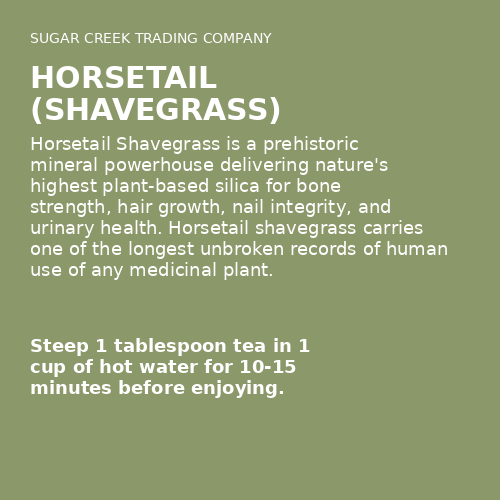
An ancient mineral-rich botanical prized for strengthening bones, hair, nails, and connective tissue through its exceptional silica content.
BOTANICAL IDENTIFICATION
Scientific Name: Equisetum arvense L.
Common Names: Horsetail, Shavegrass, Scouring Rush, Bottle Brush, Paddock Pipes, Mare's Tail, Pewterwort, Joint Grass
Family: Equisetaceae (Horsetail family)
Equisetum arvense is a perennial, non-flowering vascular plant that reproduces via spores rather than seeds, making it a living fossil with a lineage stretching back over 350 million years to the Carboniferous period. The plant produces two distinct types of shoots: fertile brownish stems that appear in early spring bearing cone-like strobili for spore dispersal, and sterile green vegetative stems that emerge later, growing 20 to 60 cm tall with whorls of slender, jointed, needle-like branches that give the plant its characteristic bottlebrush appearance.
Horsetail thrives in moist, sandy, and clay-rich soils along riverbanks, roadsides, ditches, meadows, and disturbed ground throughout the temperate regions of the Northern Hemisphere, including North America, Europe, and Asia. It is an exceptionally hardy plant with deep rhizomes that can penetrate several meters into the soil, making it both a resilient survivor and a vigorous colonizer of wet ground.
CULTURAL AND HISTORICAL USE
Horsetail is one of the oldest medicinal plants known to humanity, with recorded use spanning thousands of years across multiple cultures. The ancient Greeks and Romans recognized its healing properties; Pliny the Elder and Dioscorides both documented its use as a wound healer and diuretic in the first century CE. Galen recommended it for bleeding and kidney ailments. In medieval European herbalism, horsetail was widely used to stop hemorrhaging, heal wounds, and treat kidney and bladder stones. Its high silica content made it valuable beyond medicine: the abrasive stems were used to scour and polish pewter, wood, and metal, earning it the common names "scouring rush" and "pewterwort."
In Traditional Chinese Medicine, a related species (Equisetum hyemale, known as Mu Zei) has been used to clear heat from the Liver meridian, treat eye conditions, and address hemorrhoids. Native American peoples across North America used Equisetum species extensively as a diuretic, kidney tonic, and treatment for urinary tract complaints, as well as a poultice for wounds and fractures. The Blackfoot, Okanagan, and other nations also used it as a spring food source, consuming the young fertile shoots.
In modern Western herbalism, horsetail has become synonymous with mineral supplementation and connective tissue support. The German physician and herbalist Sebastian Kneipp (1821-1897) championed its use for rheumatic conditions and kidney health, and it remains a staple of European phytotherapy. It is monographed by the European Medicines Agency (EMA), German Commission E, and the European Scientific Cooperative on Phytotherapy (ESCOP) for its traditional use as a diuretic and for strengthening brittle nails and hair.
KEY BIOACTIVE COMPOUNDS & BENEFITS
| Compound/Class | Location in Plant | Human Benefit | Role in Plant |
|---|---|---|---|
| Silicic acid and silicates (5-8% dry weight) | Cell walls and epidermal tissue throughout aerial stems | Supports collagen synthesis, strengthens bones, hair, nails, teeth, and connective tissue | Provides structural rigidity and resistance to herbivory in the absence of lignin |
| Flavonoids (quercetin, kaempferol, isorhamnetin glycosides) | Green aerial stems and branches | Antioxidant, anti-inflammatory, capillary-strengthening, and mild diuretic activity | UV protection and defense against oxidative stress |
| Phenolic acids (caffeic acid, chlorogenic acid) | Stems and branches | Antioxidant protection, support for healthy inflammatory response | Antimicrobial defense and UV shielding |
| Equisetonin and other saponins | Whole aerial plant | Diuretic activity, hemostatic (blood-stopping) support | Chemical deterrent against herbivores and fungi |
| Minerals (potassium, calcium, magnesium, manganese, phosphorus) | Whole aerial plant | Electrolyte replenishment, bone and tissue mineralization | Absorbed from soil via extensive rhizome system; structural support |
The outstanding feature of horsetail's biochemical profile is its exceptionally high bioavailable silica content, the richest of any land plant. Silicon is an essential trace element for human connective tissue formation, and horsetail delivers it in organic silicic acid form that the body can readily absorb. Combined with its flavonoids and mineral density, horsetail functions as a comprehensive remineralizing and tissue-strengthening botanical with complementary diuretic and antioxidant actions.
HOW IT WORKS IN THE BODY
Horsetail exerts its effects primarily through mineral delivery and gentle modulation of renal and connective tissue function, acting as a building and tonifying herb rather than a stimulant.
Connective Tissue and Structural Support:
The bioavailable silicic acid in horsetail serves as a critical cofactor in collagen and elastin synthesis, the structural proteins that form the matrix of skin, bone, cartilage, tendons, blood vessels, hair, and nails. Silicon facilitates the cross-linking of collagen fibers, improving tissue strength and elasticity. Studies have shown that silicon supplementation increases bone mineral density and improves nail and hair quality by strengthening the keratin matrix. Horsetail's silica is particularly valued because it occurs in a water-soluble, orthosilicic acid form that is more bioavailable than mineral silica from geological sources.
Kidney and Urinary Function:
Horsetail acts as a gentle, potassium-sparing diuretic, increasing urine output without the potassium depletion associated with pharmaceutical diuretics. Its flavonoids and saponins stimulate renal blood flow and glomerular filtration, supporting the body's natural flushing of the urinary tract. This action has traditionally been used to support individuals with urinary tract infections, kidney gravel, mild edema, and water retention. The EMA and German Commission E both approve horsetail for use as a flushing therapy for bacterial and inflammatory conditions of the urinary tract.
Antioxidant and Anti-Inflammatory Activity:
The flavonoid and phenolic acid content of horsetail provides meaningful antioxidant protection, scavenging free radicals and reducing lipid peroxidation. In vitro and animal studies have demonstrated anti-inflammatory effects through inhibition of cyclooxygenase (COX) and lipoxygenase (LOX) pathways. This antioxidant and anti-inflammatory combination supports the herb's traditional use for joint conditions and tissue healing.
Wound Healing and Hemostasis:
Horsetail has a long traditional reputation as a vulnerary (wound-healing) herb. Its silica content supports tissue regeneration, while its astringent and hemostatic properties help slow bleeding and tighten tissues. Modern research suggests that horsetail extracts can stimulate fibroblast proliferation and collagen deposition, supporting the wound repair process.
DOSE GUIDELINES
| Preparation Type | Typical Dose | Purpose |
|---|---|---|
| Infusion (dried aerial herb) | 2-4 g steeped in hot water for 10-15 minutes, 2-3 times daily | General remineralization, urinary support, hair and nail strengthening |
| Decoction (simmered) | 2-4 g simmered for 15-20 minutes, 2-3 times daily | Extracts more silica than infusion; preferred for bone and connective tissue support |
| Tincture (1:5, 25-40% ethanol) | 2-4 mL, 3 times daily | Convenient daily diuretic and mineral tonic |
| Powdered herb (capsules or stirred into liquid) | 1-3 g daily | Direct mineral supplementation for bones, hair, nails |
Horsetail is traditionally used in cycles of 4 to 6 weeks followed by a 1 to 2 week break, rather than continuously without interruption. For connective tissue and bone support, consistent use over several months is typically needed to see results, as mineral-driven tissue remodeling is a gradual process. A decoction or long infusion is recommended over a quick steep when maximum silica extraction is desired.
PREPARATION AND USES
The dried green aerial stems (sterile shoots) are the medicinal part of the plant. For tea, a decoction or extended infusion is preferred because the silica and minerals are more thoroughly extracted with prolonged heat. Bring water to a boil, add the herb, reduce to a simmer for 15 to 20 minutes, then strain. The resulting tea has a mild, slightly grassy, and faintly earthy flavor. Horsetail combines well with nettle leaf, oat straw, and red clover in mineral-rich tea blends designed to nourish hair, skin, nails, and bones.
Externally, strong horsetail decoction or infusion can be used as a compress or soak for wounds, minor bleeding, sprains, and nail fungus. The cooled tea also makes an excellent hair rinse to strengthen hair shafts and add shine. Powdered horsetail can be encapsulated for daily mineral supplementation or added to smoothies. In organic gardening, horsetail tea is widely used as a natural fungicide spray for plants, leveraging its silica content to strengthen plant cell walls against fungal penetration.
OPTIMAL CONTEXT FOR USE
Horsetail is especially well-suited for individuals experiencing:
Brittle nails, thinning hair, or weak, slow-growing nails and hair seeking structural improvement through natural mineral supplementation
Osteopenia, osteoporosis risk, or recovery from bone fractures where enhanced mineralization and collagen support are beneficial
Recurrent urinary tract infections, mild edema, or water retention requiring gentle, potassium-sparing diuretic support
Joint stiffness, mild arthritis, or connective tissue weakness where improved collagen and elastin integrity may offer relief
Post-surgical or wound healing contexts where tissue repair and collagen formation need nutritional support
Horsetail works particularly well alongside other mineral-rich herbs such as nettle leaf, oat straw, and alfalfa in comprehensive remineralization programs. For bone health, it pairs effectively with calcium- and vitamin D-rich foods and appropriate weight-bearing exercise.
SUSTAINABILITY AND ETHICAL HARVESTING
Equisetum arvense is one of the most abundant and ecologically resilient plants on earth, thriving across vast swaths of the Northern Hemisphere in environments ranging from roadsides to riverbanks to agricultural margins. Its deep rhizome system and vigorous vegetative reproduction make it nearly impossible to eradicate once established, and it is often classified as a weed in agricultural and garden settings. As a result, there are no conservation concerns associated with sustainable wild harvesting of this species.
Most commercial horsetail is wild-harvested in Europe and North America from abundant natural stands. Ethical harvesting involves cutting the green sterile stems during summer when silica content is highest, leaving the rhizome system intact to regenerate. Sugar Creek Trading Company sources horsetail with attention to quality, proper identification (distinguishing E. arvense from other Equisetum species), and clean harvesting sites away from roadsides, industrial areas, and chemically treated land.
SAFETY AND CAUTIONS
Horsetail is generally considered safe for short- to medium-term use in healthy adults when used at recommended doses. It has a long history of traditional use as both food and medicine.
Contains thiaminase, an enzyme that breaks down vitamin B1 (thiamine). Prolonged, heavy use without breaks may contribute to thiamine depletion. Cycling use (4-6 weeks on, 1-2 weeks off) and ensuring adequate B-vitamin intake mitigates this risk. Heat processing and drying reduce but may not fully eliminate thiaminase activity.
Its diuretic action means it should be used with caution by individuals taking prescription diuretics, lithium, or medications affected by fluid balance. Consult a healthcare provider if on such medications.
Not recommended during pregnancy or breastfeeding due to insufficient safety data and potential effects on mineral and fluid balance.
Individuals with kidney disease, heart failure, or severe edema should use horsetail only under professional guidance, as its diuretic properties may affect electrolyte balance in sensitive individuals.
Proper botanical identification is essential: some Equisetum species (e.g., E. palustre, marsh horsetail) contain higher levels of potentially toxic alkaloids and should not be substituted for E. arvense.
REFERENCES
European Medicines Agency (EMA). "Assessment Report on Equisetum arvense L., herba." EMA/HMPC/278091/2015.
Carneiro, D.M., et al. "Randomized, Double-Blind Clinical Trial to Assess the Acute Diuretic Effect of Equisetum arvense." Evidence-Based Complementary and Alternative Medicine, 2014; 2014: 760683.
Jugdaohsingh, R. "Silicon and Bone Health." Journal of Nutrition, Health and Aging, 2007; 11(2): 99-110.
Blumenthal, M., et al. The Complete German Commission E Monographs: Therapeutic Guide to Herbal Medicines. American Botanical Council, 1998.
FINAL NOTE
Horsetail stands as a bridge between deep botanical antiquity and modern mineral nutrition, a plant whose lineage predates the dinosaurs and whose silica-rich chemistry remains unmatched in the plant kingdom. For those seeking to rebuild and strengthen the structural foundations of the body, from bones and joints to hair and nails, horsetail offers something no other herb can: the raw mineral architecture of resilience itself. It is quiet, fundamental, and profoundly effective when used with patience and consistency.
Share