Sugar Creek Trading Company
Irish Breakfast Black Tea
Irish Breakfast Black Tea
Couldn't load pickup availability
CAMELLIA SINENSIS
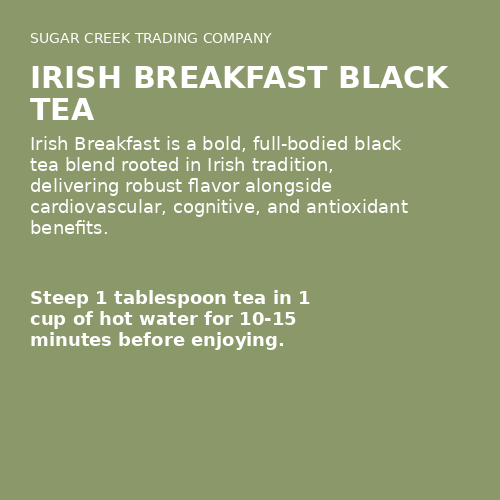
A bold, full-bodied black tea blend rooted in Irish tradition, delivering robust flavor alongside cardiovascular, cognitive, and antioxidant benefits.
BOTANICAL IDENTIFICATION
Scientific Name: Camellia sinensis (L.) Kuntze
Common Names: Irish Breakfast Tea, Black Tea, Assam Tea, Ceylon Tea, Tea Plant
Family: Theaceae (Tea family)
Camellia sinensis is an evergreen shrub or small tree that, when cultivated, is maintained at a height of 1 to 1.5 meters through regular pruning to encourage the production of tender young leaves and buds. In the wild, it can grow up to 15 meters tall. The leaves are alternately arranged, glossy dark green, elliptical to lanceolate, 5 to 12 cm long with serrated margins. Small, fragrant white flowers with yellow stamens bloom in autumn, followed by small, hard-shelled seed capsules. Irish Breakfast Tea is made from the fully oxidized (fermented) leaves of the Assam variety (Camellia sinensis var. assamica), often blended with robust teas from Ceylon, Kenya, or other origins.
Camellia sinensis is native to the subtropical and tropical forests of Southeast Asia, with two primary varieties: the small-leaved Chinese variety (var. sinensis) from Yunnan and the large-leaved Assam variety (var. assamica) from northeastern India. Irish Breakfast blends typically favor Assam-type teas grown in the warm, humid lowlands of Assam (India), Sri Lanka, and East Africa, where the climate produces leaves with high levels of theaflavins and a characteristically malty, strong flavor profile.
CULTURAL AND HISTORICAL USE
Tea has been consumed for over 5,000 years, originating in ancient China where legend attributes its discovery to Emperor Shen Nung in 2737 BCE. While China developed the art of green and oolong teas, the full oxidation process that produces black tea was developed later and became the dominant style of tea exported to Europe from the 17th century onward. Black tea arrived in Ireland through British trade routes in the early 18th century and quickly became a centerpiece of Irish daily life, far exceeding its popularity in most other European nations.
Ireland developed one of the highest per-capita rates of tea consumption in the world, and Irish Breakfast Tea evolved as a distinct blend to suit Irish tastes and water conditions. Unlike the lighter English Breakfast blends, Irish Breakfast is characteristically stronger, maltier, and more full-bodied, typically built on a base of robust Assam teas with additions from Ceylon and sometimes Kenya or Indonesia. This strength was practical: Irish Breakfast was designed to stand up to the addition of milk and sugar and to provide a fortifying start to the day in a cold, damp climate. Brands like Barry's and Bewley's became cultural institutions, and the ritual of the tea break became woven into the fabric of Irish social life.
Beyond Ireland, black tea holds deep cultural significance across the globe. In India, Chai is the national beverage. In England, the afternoon tea ceremony became a social institution. In Morocco, Russia, Turkey, and Iran, tea culture developed its own distinctive preparation methods and rituals. In Traditional Chinese Medicine, aged black teas (known as red tea, or Hong Cha) are valued for their warming properties and are prescribed to support digestion and circulation. The Irish Breakfast blend represents one expression of this worldwide tradition, optimized for strength, flavor, and daily drinkability.
KEY BIOACTIVE COMPOUNDS & BENEFITS
| Compound/Class | Location in Plant | Human Benefit | Role in Plant |
|---|---|---|---|
| Theaflavins and thearubigins | Formed during leaf oxidation (from catechins) | Cardiovascular protection, cholesterol regulation, antioxidant activity | Formed during enzymatic browning; not present in fresh leaf |
| Caffeine (theine) | Young leaves and buds | Mental alertness, focus, physical endurance, bronchodilation | Insecticidal defense compound and allelopathic agent deterring competing seedlings |
| L-theanine | Leaves (especially shade-grown) | Calm focus, anxiety reduction, enhanced alpha brain wave activity | Amino acid involved in nitrogen metabolism |
| Flavonoids (quercetin, kaempferol, myricetin glycosides) | Leaves | Antioxidant protection, anti-inflammatory effects, vascular health | UV protection and defense against herbivory |
| Polyphenolic tannins | Leaves and stems | Antimicrobial activity, digestive support, astringent tissue-toning | Anti-herbivory defense creating bitter taste and digestive inhibition in predators |
Black tea's unique chemistry is shaped by the oxidation process, which converts the catechins found in green tea into theaflavins and thearubigins, larger polyphenolic compounds responsible for black tea's dark color, brisk astringency, and distinctive health benefits. While green tea is often highlighted for its EGCG content, black tea's theaflavins have their own impressive body of research supporting cardiovascular protection, blood sugar regulation, and antioxidant activity. The combination of caffeine and L-theanine creates a state of alert relaxation that is distinct from the jittery stimulation of coffee, making black tea one of the most balanced natural cognitive enhancers available.
HOW IT WORKS IN THE BODY
Irish Breakfast Black Tea delivers its benefits through the interplay of stimulant, calming, and protective compounds that act across multiple body systems.
Cognitive Enhancement and Mental Clarity:
Caffeine blocks adenosine receptors in the brain, preventing the buildup of sleepiness signals and promoting wakefulness and concentration. Simultaneously, L-theanine crosses the blood-brain barrier and promotes alpha brain wave activity, a pattern associated with relaxed focus and creative thinking. This caffeine-theanine synergy is unique to tea and produces a smoother, more sustained state of alertness compared to coffee, without the typical crash or anxiety. Studies have shown this combination improves attention, reaction time, and task-switching ability.
Cardiovascular Protection:
Theaflavins and thearubigins have demonstrated significant cardiovascular benefits in clinical studies. Theaflavin-3,3'-digallate inhibits cholesterol absorption and has been shown to reduce LDL cholesterol levels. Black tea polyphenols improve endothelial function, promoting healthy blood vessel dilation through enhanced nitric oxide production. Regular black tea consumption is associated with reduced risk of stroke and coronary heart disease in multiple large-scale epidemiological studies.
Metabolic and Digestive Support:
Black tea polyphenols modulate gut microbiota composition, promoting the growth of beneficial Bacteroidetes and Firmicutes species. The tannins in black tea provide mild astringent activity in the digestive tract, toning mucous membranes and supporting healthy bowel function. Research suggests regular black tea consumption supports healthy blood sugar regulation by improving insulin sensitivity and slowing carbohydrate absorption.
Antioxidant Defense:
Despite undergoing full oxidation, black tea retains powerful antioxidant capacity. The theaflavins and thearubigins, along with residual flavonoids, scavenge reactive oxygen species and chelate pro-oxidant metal ions. This antioxidant activity helps protect cells from oxidative damage associated with aging, chronic disease, and environmental exposure.
DOSE GUIDELINES
| Preparation Type | Typical Dose | Purpose |
|---|---|---|
| Standard brew | 2-3 g (1 teaspoon) per 8 oz boiling water, steeped 3-5 minutes | Daily enjoyment, cognitive enhancement, cardiovascular support |
| Strong brew (Irish style) | 3-5 g per 8 oz boiling water, steeped 4-6 minutes | Maximum flavor and compound extraction, traditional Irish strength |
| Cold brew | 4-6 g per 16 oz cold water, steeped in refrigerator 8-12 hours | Smooth, low-tannin preparation with full polyphenol content |
Irish Breakfast Tea is traditionally brewed strong with freshly boiling water and steeped for at least 4 minutes to achieve its characteristic robust body. It is classically served with milk and optionally sugar, a practice that slightly reduces the astringency of tannins while creating its signature creamy, malty flavor. For maximum health benefits, 3-5 cups daily is the range most commonly associated with cardiovascular and cognitive benefits in clinical research. Caffeine-sensitive individuals may prefer to limit consumption to 1-2 cups in the morning or to use a brief initial steep-and-discard method to reduce caffeine content by approximately 30-40%.
PREPARATION AND USES
For the best Irish Breakfast experience, use freshly drawn, filtered water brought to a full, rolling boil. Warm the teapot or mug first by rinsing with hot water, then add one teaspoon (2-3 g) of loose tea per cup. Pour boiling water directly over the leaves and steep for 4-5 minutes. The traditional Irish method is to steep slightly longer than English style, producing a stronger, darker cup that pairs beautifully with a splash of whole milk or cream. Sugar or honey may be added to taste, though many purists prefer milk alone.
Loose-leaf Irish Breakfast is vastly superior to tea bags in flavor complexity and compound density, as the larger leaf pieces allow for more controlled extraction and deliver a cleaner, more nuanced cup. Beyond the morning cup, Irish Breakfast Black Tea can be used as the base for homemade Chai by simmering with ginger, cinnamon, cardamom, cloves, and black pepper in milk and water. It also makes an excellent iced tea when brewed double-strength and poured over ice, and can be used in cooking to add depth to braised meats, marinades, and even baked goods like tea-infused scones or tea brack (traditional Irish tea bread).
OPTIMAL CONTEXT FOR USE
Irish Breakfast Black Tea is especially well-suited for individuals seeking:
A robust, full-flavored daily tea that provides sustained mental clarity and focus without the jitters or crash associated with coffee
Cardiovascular support through regular polyphenol intake, particularly for those concerned about cholesterol, blood pressure, or vascular health
A traditional morning ritual that combines enjoyment with genuine health benefits
Digestive regularity and gut microbiome support through daily polyphenol and tannin intake
A versatile base tea for chai, iced tea, cooking, or blending with other flavors and herbs
Black tea integrates seamlessly into a healthy daily routine and pairs well with a balanced, whole-foods diet. For enhanced antioxidant benefit, consider alternating with green tea or combining your tea practice with other polyphenol-rich foods such as berries, dark chocolate, and olive oil.
SUSTAINABILITY AND ETHICAL HARVESTING
Tea is one of the most widely cultivated crops in the world, grown across Asia, Africa, and South America. The environmental impact of tea production varies significantly depending on farming practices. Conventional tea farming can involve heavy pesticide use, monoculture planting, deforestation, and labor exploitation. However, the tea industry has made considerable progress in sustainability certification, with programs such as Rainforest Alliance, Fair Trade, and organic certification providing frameworks for responsible production.
Sugar Creek Trading Company sources Irish Breakfast Black Tea with attention to both quality and ethical supply chains. We seek teas grown under conditions that respect workers' rights, minimize chemical inputs, and protect the biodiversity of tea-growing regions. The shift toward organic and sustainable tea farming is ongoing, and by choosing responsibly sourced loose-leaf tea, consumers directly support farms and cooperatives that prioritize environmental stewardship and fair labor practices.
SAFETY AND CAUTIONS
Black tea is one of the most widely consumed beverages in the world and has an excellent safety profile when consumed in moderate amounts (3-5 cups daily).
Caffeine content averages 40-70 mg per 8 oz cup, depending on steeping time and tea strength. Caffeine-sensitive individuals, those with anxiety disorders, or those with cardiac arrhythmias should moderate their intake accordingly.
Tannins in black tea can reduce the absorption of non-heme iron from plant foods and supplements. Individuals with iron-deficiency anemia should avoid drinking tea with meals and instead consume it between meals.
Black tea may interact with certain medications, including stimulants, MAO inhibitors, blood thinners (due to vitamin K content), and some antibiotics (fluoroquinolones). Consult a healthcare provider if taking such medications.
Pregnant individuals are generally advised to limit caffeine intake to 200 mg daily (approximately 3 cups of black tea). Nursing mothers should monitor infant sensitivity to caffeine.
Excessive consumption (more than 8-10 cups daily) may lead to caffeine-related side effects including insomnia, restlessness, increased heart rate, and digestive upset.
REFERENCES
Khan, N. & Mukhtar, H. "Tea and Health: Studies in Humans." Current Pharmaceutical Design, 2013; 19(34): 6141-6147.
Hodgson, J.M. "Effects of Tea and Tea Flavonoids on Endothelial Function and Blood Pressure." Journal of Hypertension, 2006; 24(2): 215-222.
Bryan, J. "Psychological Effects of Dietary Components of Tea: Caffeine and L-theanine." Nutrition Reviews, 2008; 66(2): 82-90.
Mair, V.H. & Hoh, E. The True History of Tea. Thames & Hudson, 2009.
FINAL NOTE
Irish Breakfast Tea is more than a beverage; it is a daily ritual that has anchored Irish households for over two centuries and continues to offer one of the most accessible, enjoyable paths to better health. Its combination of bold Assam character, smooth drinkability, and a biochemical profile that genuinely supports heart, brain, and gut health makes it a remarkable intersection of pleasure and function. Whether you take it strong with a cloud of milk in the traditional fashion or brew it into a spiced chai, this is a tea that rewards daily devotion with both flavor and vitality.
Share