Sugar Creek Trading Company
Jasmine Flower
Jasmine Flower
Couldn't load pickup availability
JASMINUM OFFICINALE / JASMINUM SAMBAC
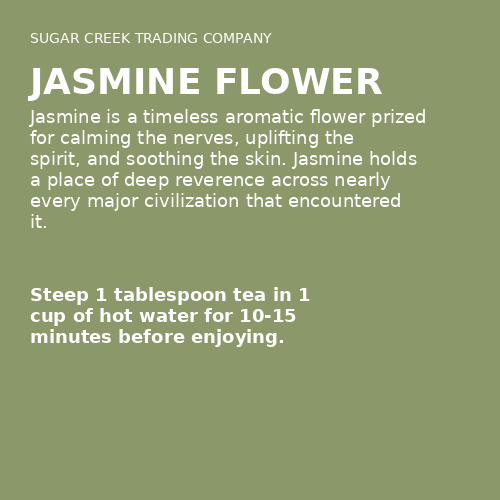
A timeless aromatic flower prized for calming the nerves, uplifting the spirit, and soothing the skin.
BOTANICAL IDENTIFICATION
Scientific Name: Jasminum officinale L. / Jasminum sambac (L.) Aiton
Common Names: Jasmine, Common Jasmine, Poet's Jasmine, Royal Jasmine, Arabian Jasmine, Mogra, Pikake, Malli
Family: Oleaceae (Olive family)
Jasmine is a climbing or sprawling shrub that can reach 10 to 15 feet in height when supported. It produces dark green, pinnately compound leaves and intensely fragrant, star-shaped white flowers that bloom most heavily during summer evenings. The flowers are small, typically five-petaled, and release their richest scent after sunset.
Native to the Himalayan regions of India, western China, and the Middle East, jasmine thrives in warm, temperate to tropical climates with well-drained soil and full to partial sun. It is now cultivated worldwide, with major production centers in India, Egypt, China, and southern France.
CULTURAL AND HISTORICAL USE
Jasmine holds a place of deep reverence across nearly every major civilization that encountered it. In Ayurvedic medicine, jasmine flowers have been used for thousands of years to calm pitta-related heat and agitation, soothe headaches, and support emotional balance. The flowers were strung into garlands for temple offerings and wedding ceremonies, symbolizing purity, love, and divine connection. In traditional Indian women's health, jasmine was applied to support lactation, ease menstrual discomfort, and cool inflammatory skin conditions.
In Traditional Chinese Medicine, jasmine flower tea (molihua cha) has been consumed since the Song Dynasty (960-1279 CE) to smooth the flow of liver qi, ease digestive tension, and settle the shen (spirit). Jasmine-scented green tea remains one of the most popular teas in China to this day, valued both for its flavor and its gentle calming properties. Persian and Arabic cultures regarded jasmine as the "gift of God" and used jasmine oil extensively in perfumery, bathing rituals, and as a nervine remedy for anxiety and melancholy.
In Western herbalism, jasmine was introduced through trade routes and became a fixture in European apothecaries by the 16th century. It was used as a gentle sedative, a skin tonic, and an aphrodisiac. The flower's essential oil, one of the most expensive in the world due to the enormous quantity of blossoms needed for extraction, became a cornerstone of French perfumery. In Hawaii, jasmine sambac (pikake) is woven into leis to honor guests and celebrate important occasions.
KEY BIOACTIVE COMPOUNDS & BENEFITS
| Compound/Class | Location in Plant | Human Benefit | Role in Plant |
|---|---|---|---|
| Linalool | Flowers (essential oil) | Anxiolytic, sedative, and anti-inflammatory effects; promotes relaxation and sleep | Attracts pollinators and deters herbivores |
| Benzyl acetate | Flowers (essential oil) | Calming aromatic compound; supports mood elevation and stress relief | Primary volatile for nocturnal pollinator attraction |
| Indole | Flowers (essential oil) | Contributes to the deep, heady quality of jasmine aroma; supports emotional grounding | Intensifies scent signal at night to attract moths |
| Flavonoids (rutin, quercetin) | Flowers, leaves | Antioxidant protection, anti-inflammatory, supports vascular health | UV protection and pathogen defense |
| Salicylic acid derivatives | Leaves, flowers | Mild analgesic and anti-inflammatory properties | Systemic defense signaling against pathogens |
Jasmine's therapeutic profile centers on its remarkable volatile chemistry. The combination of linalool, benzyl acetate, and indole creates a synergistic aromatic effect that engages the limbic system, producing both calming and gently uplifting responses. Its flavonoid content adds antioxidant and anti-inflammatory support, making jasmine a multidimensional herb for both emotional and physical well-being.
HOW IT WORKS IN THE BODY
Jasmine exerts its effects primarily through aromatic and ingested pathways, influencing the nervous system, skin, and digestive tract.
Nervous System and Mood Regulation:
Linalool and other volatile compounds in jasmine interact with GABA-A receptors in the brain, producing anxiolytic and mildly sedative effects. Inhaled jasmine aroma has been shown in studies to increase parasympathetic activity, lower heart rate, and promote a sense of calm alertness. This makes jasmine distinct from purely sedating herbs -- it relaxes without heavy drowsiness.
Skin and Tissue Support:
Applied topically as a tea wash or infused oil, jasmine's anti-inflammatory flavonoids and salicylic acid derivatives help soothe irritated, dry, or inflamed skin. Traditional use for wound healing and skin softening is supported by its antioxidant activity, which helps protect against oxidative damage to skin cells.
Digestive Ease:
As a tea, jasmine gently relaxes smooth muscle in the digestive tract, easing cramping, bloating, and nervous stomach. Its mild antispasmodic action is complemented by the calming effect on the vagus nerve, bridging the gut-brain axis to address stress-related digestive discomfort.
DOSE GUIDELINES
| Preparation Type | Typical Dose | Purpose |
|---|---|---|
| Flower Tea (infusion) | 1-2 teaspoons dried flowers per 8 oz hot water, steep 3-5 minutes | Relaxation, digestive support, daily enjoyment |
| Jasmine-scented green tea | 1-2 teaspoons per 8 oz water at 175-185 F, steep 2-3 minutes | Gentle energy with calm focus, antioxidant support |
| Topical wash or compress | Strong infusion (2 tablespoons per cup), cooled and applied | Skin soothing, minor irritation relief |
| Aromatherapy | A handful of dried flowers in a sachet or bowl near bedside | Sleep support, stress reduction, mood elevation |
Jasmine is best used as a daily or nightly ritual tea. Its effects are gentle and cumulative, well-suited for ongoing use rather than acute intervention. Evening consumption aligns with the flower's own nocturnal blooming rhythm and supports wind-down routines.
PREPARATION AND USES
The most common preparation is a simple hot infusion of the dried flowers. Pour water just below boiling (around 185 F) over the blossoms and steep for 3 to 5 minutes. Jasmine flowers can also be blended with green tea, white tea, or other herbs such as chamomile, lavender, or rose petals for custom relaxation blends. For iced tea, steep a double-strength infusion and pour over ice.
Topically, a cooled jasmine infusion makes an excellent facial toner or compress for irritated skin. The dried flowers can be added to bath sachets for a luxurious, aromatic soak. In the kitchen, jasmine flowers can be used to infuse honey, sugar, or cream for desserts. For aromatherapy, simply place dried blossoms in a small dish on a nightstand or tuck them into a linen sachet for the pillow.
OPTIMAL CONTEXT FOR USE
Jasmine flower is especially well-suited for individuals experiencing:
Stress, anxiety, or nervous tension, particularly when it manifests as restlessness or difficulty unwinding in the evening
Trouble falling asleep or maintaining a consistent bedtime routine, especially when heavy sedatives feel like too much
Stress-related digestive upset, including nervous stomach, mild cramping, or appetite loss due to tension
Dry, irritated, or inflamed skin that benefits from gentle topical anti-inflammatory support
A desire for a fragrant, ritual-quality tea that supports emotional well-being as part of a daily self-care practice
Jasmine pairs beautifully with other calming herbs like chamomile, passionflower, or lemon balm for enhanced relaxation, or with green tea for a focused yet calm daytime blend.
SUSTAINABILITY AND ETHICAL HARVESTING
Jasmine is widely cultivated across tropical and subtropical regions, and wild populations are not considered threatened. Commercial jasmine cultivation provides important income for smallholder farmers in India, Egypt, and Southeast Asia, where hand-picking of blossoms -- often done at night or in the early morning hours when scent concentration peaks -- is labor-intensive and culturally significant work. Supporting ethically sourced jasmine helps sustain these traditional livelihoods.
Because jasmine is almost entirely cultivated rather than wild-harvested, sustainability concerns are minimal. However, buyers should be aware that jasmine essential oil production requires enormous quantities of flowers (approximately 7 million blossoms per kilogram of absolute), making whole dried flowers a far more resource-efficient way to enjoy this plant's benefits.
SAFETY AND CAUTIONS
Jasmine flower is generally regarded as very safe for most adults when consumed as a tea or used topically.
Individuals with known allergies to plants in the Oleaceae family (olive, lilac, ash) should exercise caution and test a small amount first.
Jasmine tea consumed in large quantities before bed may cause mild stomach upset in sensitive individuals. Start with a light infusion and adjust to preference.
Pregnant and nursing women have traditionally used jasmine safely, but should consult a healthcare provider before using it medicinally, as some traditional systems associate jasmine with uterine-stimulating properties in concentrated doses.
If blending jasmine with green or white tea, be mindful of caffeine content, especially for evening use.
REFERENCES
Kuroda, K., et al. (2005). "Sedative effects of the jasmine tea odor and (R)-(-)-linalool, one of its major odor components, on autonomic nerve activity and mood states." European Journal of Applied Physiology, 95(2-3), 107-114.
Hongratanaworakit, T. (2010). "Stimulating effect of aromatherapy massage with jasmine oil." Natural Product Communications, 5(1), 157-162.
Lis-Balchin, M. (2006). Aromatherapy Science: A Guide for Healthcare Professionals. Pharmaceutical Press, London.
FINAL NOTE
Jasmine flower is one of the world's most beloved aromatics for good reason -- it calms without sedating, uplifts without stimulating, and brings a quiet elegance to any tea blend or self-care ritual. Whether sipped as a nightly infusion, tucked into a pillow sachet, or blended into a soothing skin wash, jasmine offers a gentle, time-honored path to ease and emotional balance. Few plants bridge the gap between pleasure and medicine so gracefully.
Share