Sugar Creek Trading Company
Kale
Kale
Couldn't load pickup availability
BRASSICA OLERACEA VAR. SABELLICA
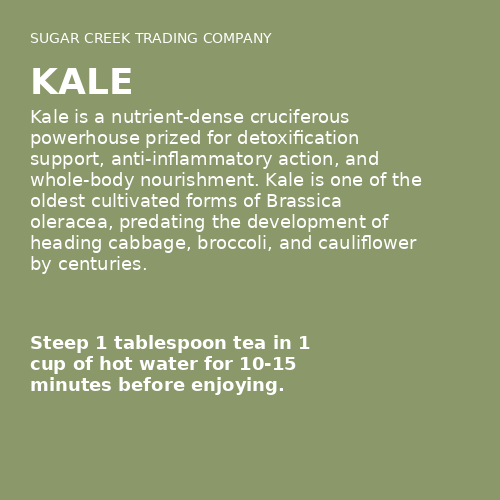
A nutrient-dense cruciferous powerhouse prized for detoxification support, anti-inflammatory action, and whole-body nourishment.
BOTANICAL IDENTIFICATION
Scientific Name: Brassica oleracea L. var. sabellica
Common Names: Kale, Curly Kale, Scotch Kale, Borecole, Leaf Cabbage, Cow Cabbage, Farmer's Cabbage
Family: Brassicaceae (Mustard/Cruciferous family)
Kale is a biennial or short-lived perennial leafy green that grows 1 to 3 feet tall, producing large, deeply curled or ruffled leaves on sturdy central stems. Unlike its close relatives cabbage and broccoli, kale does not form a compact head -- instead, its broad, open rosette of leaves continues to grow outward, allowing for repeated harvest. Leaf color ranges from deep green to blue-green to purple, depending on variety and temperature.
Kale originated in the wild cabbage populations of the eastern Mediterranean and western Asia Minor, and has been cultivated in Europe for over 2,000 years. It thrives in cool weather, tolerating frost down to about 10 F (which actually improves its flavor by converting starches to sugars), and prefers rich, well-drained soil with consistent moisture. It is now grown worldwide as a cold-season crop and is among the most nutritionally dense vegetables known.
CULTURAL AND HISTORICAL USE
Kale is one of the oldest cultivated forms of Brassica oleracea, predating the development of heading cabbage, broccoli, and cauliflower by centuries. The ancient Greeks and Romans grew kale-like leafy brassicas and valued them as food and medicine. Cato the Elder, writing around 160 BCE, described the medicinal use of brassica leaves for digestive complaints, wound healing, and joint pain. Greek physicians including Hippocrates and Dioscorides recommended brassica preparations for a wide range of ailments.
In medieval and Renaissance Europe, kale was a dietary staple of enormous importance, particularly in Scotland, Ireland, Germany, and Scandinavia, where it was one of the few green vegetables that could survive harsh winters. In Scotland, "kailyard" (kale garden) was synonymous with kitchen garden, and the word "kale" itself became Scottish slang for food in general. German settlers brought kale to the Americas, and it remained a common garden crop until the 20th century, when it was gradually eclipsed by milder-flavored greens.
The modern resurgence of kale as a "superfood" began in the early 2000s, driven by growing awareness of its exceptional nutrient density. However, herbalists and traditional food practitioners have long recognized dried kale leaf as a concentrated source of minerals, vitamins, and phytonutrients that can be used in teas, broths, green powders, and capsules for nutritive supplementation. Certified organic dried kale leaf offers a convenient, shelf-stable way to incorporate this powerhouse green into daily health routines year-round.
KEY BIOACTIVE COMPOUNDS & BENEFITS
| Compound/Class | Location in Plant | Human Benefit | Role in Plant |
|---|---|---|---|
| Glucosinolates (glucobrassicin, sinigrin) | Leaves, stems | Converted to isothiocyanates (sulforaphane, indole-3-carbinol) which support Phase II liver detoxification and have demonstrated anti-cancer properties | Defense against herbivores and pathogens; release toxic compounds when tissue is damaged |
| Carotenoids (lutein, zeaxanthin, beta-carotene) | Leaves | Protect eyes from macular degeneration; antioxidant; beta-carotene converts to vitamin A | Photosynthetic accessory pigments; photoprotection against UV damage |
| Flavonoids (kaempferol, quercetin) | Leaves | Potent anti-inflammatory and antioxidant activity; cardiovascular protection | UV screening, pollinator signaling, pathogen defense |
| Vitamin K1 (phylloquinone) | Leaves | Essential for blood clotting and bone mineralization; one of the richest food sources known | Electron carrier in photosynthesis |
| Minerals (calcium, potassium, magnesium, iron) | Leaves, stems | Bone health, electrolyte balance, oxygen transport, muscle and nerve function | Structural and enzymatic functions in plant metabolism |
Kale's extraordinary nutritional profile combines dense mineral content, high levels of vitamins A, C, and K, and a rich array of sulfur-containing glucosinolates and protective flavonoids. This makes it not just a food but a genuine phytomedicine -- a concentrated source of the specific compounds the human body uses for detoxification, antioxidant defense, and inflammation control. Dried kale leaf concentrates these nutrients, delivering more per gram than fresh kale due to water removal.
HOW IT WORKS IN THE BODY
Kale's health benefits operate through multiple complementary mechanisms, centered on detoxification support, antioxidant defense, and nutrient replenishment.
Phase II Detoxification and Cellular Protection:
When kale's glucosinolates are broken down during digestion, they produce isothiocyanates including sulforaphane and indole-3-carbinol (I3C). These compounds are potent inducers of Phase II detoxification enzymes in the liver, including glutathione S-transferase and quinone reductase. Phase II enzymes are responsible for neutralizing and excreting carcinogens, environmental toxins, and metabolic waste products. This is one of the most well-documented anti-cancer mechanisms in nutritional science, with dozens of epidemiological studies linking high cruciferous vegetable intake to reduced cancer risk.
Anti-Inflammatory Pathways:
Kaempferol and quercetin, the two dominant flavonoids in kale, inhibit NF-kB, a master inflammatory signaling pathway involved in chronic disease, pain, and tissue damage. These flavonoids also inhibit COX-2 and lipoxygenase enzymes, reducing prostaglandin and leukotriene production. The omega-3 fatty acid alpha-linolenic acid (ALA), present in kale leaves in small but meaningful amounts, provides additional anti-inflammatory support.
Bone and Cardiovascular Support:
Kale is one of the richest known food sources of vitamin K1, providing over 600% of the daily value per 100 grams of fresh leaf. Vitamin K1 activates osteocalcin, a protein essential for calcium deposition in bone. Simultaneously, it activates matrix Gla protein (MGP), which prevents calcium from depositing in arterial walls. This dual action supports both bone density and cardiovascular health. Kale's highly bioavailable calcium (absorption rate of approximately 49%, compared to about 32% for milk) further enhances bone support.
Eye and Skin Health:
Kale contains more lutein and zeaxanthin per serving than virtually any other food. These carotenoids accumulate in the macula of the eye, where they filter blue light and protect photoreceptor cells from oxidative damage. Consistent intake is associated with reduced risk of age-related macular degeneration and cataracts. Beta-carotene, converted to vitamin A in the body, supports skin cell turnover, immune function, and mucosal membrane integrity.
DOSE GUIDELINES
| Preparation Type | Typical Dose | Purpose |
|---|---|---|
| Nutritive infusion (overnight steep) | 1-2 tablespoons dried leaf in 1 quart boiling water, steep 4-8 hours, strain | Deep mineral and vitamin extraction; daily nourishment |
| Powder (added to food) | 1-2 teaspoons (3-6 grams) daily, mixed into smoothies, soups, or broth | Concentrated nutrition, convenient daily supplementation |
| Capsules | 2-4 capsules (500 mg each), 1-2 times daily | Standardized daily nutrient support for those who dislike the taste |
| Broth or cooking addition | 1-3 tablespoons crumbled dried leaf added to soups, stews, or grains | Nutritional enrichment of meals |
Kale leaf is best used as a daily nutritive supplement, consumed consistently over time for cumulative benefit. The overnight nutritive infusion method, popularized by herbalist Susun Weed, extracts maximum mineral content and produces a rich, green, mineral-dense liquid. For those new to dried kale, starting with smaller amounts and increasing gradually allows the digestive system to adjust to the fiber and sulfur content.
PREPARATION AND USES
Dried kale leaf is remarkably versatile. For a nutritive infusion, place 1 to 2 tablespoons of dried leaf in a quart jar, fill with boiling water, cap tightly, and steep for 4 to 8 hours (or overnight). Strain and drink throughout the day -- hot, cold, or at room temperature. This method extracts calcium, magnesium, iron, and potassium far more effectively than a quick tea steep. The flavor is mild, earthy, and slightly mineral-rich, and can be improved with a squeeze of lemon (which also enhances iron absorption).
Powdered dried kale blends seamlessly into smoothies, green juices, scrambled eggs, soups, stews, rice dishes, pasta sauces, and homemade bread or muffin batters. It can be sprinkled over salads or mixed into salad dressings. For encapsulation, finely powdered kale leaf fills size 00 capsules for those who prefer a tasteless supplementation method. Dried kale leaf also makes an excellent base for custom green blends -- combine with dried nettle, spirulina, moringa, or wheatgrass for a comprehensive daily greens formula.
OPTIMAL CONTEXT FOR USE
Certified organic kale leaf is especially well-suited for individuals experiencing:
Nutritional deficiencies or inadequate vegetable intake, particularly in vitamins A, C, and K, calcium, iron, and magnesium
A desire for enhanced detoxification support, whether from environmental exposures, dietary changes, or general wellness goals
Concerns about bone density, osteoporosis risk, or calcium intake -- especially for those who do not consume dairy products
Eye health concerns, including age-related macular degeneration risk, heavy screen use, or a family history of vision loss
Chronic low-grade inflammation that manifests as joint stiffness, skin issues, fatigue, or general malaise
Kale leaf combines exceptionally well with nettle leaf for a mineral-dense nutritive tea, with turmeric for enhanced anti-inflammatory action, or with dandelion root for comprehensive liver and digestive support.
SUSTAINABILITY AND ETHICAL HARVESTING
Kale is one of the most sustainable and efficient crops to produce. It grows rapidly, tolerates poor soil, requires relatively little water compared to other greens, and can be harvested continuously by picking outer leaves while the plant continues to grow. It has a low carbon footprint and is well-suited to organic cultivation, as healthy brassica plants in diverse growing systems naturally resist many pests.
Certified organic kale ensures the product was grown without synthetic pesticides, herbicides, or chemical fertilizers -- an important consideration given that conventionally grown kale frequently appears on the Environmental Working Group's "Dirty Dozen" list of produce with high pesticide residues. Organic certification also prohibits irradiation and genetic modification, ensuring a clean, whole-food product. Purchasing certified organic dried kale supports farming practices that build soil health, protect waterways, and sustain pollinator populations.
SAFETY AND CAUTIONS
Kale is a common food with an excellent safety profile. However, a few considerations apply, particularly at supplemental doses.
Individuals taking blood-thinning medications (warfarin/Coumadin) should maintain consistent vitamin K intake rather than dramatically increasing or decreasing kale consumption, as vitamin K directly affects clotting factor production. Consult your prescribing physician before adding significant amounts of kale to your routine.
Kale contains oxalates, though at lower levels than spinach. Individuals with a history of oxalate kidney stones should moderate intake and ensure adequate hydration and calcium consumption.
Raw kale contains goitrogens (compounds that can interfere with thyroid hormone production when consumed in very large quantities). Individuals with hypothyroidism or iodine deficiency should be mindful of total cruciferous intake. Cooking or drying significantly reduces goitrogen content.
Some individuals may experience gas or bloating when first introducing concentrated kale to their diet, due to its fiber and sulfur content. Start with small amounts and increase gradually.
REFERENCES
Manchali, S., et al. (2012). "Crucial facts about health benefits of popular cruciferous vegetables." Journal of Functional Foods, 4(1), 94-106.
Šamec, D., et al. (2019). "Kale (Brassica oleracea var. acephala) as a superfood: Review of the scientific evidence behind the statement." Critical Reviews in Food Science and Nutrition, 59(15), 2411-2422.
Higdon, J.V., et al. (2007). "Cruciferous vegetables and human cancer risk: Epidemiologic evidence and mechanistic basis." Pharmacological Research, 55(3), 224-236.
FINAL NOTE
Kale leaf may lack the exotic mystique of rare tropical herbs, but it delivers an unrivaled concentration of the specific nutrients and phytochemicals that the modern body most needs -- minerals for bone and nerve function, carotenoids for eye and skin protection, glucosinolates for detoxification, and flavonoids for inflammation control. Certified organic dried kale leaf makes this nutritional powerhouse available year-round in a concentrated, shelf-stable form that can be sipped as an infusion, blended into food, or encapsulated for daily use. Sometimes the most powerful medicine is simply exceptional food.
Share