Sugar Creek Trading Company
Kansas Snake Root
Kansas Snake Root
Couldn't load pickup availability
ECHINACEA ANGUSTIFOLIA
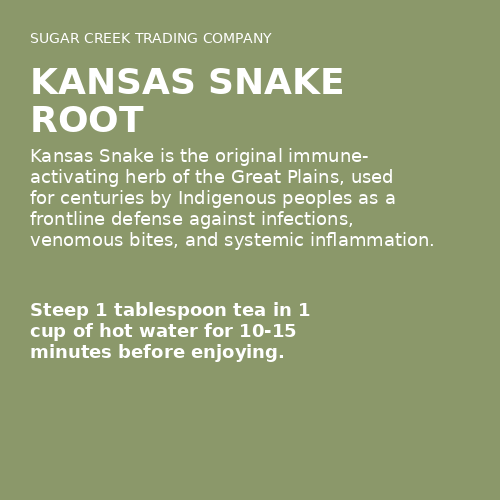
The original immune-activating herb of the Great Plains, used for centuries by Indigenous peoples as a frontline defense against infections, venomous bites, and systemic inflammation.
BOTANICAL IDENTIFICATION
Scientific Name: Echinacea angustifolia DC.
Common Names: Kansas snake root, narrow-leaf coneflower, narrow-leaved purple coneflower, black sampson, scurvy root, comb flower, hedgehog coneflower
Family: Asteraceae (Daisy/Composite family)
Echinacea angustifolia is a hardy perennial herb growing 30 to 70 centimeters tall from a thick, dark, taproot that can extend 30 centimeters or more into the soil. The stems are rough-hairy and typically unbranched, bearing narrow, lance-shaped leaves 5 to 15 centimeters long with three prominent veins and a coarse, bristly texture. The flower heads are solitary, featuring a prominent spiny central cone (the "hedgehog" from which the genus name derives, from the Greek echinos) surrounded by drooping, pale purple to pink ray florets. The distinctive taproot is dark brown to black on the exterior, with a pungent, tingling taste that numbs the tongue upon chewing, a key indicator of potency.
Native to the central Great Plains of North America, E. angustifolia ranges from Saskatchewan and Manitoba south through the Dakotas, Nebraska, Kansas, Oklahoma, and into Texas. It thrives in dry, well-drained prairie soils, rocky limestone glades, and open grasslands at elevations from 300 to 1,500 meters. Unlike its taller cousin E. purpurea, this species is strictly a plant of the open prairie, requiring full sun and lean, alkaline soils to flourish.
CULTURAL AND HISTORICAL USE
Echinacea angustifolia was the most widely used medicinal plant among the Indigenous peoples of the Great Plains, with documented use by more than a dozen tribal nations. The Lakota (Sioux) called it icahpe hu and used it as a universal remedy for snakebite, toothache, sore throat, and pain. The Cheyenne employed the root for sore mouth and gum diseases. The Pawnee used it for headaches and as a wash for burns. The Kiowa chewed the root for coughs and sore throats. The Comanche and Omaha-Ponca used it extensively for toothache by placing pieces of fresh root directly against the affected tooth, exploiting the root's powerful numbing effect. Among the Lakota, Kansas snake root was considered one of the most important plants in the entire pharmacopoeia, second in reverence only to the sacred pipe.
The name "Kansas snake root" arose from the herb's prominent use as a snakebite remedy among both Indigenous peoples and early Euro-American settlers of Kansas and the surrounding territories. The root was chewed and applied as a poultice to the bite wound while simultaneously taken internally to counteract the venom's systemic effects. Whether the herb's efficacy against snakebite was due to genuine anti-venom properties, immune stimulation, anti-inflammatory action, or a combination remains a subject of interest, but the practice was widespread and deeply trusted across cultures.
Echinacea entered Western herbal medicine through the work of H. C. F. Meyer, a lay physician in Pawnee City, Nebraska, who learned of the plant from local Indigenous people in the 1870s. Meyer promoted a proprietary echinacea preparation with considerable fervor, eventually sending samples to John Uri Lloyd and John King, prominent Eclectic physicians in Cincinnati. After initial skepticism, the Eclectics adopted echinacea enthusiastically, and it became the single best-selling botanical medicine in the United States by the early 1900s. The Eclectic physicians used it primarily for blood poisoning, septicemia, gangrene, diphtheria, typhoid fever, and virtually any condition involving systemic infection, earning it the reputation as the "king of blood purifiers." It is worth noting that the Eclectics specifically preferred E. angustifolia root over all other Echinacea species, considering it significantly more potent.
KEY BIOACTIVE COMPOUNDS & BENEFITS
| Compound/Class | Location in Plant | Human Benefit | Role in Plant |
|---|---|---|---|
| Alkylamides (isobutylamides, notably dodeca-2E,4E,8Z,10E/Z-tetraenoic acid isobutylamides) | Root (highest concentration) | Immune modulation via CB2 cannabinoid receptor activation; anti-inflammatory; responsible for the characteristic tongue-tingling sensation | Insecticidal defense compounds |
| Echinacoside (caffeic acid glycoside) | Root | Antimicrobial and antiviral activity; antioxidant protection; supports connective tissue integrity | Antimicrobial root defense |
| Cynarin and caftaric acid | Root and aerial parts | Antioxidant; hepatoprotective; support healthy inflammatory response | UV protection and oxidative stress defense |
| Polysaccharides (arabinogalactans, heteroxylan) | Root | Activate macrophages and dendritic cells; enhance phagocytic activity; support innate immune response | Cell wall structural components and water retention |
| Polyacetylenes (notably pontica epoxide) | Root | Antifungal; immunostimulatory; cytotoxic to certain abnormal cell lines | Antimicrobial defense in soil environment |
What distinguishes E. angustifolia from other Echinacea species is its exceptionally high concentration of alkylamides and echinacoside in the root. While E. purpurea is more commonly cultivated and studied, E. angustifolia root consistently shows higher levels of these two compound classes. The alkylamides are now understood to be the primary immune-modulating constituents, and their characteristic tongue-numbing effect has been used for centuries as a field test for root quality. A root that does not produce a strong, persistent tingling sensation is considered inferior.
HOW IT WORKS IN THE BODY
Echinacea angustifolia root works through multiple interconnected immune and inflammatory pathways, functioning not simply as a stimulant but as a sophisticated immune modulator.
Innate Immune Activation:
The polysaccharides and alkylamides in E. angustifolia root activate the innate immune system through distinct but complementary mechanisms. Arabinogalactan polysaccharides bind to receptors on macrophages and dendritic cells, stimulating phagocytosis (the engulfing and destruction of pathogens) and increasing the production of immune-signaling cytokines including TNF-alpha, IL-1, and IL-6. The alkylamides, which are rapidly absorbed through oral and buccal mucosa, modulate these same pathways through interaction with the CB2 cannabinoid receptor, as demonstrated by Raduner et al. in a landmark 2006 study published in the Journal of Biological Chemistry.
Anti-inflammatory Modulation:
Rather than simply ramping up immune activity, the alkylamides exert a biphasic effect. At the onset of infection, they enhance the immune response. As the immune reaction proceeds, they help modulate excessive inflammation by inhibiting NF-kB activation and reducing the production of nitric oxide and prostaglandin E2. This dual action helps explain why echinacea can simultaneously fight infection while preventing the immune system from causing collateral damage through excessive inflammatory response.
Antimicrobial and Antiviral Activity:
Echinacoside and the polyacetylenes have demonstrated direct antimicrobial activity against a range of bacteria including Staphylococcus aureus and Streptococcus pyogenes, as well as antiviral effects against influenza viruses and rhinoviruses. These compounds work by disrupting microbial cell membranes and inhibiting viral attachment to host cells, providing a direct antimicrobial complement to the herb's immune-stimulating properties.
Hyaluronidase Inhibition:
One of the most pharmacologically significant actions of echinacea is its ability to inhibit hyaluronidase, an enzyme produced by many pathogenic bacteria and found in snake and insect venoms that breaks down hyaluronic acid in connective tissue, allowing pathogens or toxins to spread through tissue. By blocking this enzyme, echinacea helps maintain the structural integrity of the tissue barrier, limiting the spread of infection. This mechanism provides a rational pharmacological basis for the traditional snakebite and wound infection applications.
DOSE GUIDELINES
| Preparation Type | Typical Dose | Purpose |
|---|---|---|
| Dried root powder | 1 to 3 grams, three times daily | Acute immune support at onset of illness |
| Tincture (1:5 in 50% ethanol) | 2 to 5 ml, three to five times daily during acute illness | Rapid immune activation; best when held in mouth before swallowing |
| Decoction | 5 to 10 grams root simmered in 500 ml water for 15 minutes | Traditional preparation for serious infections and as a gargle for throat infections |
| Fresh root chewed | Small piece (1 to 2 grams) chewed as needed | Toothache, sore throat, direct mucosal immune stimulation (traditional method) |
Kansas snake root is best used as an acute, short-term remedy rather than a daily preventive supplement. The traditional and Eclectic approach emphasizes high, frequent doses at the very first sign of illness, taken every two to three hours for the first 24 to 48 hours and then gradually tapered over 7 to 10 days. The German Commission E recommends limiting continuous use to 8 weeks. The tongue-tingling sensation upon taking the tincture or chewing the root is a useful quality indicator; if you do not feel it, the preparation may be of low potency.
PREPARATION AND USES
The dried root is the primary part used medicinally. For a decoction, simmer 5 to 10 grams of chopped or coarsely ground root in 500 ml of water for 15 to 20 minutes, strain, and drink in divided doses throughout the day. This preparation is excellent for gargling with sore throats and as a wound wash for infected cuts or abrasions. For a tincture, the root is typically extracted at a 1:5 ratio in 50-percent ethanol, which effectively captures both the water-soluble polysaccharides and the alcohol-soluble alkylamides. The tincture should be held in the mouth for 10 to 15 seconds before swallowing to allow buccal absorption of the alkylamides.
The powdered root can be encapsulated for convenience, though many herbalists argue that the direct contact of the herb with the oral mucosa is an important part of its immune-activating effect. Kansas snake root powder can also be blended with other immune-supportive herbs into custom formulas. For topical use, a strong decoction or diluted tincture can be applied to wounds, insect bites, and skin infections. Traditional poultices were made by mashing fresh root and applying it directly to snakebites and venomous insect stings. The root's natural preservative compounds make it relatively shelf-stable when stored dry in a cool, dark location.
OPTIMAL CONTEXT FOR USE
This herb is especially well-suited for individuals experiencing:
Early onset of cold, flu, or upper respiratory infection, particularly when caught within the first 24 hours of symptom appearance
Recurrent infections suggesting an underactive or sluggish innate immune response that needs short-term stimulation
Wound infections, slow-healing cuts, or insect and spider bites where antimicrobial and tissue-protective action is needed both internally and topically
Sore throat, tonsillitis, and oral infections where the direct mucous membrane contact of chewing the root or gargling with the decoction provides local and systemic benefit
Seasonal immune preparation for individuals heading into cold and flu season who want a potent acute remedy on hand
Kansas snake root pairs exceptionally well with goldenseal (Hydrastis canadensis) for enhanced antimicrobial action, with elderberry for antiviral support, with astragalus for deeper immune building (astragalus for long-term tonic, echinacea for acute activation), and with yarrow for fever management during acute illness.
SUSTAINABILITY AND ETHICAL HARVESTING
Echinacea angustifolia faces significant conservation concerns due to decades of overharvesting from wild prairie populations combined with ongoing habitat loss from agricultural conversion of native grasslands. Unlike E. purpurea, which adapts readily to cultivation in diverse conditions, E. angustifolia is more challenging to cultivate commercially because it requires specific prairie soil conditions, takes 3 to 4 years to develop a harvestable root, and does not produce the same yields per acre as its easier-to-grow relatives. Wild populations have declined substantially across its native range, and several states have flagged it as a species of concern.
Ethical sourcing of Kansas snake root demands attention to whether the material is cultivated or wild-harvested. Cultivated E. angustifolia, while more expensive and slower to produce, is now available from dedicated prairie herb farms, particularly in the Dakotas and Nebraska. When wild-harvested material is used, it should come from managed harvesting programs that take no more than a small percentage of the population and leave mature seed-producing plants in place. The United Plant Savers organization lists E. angustifolia on its "At-Risk" list, urging herbalists and consumers to prioritize cultivated sources.
SAFETY AND CAUTIONS
Echinacea angustifolia has a strong safety profile when used at recommended doses for appropriate durations.
Asteraceae (daisy family) allergy: Individuals with known allergies to ragweed, chrysanthemums, marigolds, or other Asteraceae plants may experience allergic reactions ranging from mild skin rash to, rarely, anaphylaxis. Start with a small test dose if there is any family allergy history.
Autoimmune conditions: Because echinacea stimulates immune function, it has traditionally been cautioned against in autoimmune diseases (lupus, rheumatoid arthritis, multiple sclerosis) where immune overactivation could theoretically worsen symptoms. However, recent research suggests the herb's immunomodulatory (rather than purely immunostimulatory) action may be less problematic than once thought. Consult a knowledgeable practitioner.
Immunosuppressive medications: Echinacea may counteract the effects of immunosuppressive drugs used after organ transplants or for autoimmune conditions. Do not use concurrently without medical supervision.
Pregnancy and nursing: While no teratogenic effects have been documented, and a prospective cohort study published in the Archives of Internal Medicine (2000) found no increased risk, some practitioners still recommend caution during the first trimester. Use during later pregnancy and while nursing appears to carry minimal risk at standard doses.
REFERENCES
Raduner, S., et al. "Alkylamides from Echinacea are a new class of cannabinomimetics: Cannabinoid type 2 receptor-dependent and -independent immunomodulatory effects." Journal of Biological Chemistry, 281(20), 2006, pp. 14192-14206.
Barnes, J., et al. "Echinacea species (Echinacea angustifolia (DC.) Hell., Echinacea pallida (Nutt.) Nutt., Echinacea purpurea (L.) Moench): a review of their chemistry, pharmacology, and clinical properties." Journal of Pharmacy and Pharmacology, 57(8), 2005, pp. 929-954.
Moerman, D. E. Native American Ethnobotany. Timber Press, Portland, OR, 1998.
Foster, S. "Echinacea: Nature's Immune Enhancer." Healing Arts Press, Rochester, VT, 1991.
FINAL NOTE
Echinacea angustifolia is the original echinacea, the species that Indigenous peoples of the Great Plains relied upon for centuries and that launched one of the most successful botanical medicines in Western herbal history. Its root delivers a uniquely potent combination of alkylamides, echinacoside, and immunostimulatory polysaccharides that modern pharmacology has confirmed to be among the most effective natural immune modulators known. For acute immune support at the onset of infection, there are few single herbs that can match the speed and depth of Kansas snake root's action.
Share