Sugar Creek Trading Company
Uva Ursi Leaf (Bearberry, Kinnikinnick)
Uva Ursi Leaf (Bearberry, Kinnikinnick)
Couldn't load pickup availability
ARCTOSTAPHYLOS UVA-URSI
Bearberry leaf — the evergreen groundcover of northern sand and stone, long carried as a urinary herb in Europe and as the base of the smoking mixtures of North America.
BOTANICAL IDENTIFICATION
Scientific Name: Arctostaphylos uva-ursi (L.) Spreng.
Common Names: Uva Ursi, Bearberry, Kinnikinnick, Mealberry, Hog Cranberry, Larb (French-Canadian fur trade term)
Family: Ericaceae
Part Used: Leaf, dried
The name says the same thing twice in two languages. Arctostaphylos is Greek — arktos, bear, and staphyle, a bunch of grapes. Uva ursi is the Latin for bear's grape. Two naming traditions, continents apart, both watched bears eat the berries and named the plant for it.
It is a low, trailing evergreen shrub, mat-forming, rarely exceeding 30 centimetres in height and spreading instead by layering its woody stems across the ground. The leaves are small, leathery and spatulate, glossy dark green above and paler beneath, arranged alternately. Urn-shaped flowers in pink and white appear in spring, followed by bright red drupes that persist on the plant through winter — which is what makes it worth a bear's attention in the first place.
Its distribution is circumpolar. In North America it runs from Alaska and northern Canada south through the mountain regions to New Mexico and Virginia, and it occurs across northern Europe and northern Asia on the same kind of ground: well-drained, acidic, sandy or gravelly soils, from sea level to alpine elevations. It is a plant of poor ground. Where the soil is thin and sharp and nothing else wants to hold, bearberry holds.
CONSTITUENTS
| Compound | Class | Note |
|---|---|---|
| Arbutin | Hydroquinone glycoside | The principal marker compound of the leaf, typically in the range of 5–15% of dried weight |
| Methylarbutin | Hydroquinone glycoside | Minor related glycoside occurring alongside arbutin |
| Gallotannins | Hydrolysable tannins | Often 15–20% of the leaf; the source of its astringency and of most of its stomach irritation |
| Ursolic acid | Pentacyclic triterpene | Common in waxy evergreen leaf cuticles |
| Flavonoid glycosides | Flavonols | Quercetin and myricetin derivatives |
| Allantoin | Purine derivative | Associated in traditional use with soothing of irritated tissue |
TRADITIONAL AND HISTORICAL USE
Bearberry leaf is among the longest-documented urinary herbs in the European tradition, appearing in medieval herbals and carried forward into the modern European monograph literature. The traditional rationale is straightforward: arbutin is absorbed and then excreted by way of the kidneys, so the leaf was understood as a herb that acts where it is sent rather than where it is swallowed. Older practice held that it performed best when the urine was alkaline, and traditional regimens were built around that belief.
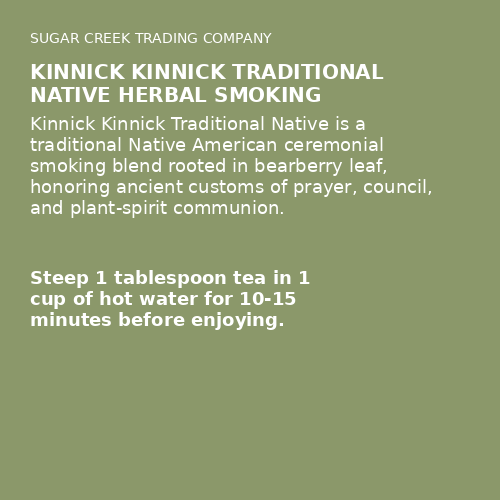
In North America the same leaf was one of the most widely smoked plants on the continent. It was smoked on its own, and it was the usual base of the prepared mixtures known by the Algonquian word kinnikinnick, meaning roughly "that which is mixed." The heavy tannin content gives a smoke that is mild and faintly cooling rather than sharp, which is why bearberry rather than something more aromatic became the foundation so widely.
The fur trade carried it under its own name. French-Canadian traders called it larb, from l'herbe — the herb, as though there were only one worth naming.
PREPARATION
Cold maceration — the preferred method. Roughly 3 grams of dried leaf to 150 millilitres of cold water, left to stand for about twelve hours, then strained. Cold water draws the arbutin out while leaving most of the tannin behind in the leaf. The result is gentler on the stomach than a hot preparation and is the method the European literature favours.
Hot infusion. Faster, and extracts considerably more tannin along with everything else. Noticeably more astringent, and more likely to unsettle a sensitive stomach.
Smoked. The dried leaf crumbled and smoked on its own, or used as the base of a mixture. Keep it dry and whole until use; crumbling it early costs you the aromatics.
Storage. Airtight, out of direct light, somewhere cool. The leaf is leathery and keeps well, but tannins and aromatics both degrade with light and heat.
SAFETY AND CAUTIONS
- Short-term use only. European monograph guidance limits bearberry to short courses — on the order of a week at a time, and only a few such courses in a year. This is not a herb for daily or indefinite use.
- Not during pregnancy or lactation.
- Not for young children.
- Not with existing kidney disease, or alongside other medication, without advice from a qualified practitioner.
- Tannins may irritate the stomach. The cold macerate substantially reduces this; taking it with food helps further.
- It can turn urine a greenish-brown. This is expected and harmless.
- Smoking anything means inhaling combustion products, regardless of how mild the plant is.
These statements have not been evaluated by the Food and Drug Administration. This product is not intended to diagnose, treat, cure, or prevent any disease.
FINAL NOTE
Bearberry asks for almost nothing. It grows where the soil has already given up, holds that ground with trailing stems that root as they go, keeps its leaves through winter, and feeds whatever comes along in the months when little else is fruiting. Two separate naming traditions looked at it and saw the same thing — the bear, and the grape. It is a plant that has been useful to people for a very long time without ever being cultivated at scale, and it is worth treating with the restraint its own monographs ask for.
Share