Sugar Creek Trading Company
Lady's Mantle Herb
Lady's Mantle Herb
Couldn't load pickup availability
ALCHEMILLA VULGARIS
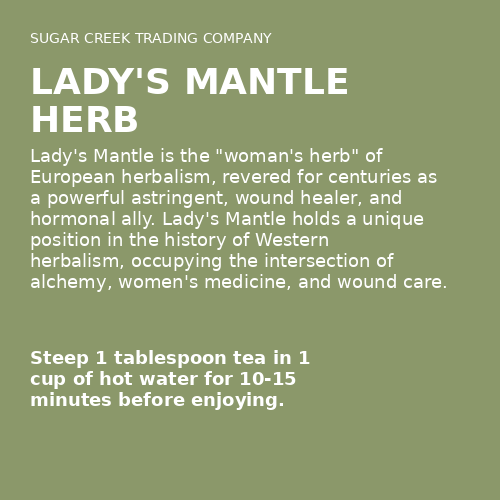
The "woman's herb" of European herbalism, revered for centuries as a powerful astringent, wound healer, and hormonal ally.
BOTANICAL IDENTIFICATION
Scientific Name: Alchemilla vulgaris L.
Common Names: Lady's Mantle, Lion's Foot, Bear's Foot, Dew Cup, Stellaria, Alchemilla, Frauenmantel (German), Pied-de-lion (French)
Family: Rosaceae (Rose family)
Lady's Mantle is a low-growing perennial herb reaching 20 to 50 cm in height, forming dense, mounding clumps of distinctive fan-shaped, palmately lobed leaves with scalloped, serrated margins. The leaves are covered in fine silky hairs that cause morning dew to collect in glistening droplets at their centers, a phenomenon that fascinated medieval alchemists who believed this "celestial water" held transformative properties. Tiny, yellow-green flowers appear in loose, branching clusters (cymes) from late spring through summer, lacking true petals but displaying prominent sepals and an epicalyx.
Native to Europe and temperate regions of Asia, Lady's Mantle thrives in moist meadows, woodland edges, and mountain pastures at elevations up to 2,800 meters. It prefers partial shade to full sun with consistently moist, well-drained soil, and has naturalized in parts of North America where it is commonly grown as both an ornamental groundcover and a medicinal herb.
CULTURAL AND HISTORICAL USE
Lady's Mantle holds a unique position in the history of Western herbalism, occupying the intersection of alchemy, women's medicine, and wound care. The genus name Alchemilla derives from the Arabic word "al-kemelyeh" (alchemy), reflecting the medieval belief that the dewdrops collected in its cupped leaves were a key ingredient in the alchemist's pursuit of the philosopher's stone. The common name "Lady's Mantle" refers to the Virgin Mary, as the lobed leaves were thought to resemble the scalloped edges of her cloak in medieval iconography. This Marian association cemented the herb's connection to feminine health in European folk medicine.
In the traditional herbalism of the Alpine regions, Lady's Mantle was considered the premier herb for women's complaints. Swiss and Austrian herbalists prescribed it as a tea for menstrual irregularities, excessive bleeding, and to strengthen the uterus before and after childbirth. The celebrated Austrian herbalist Maria Treben (1907-1991) considered it indispensable, writing that "every woman should drink Lady's Mantle tea from time to time" and recommending it extensively in her influential book Health Through God's Pharmacy. In German-speaking countries, it remains one of the most widely used gynecological herbs, commonly found in blended teas for menstrual support.
Beyond women's health, Lady's Mantle was a valued wound herb throughout medieval Europe. The English herbalist John Gerard (1597) recommended it for treating wounds and stopping bleeding, while Nicholas Culpeper (1653) classified it under Venus and prescribed it for "wounds, ruptures, and women's diseases." In Scandinavian folk medicine, the leaves were applied as poultices to cuts and inflammations. The herb also found culinary use in salads and as a pot herb in parts of Northern Europe, and was used as a natural dye yielding yellow-green tones.
KEY BIOACTIVE COMPOUNDS & BENEFITS
| Compound/Class | Location in Plant | Human Benefit | Role in Plant |
|---|---|---|---|
| Ellagitannins (pedunculagin, agrimoniin) | Leaves, stems | Potent astringent action; reduces excessive bleeding; anti-inflammatory and antioxidant effects | Defense against herbivory and microbial pathogens |
| Flavonoids (quercetin, kaempferol glycosides) | Leaves, flowers | Antioxidant protection; anti-inflammatory; supports vascular integrity | UV protection and pollinator attraction |
| Salicylic acid derivatives | Leaves | Mild analgesic and anti-inflammatory effects | Signaling molecule in plant immune defense |
| Tannins (6-8% total) | Whole aerial herb | Tissue-tightening astringency; antimicrobial; supports wound healing | Deterrent to herbivores; antimicrobial defense |
| Phenolic acids (gallic acid, caffeic acid) | Leaves | Antioxidant; hepatoprotective; supports cellular health | Structural support and pathogen defense |
Lady's Mantle's therapeutic profile is dominated by its exceptionally high tannin content, particularly the ellagitannins agrimoniin and pedunculagin, which account for its strong astringent and hemostatic (bleeding-reducing) properties. These are complemented by a diverse flavonoid fraction that contributes antioxidant and anti-inflammatory activity, creating an herb that is simultaneously toning, protective, and soothing to mucous membranes and skin.
HOW IT WORKS IN THE BODY
Lady's Mantle exerts its effects primarily through astringent, anti-inflammatory, and antioxidant mechanisms that act on mucosal tissues, the vascular system, and the skin.
Astringent and Hemostatic Action:
The high concentration of ellagitannins binds to proteins in mucosal tissue and skin, causing them to contract and form a protective barrier. This tightening effect reduces secretions and bleeding, which is the basis for the herb's traditional use in managing heavy menstrual flow (menorrhagia) and diarrhea. The tannins also precipitate proteins on wound surfaces, accelerating clot formation and creating a natural bandage over damaged tissue.
Uterine and Reproductive Support:
Lady's Mantle has a documented affinity for the pelvic organs. Its astringent compounds tone the uterine musculature and vasculature, helping to reduce excessive menstrual bleeding and post-partum hemorrhage. Research published in the Journal of Ethnopharmacology has confirmed anti-inflammatory and antispasmodic effects on uterine smooth muscle, supporting its traditional gynecological applications.
Anti-inflammatory and Antioxidant Protection:
The flavonoids quercetin and kaempferol inhibit pro-inflammatory enzymes including cyclooxygenase (COX) and lipoxygenase (LOX), reducing the production of inflammatory mediators. Combined with the free-radical scavenging activity of phenolic acids and ellagitannins, this gives Lady's Mantle a broad protective effect against oxidative stress and chronic low-grade inflammation.
Wound Healing and Skin Repair:
Applied topically, the tannin-rich extract promotes wound contraction, reduces microbial colonization, and supports re-epithelialization. Studies have demonstrated that Alchemilla vulgaris extracts enhance fibroblast proliferation and collagen synthesis, providing a pharmacological basis for its long history as a vulnerary (wound-healing) herb.
DOSE GUIDELINES
| Preparation Type | Typical Dose | Purpose |
|---|---|---|
| Herbal Tea (Infusion) | 1-2 teaspoons dried herb per cup, steeped 10-15 minutes; 2-3 cups daily | Menstrual support, digestive toning, general astringent use |
| Tincture (1:5, 45% ethanol) | 2-4 mL, three times daily | Concentrated internal use for heavy menstruation or diarrhea |
| Topical Wash / Compress | Strong infusion (2 tablespoons per cup), cooled and applied externally | Wound healing, skin irritation, minor cuts, mouth rinse |
| Sitz Bath | 3-5 tablespoons herb steeped in 1 liter water, added to bath | Postpartum recovery, vaginal inflammation |
Lady's Mantle is best used as a course of treatment over several weeks for menstrual and reproductive concerns, typically beginning a week before the expected onset of menstruation and continuing through the cycle. For acute wound care or digestive complaints, it can be used as needed. The tea is the most traditional and gentle preparation.
PREPARATION AND USES
The most common preparation is a simple hot infusion. Pour boiling water over 1-2 teaspoons of dried Lady's Mantle herb, cover, and steep for 10 to 15 minutes. The longer steeping time is important for extracting the full tannin content. The resulting tea has a mildly astringent, slightly bitter, and pleasantly green taste that pairs well with honey or lemon. For menstrual support, many herbalists recommend blending Lady's Mantle with raspberry leaf, yarrow, or shepherd's purse to create a synergistic women's health tea.
Externally, a strong infusion or decoction can be used as a wound wash, facial toner, or gargle for sore gums and throat inflammation. Soaked cloths can be applied as compresses to minor wounds, insect bites, or skin rashes. For postpartum care, the herb is traditionally added to sitz baths. Tinctures offer a more concentrated and shelf-stable option for internal use, and Lady's Mantle can also be encapsulated as a powdered herb for those who prefer not to drink tea.
OPTIMAL CONTEXT FOR USE
Lady's Mantle is especially well-suited for individuals experiencing:
Heavy or prolonged menstrual bleeding (menorrhagia) seeking a gentle, traditional astringent approach
Menstrual irregularity, cramping, or premenstrual discomfort during the transition from perimenopause through menopause
Mild, non-infectious diarrhea or loose stools related to poor intestinal tone
Slow-healing minor wounds, cuts, skin irritation, or mild eczema requiring topical astringent support
Postpartum recovery, including support for uterine involution and perineal healing
Lady's Mantle works well as part of a broader wellness protocol that includes dietary balance, stress management, and consultation with a qualified healthcare provider for persistent or severe symptoms.
SUSTAINABILITY AND ETHICAL HARVESTING
Lady's Mantle is abundant throughout its native European range and is not considered threatened or endangered. It readily self-seeds and spreads vegetatively, making it an easily renewable resource. The aerial parts are harvested during the flowering period (May through August) when tannin content is highest, and the plant regenerates readily from its perennial rootstock after cutting. Most commercial supply comes from cultivated sources or sustainably wild-harvested populations in Eastern Europe, particularly Poland, Hungary, and the Balkans.
Home cultivation is straightforward and encouraged. Lady's Mantle thrives in USDA zones 3-8 and makes an attractive, low-maintenance garden plant that also serves as a living pharmacy. Growing your own ensures the freshest material and removes any concern about supply chain sustainability.
SAFETY AND CAUTIONS
Lady's Mantle has an excellent safety profile and has been used for centuries without reports of significant adverse effects. The European Medicines Agency (EMA) classifies it as a traditional herbal medicinal product. However, the following precautions should be observed:
The high tannin content may cause mild stomach upset in sensitive individuals, especially when taken on an empty stomach. Taking with food or reducing the dose usually resolves this.
Tannins can reduce the absorption of iron supplements and certain medications (including alkaloid-based drugs) if taken simultaneously. Separate doses by at least two hours.
While traditionally used to support pregnancy and postpartum recovery, pregnant women should consult a qualified healthcare provider before use due to the herb's uterine-toning effects.
Individuals with constipation should use Lady's Mantle cautiously, as the astringent tannins may worsen the condition.
REFERENCES
Geiger, C., et al. "Ellagitannins from Alchemilla xanthochlora and Potentilla erecta." Planta Medica, vol. 60, no. 4, 1994, pp. 384-385.
Shrivastava, R., et al. "Tannic acid-based herbal formulation for wound healing." Journal of Ethnopharmacology, vol. 120, no. 3, 2008, pp. 443-451.
European Medicines Agency (EMA). "Assessment report on Alchemilla vulgaris L., herba." EMA/HMPC/Article 16(1) Monograph, 2010.
Wichtl, Max. Herbal Drugs and Phytopharmaceuticals, 3rd ed., Medpharm Scientific Publishers, 2004, pp. 36-38.
Treben, Maria. Health Through God's Pharmacy, Ennsthaler Verlag, 1980.
FINAL NOTE
Lady's Mantle is one of those rare herbs whose folklore and pharmacology align almost perfectly. The medieval intuition that this plant was a gift for women's health has been validated by modern analysis of its tannin-rich, astringent chemistry. Whether sipped as a gentle daily tea or applied as a healing compress, Alchemilla vulgaris remains an indispensable ally in the herbal tradition, quietly effective and deeply rooted in centuries of trusted use.
Share